
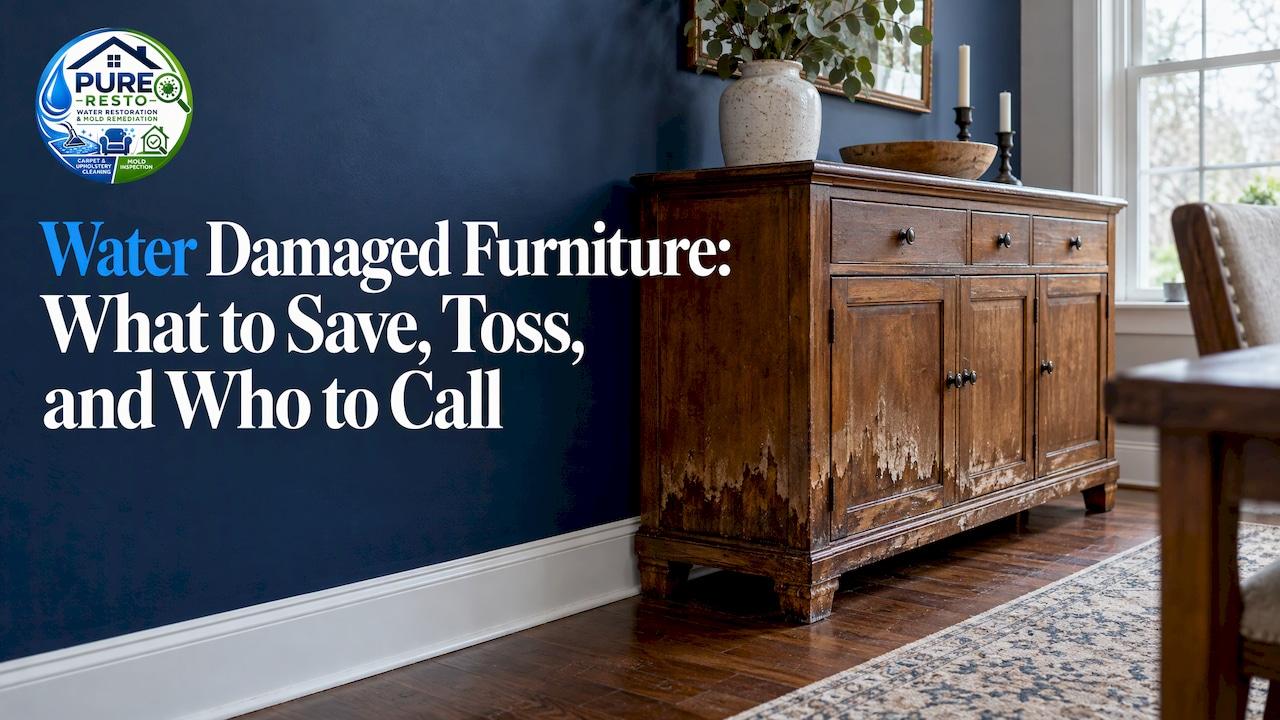
Water damaged furniture can often be saved, but only if you sort it correctly and start drying within the first day or two. Solid wood usually survives. Particleboard, swollen veneer and soaked upholstery often do not. Contaminated water changes the answer for everything. This guide shows you how to tell the difference, what to do in the first 48 hours, and when a professional restoration team should take over.
TL;DR
- Start drying within 24 to 48 hours. The CDC advises throwing away anything wet with flood water that cannot be cleaned and dried completely in that window.
- Solid wood furniture can usually be restored. Swollen particleboard under veneer is permanent damage, and soaked, contaminated upholstery is usually best discarded.
- Dry slowly, out of direct sun and away from direct heat. Rushing it causes splitting and warping.
- Antiques, veneered pieces and anything that sat in sewage or flood water need a professional, not a household fix.
- If you are in Bowie, Bethesda, Silver Spring, Rockville or nearby, we can extract, dry, clean and store your furniture while we handle the structure.
Table of Contents
- What to Do in the First 48 Hours
- Save or Discard: How to Decide
- Solid Wood: The Best Candidate for Restoration
- Veneer and Particleboard: Where Most Pieces Fail
- Upholstered Furniture: Sofas, Chairs and Cushions
- Mold on Wet Furniture
- White Rings, Stains and the Vinegar-and-Oil Question
- Our Perspective
- Let Us Handle the Furniture and the Water
- Where We Help Near You
- When to Call a Professional
- FAQ
- Sources
What to Do in the First 48 Hours
Speed matters more than technique. Mold needs moisture and time, and wet furniture holds both. The CDC's homeowner guide tells people to dry the home and everything in it as quickly as possible, within 24 to 48 hours if they can.
Here is the order we recommend:
- Stop the water source. A furniture rescue fails if the leak is still running. Shut off the supply or call a plumber first.
- Identify the water. Clean water from a supply line is a different problem from a sewage backup or storm flood. If it is contaminated, treat every porous item as suspect.
- Protect yourself. FEMA's ready.gov guidance calls for disposable vinyl or nitrile gloves, protective clothing, goggles and an N95 mask when handling objects pulled from contaminated water.
- Move furniture out of the wet zone. Lift pieces off wet carpet or flooring. Wet carpet and furniture legs stain each other, and standing water wicks upward into feet and lower panels.
- Remove what comes out. Take out drawers, doors and back panels where you can, so air reaches the inside. Do not force stuck drawers.
- Photograph everything. Pictures of each piece before you move it help with an insurance claim.
If the affected area is large, or the water has been sitting, this is the point to call us. Our crews can reach you quickly because we built the company around a 30-minute response goal for emergencies.
Save or Discard: How to Decide
Not every piece deserves the same effort. NC State Extension suggests weighing the extent of damage, the cost of the piece, its sentimental value and the cost of restoring it. Material matters most.
| Furniture type | Usually restorable? | What decides it |
|---|---|---|
| Solid wood (tables, chairs, dressers) | Usually yes | Restorable unless it sat in water for several days to a week and damage is severe |
| Veneer over solid wood | Often, by a professional | Lifted veneer and failed glue joints need skilled repair |
| Particleboard or MDF with veneer | Rarely | Swollen core is permanent damage |
| Printed vinyl or low-pressure laminate surfaces | No | Cannot be repaired, even by a professional |
| Upholstered sofas and chairs | Depends on the water | Clean water caught early may be saved. Hours in flood water or sewage usually means disposal |
| Antiques and heirlooms | Yes, with expert care | Leave restoration to a professional to protect value |
The particleboard rule surprises people. According to NC State, once particleboard beneath veneer has swollen, the damage is permanent. A dark, soft or powdery spot on a flat-pack desk or dresser means moisture reached the core. Surface fixes will not bring it back.
Solid Wood: The Best Candidate for Restoration
Solid wood tolerates water better than anything else in your home. It swells, it can cup or crack if dried badly, and it can grow mildew, but the material itself is sound. NDSU Agriculture confirms solid wood furniture can usually be restored unless the damage is severe.
A few practical points:
- Finished wood can be cleaned with mild detergent and clean water, then allowed to dry, according to the U.S. EPA's guidance on wet building materials. For wood surfaces, the EPA says to remove moisture immediately and use dehumidifiers, gentle heat and fans.
- Wipe gently. FEMA's guide says to gently rinse or sponge wooden surfaces, blot them and air dry slowly.
- Keep it out of the sun. The same guide warns that sun and heat cause uneven drying and can lighten or fade some wood stains.
- Check inside. Mildew keeps growing while wood moisture content stays above 20 percent, and NC State recommends checking underneath and inside the piece.
Why slow drying wins
It is tempting to point a heater at a soaked dresser. Don't. Alan Levitan, a furniture conservator with the National Park Service, explains that drying too fast creates stresses that cause splitting and deformation. His guidance is to let relative humidity fall gradually over days toward about 55 percent, at roughly 10 percent per day, and more slowly for veneered or inlaid surfaces.
NC State's advice matches this. Move the piece to a well-ventilated area away from direct sun, remove back panels, drawers and doors, and check it periodically. Complete drying can take several weeks or months before refinishing is possible.
One caution on fans: ready.gov says to increase airflow with fans, open windows or air conditioners but not point fans directly at drying objects. The CDC adds that if mold has already started to grow, fans may spread it.
Veneer and Particleboard: Where Most Pieces Fail
Most modern furniture is not solid wood. A thin layer of real wood veneer sits over particleboard, MDF or plywood. When water reaches the glue or the core, you see bubbles, peeling edges, swollen feet and soft spots.

The National Park Service lists the typical damage pattern: surface mold, splitting and deformation of wood, lifting veneers, stained finishes and failed glue joints. In most cases, it says, a conservator is eventually needed for water-soaked furniture.
For mid-value pieces, a few signs help you judge:
- Tap test. A hollow sound under a bubble suggests the veneer has separated from its base, according to a veneer repair guide from Woodworking Advisor.
- Soft or powdery dark spots on particleboard or MDF mean the core has swollen. Wood Work Science explains that sanding or bleaching cannot reverse this.
- Screw-holding areas. Where structural screws hold a piece together, replacement is the only reliable path because compromised board loses its grip.
If the piece has real value, whether financial or sentimental, have a professional look at it before you glue, iron or sand anything. NC State notes that veneered furniture repairs are usually best done by a professional.
Upholstered Furniture: Sofas, Chairs and Cushions
Upholstery is harder to save than wood because water soaks into padding that dries slowly. The U.S. EPA says water should be removed from upholstered furniture with a water extraction vacuum, with drying sped up by dehumidifiers, fans or heaters. It also notes it may be difficult to dry completely within 48 hours, and that a valuable piece calls for a restoration professional who specializes in furniture.
The source of the water changes everything. NC State's Sarah Kirby and Wilma Hammett write that if a chair or sofa sat in flood water for several hours or more, mud and silt can penetrate the fabric and padding, and the furniture may be contaminated with sewage, pesticides or industrial chemicals. In that case, it is best to discard the upholstered piece.
A clean-water leak caught early is a different story. A sofa that took on water from a burst supply line or an appliance overflow, and gets extracted quickly, has a real chance. That is where professional upholstery cleaning and extraction make the difference between a stained cushion and a replacement bill.

If cold storage is an option for a prized upholstered piece, the NPS notes that mold growth slows below 70°F and stops below 40°F, and suggests considering cold storage for upholstered furniture in an emergency.
Mold on Wet Furniture
Mold can start on damp furniture within the same 24 to 48 hour window that governs the rest of your home. The EPA says that if mold has grown or materials have been wet for more than 48 hours, its more demanding remediation guidance applies. If the water was contaminated with sewage or chemical or biological pollutants, the EPA notes OSHA requires protective equipment and containment, and an experienced professional should be consulted.
Two safety points from the CDC belong in every furniture rescue:
- Painting or caulking over mold will not stop it. The water problem has to be fixed and the mold cleaned up first.
- Never mix bleach and ammonia. It creates toxic vapors, and the CDC also notes that mold cleanup can be too difficult or dangerous for homeowners.
If you see fuzzy growth, smell mustiness from a dresser cavity, or find mold in nearby walls and carpet, treat it as a home problem, not only a furniture problem. Our mold inspection and mold remediation teams work on exactly that. Our guide to stopping mold in the 24 to 48 hours after a leak covers the timeline in more detail.
White Rings, Stains and the Vinegar-and-Oil Question
Small cosmetic marks are a separate issue from flood damage. A white ring on a sealed table is moisture trapped in the finish, not damage to the wood itself, according to Woodworking Advisor. A common home approach for modern sealed finishes is a 1:1 mix of vinegar and olive oil rubbed in circles, then wiped clean, per the same site's veneer guide.
That approach has limits. The guide says to skip it on antique shellac or unsealed veneer, where the oil and acid can do more harm than the ring. Antique finishes are delicate, so a quiet test on a hidden spot or a call to a pro is the safer path. If you are unsure what finish you have, treat it as fragile.
This kind of fix belongs to the cosmetic end of the spectrum. If the piece has been soaked, swollen or smells musty, rings are the least of the concerns, and drying properly comes first.
When refinishing makes sense
Once a piece is fully dry, you can decide how far to go. Popular Mechanics describes a lighter approach that improves the existing finish rather than replacing it: apply a restorer across the surface, work harder on rings or worn areas, and wipe away the excess with a soft cotton cloth.
A full refinish becomes the better choice when the finish has failed across about half the surface or more, when wood underneath is soft or delaminating, or when several kinds of damage stack up. That guidance comes from Woodworking Advisor. It is also a good moment to bring in a professional for antiques.
Our Perspective
Furniture is rarely the first thing people think about when water gets into a home. They think about floors and walls. Then, a day later, they notice the dresser that has been sitting in damp carpet and the sofa that smells off.
We approach furniture as part of the structure's drying plan, not a separate chore. A sofa pulled out of a wet room and left in a humid hallway can still grow mold. A solid wood table dried too fast can crack. The room, the contents and the air all have to be handled together.
That is why we combine extraction, drying and HEPA filtration with contents cleaning, storage and packout. Moving valuable pieces out of the affected area lets the work on the structure go faster and keeps your belongings from sitting in the same moisture. Our crews are IICRC-certified, licensed and insured, and we work directly with insurance providers so you are not sorting out paperwork on top of a loss.
Our advice is simple. Sort quickly, dry gently, and call us early, especially for antiques, veneered pieces and anything that touched contaminated water.
Pure
Let Us Handle the Furniture and the Water
We are an IICRC-certified restoration company based in Bowie, MD, with 24/7 emergency response. Our water damage restoration service covers extraction, drying and HEPA filtration, and our contents cleaning, storage and packout service moves your furniture and belongings out of the affected area, cleans them and stores them securely until the repairs are done.

We bill insurance providers directly where claims apply, and our work is backed by a satisfaction guarantee. If you have wet furniture right now, contact Pure Resto and tell us what happened. We will help you work out what can be saved.
Where We Help Near You
We serve homeowners, property managers and business owners across Bowie, Crofton, Glenn Dale, Lanham, Greenbelt, College Park, Beltsville, Laurel, Silver Spring, Bethesda, North Bethesda, Rockville, Potomac, North Potomac and Washington, DC.
If you are closer to one of these areas, we have local pages to help:
- Contents cleaning in Silver Spring, MD
- Contents cleaning in Lanham, MD
- Contents cleaning in Washington, DC
- Water damage restoration in Washington, DC
If the water came from a flooded lower level, our basement flood cleanup safety guide walks through what to do before and after the crew arrives.
When to Call a Professional
Call a professional restoration company when any of these apply:
- The water was sewage, storm flood water or otherwise contaminated.
- The furniture has been wet for more than 48 hours, or you can see or smell mold.
- The piece is an antique, an heirloom or veneered. NC State advises leaving antique restoration to a professional unless you are an experienced restorer, to protect the piece's value.
- The room itself is wet: carpet, subfloor, drywall and baseboards.
- You need documentation for an insurance claim.
The CDC recommends hiring a mold inspector or remediator affiliated with or certified by organizations such as NEHA, AIHA, IICRC or ACAC. IICRC certification is one we hold.
FAQ
Can water damaged furniture be saved?
Often, yes, depending on the material and the water. Solid wood can usually be restored unless it sat in water for several days to a week with severe damage. Particleboard with swollen veneer and furniture soaked in contaminated water are much harder to save.
How long does water damaged furniture take to dry?
The first priority is starting within 24 to 48 hours. Full drying of wood furniture is slower: NC State says it may take several weeks or months before a piece is ready for repair and refinishing. Keep it ventilated and out of direct sun, and avoid forcing the process.
Does vinegar and oil restore water damaged wood?
A 1:1 vinegar and olive oil mix is a common remedy for white rings on sealed, modern finishes. It is not recommended for antique shellac or unsealed veneer, where it can do more harm than the ring. It does nothing for swollen, soft or moldy wood.
Should I throw away a sofa that got wet?
It depends on the water. If it sat in flood water for hours, the padding can hold mud, silt and contaminants, and discarding it is usually the safe choice. A sofa wet by clean water and extracted promptly may be saved with professional upholstery cleaning and drying.
Can you refinish water damaged furniture without sanding?
Sometimes. If the damage is limited to the finish, a restorer product can improve rings and worn areas without stripping the piece. If the wood underneath is soft or the finish has failed over about half the surface, a fuller refinish is the better route.
Sources
- Flood-Damaged Furniture, NC State Extension
- Cleaning Flooded Upholstered Furniture, NC State Extension
- Homeowner's and Renter's Guide to Mold Cleanup After Disasters, CDC
- Mold Remediation Table 1 guidelines, U.S. EPA
- Conserve O Gram 7/7, Emergency Treatment for Water-Soaked Furniture, National Park Service
- Salvaging Water-Damaged Family Valuables and Heirlooms, ready.gov
- Flood-Damaged Furniture and Appliances, NDSU Agriculture
- Repair Water Damaged Wood Veneer, Woodworking Advisor
- How to Repair Furniture Finish, Woodworking Advisor
- How Do You Remove White Rings, Dark Spots, and Water Stains, Wood Work Science
- How Do You Repair Water Damage on Wood, Wood Work Science
- Refinish Wood Furniture Without Stripping, Popular Mechanics