
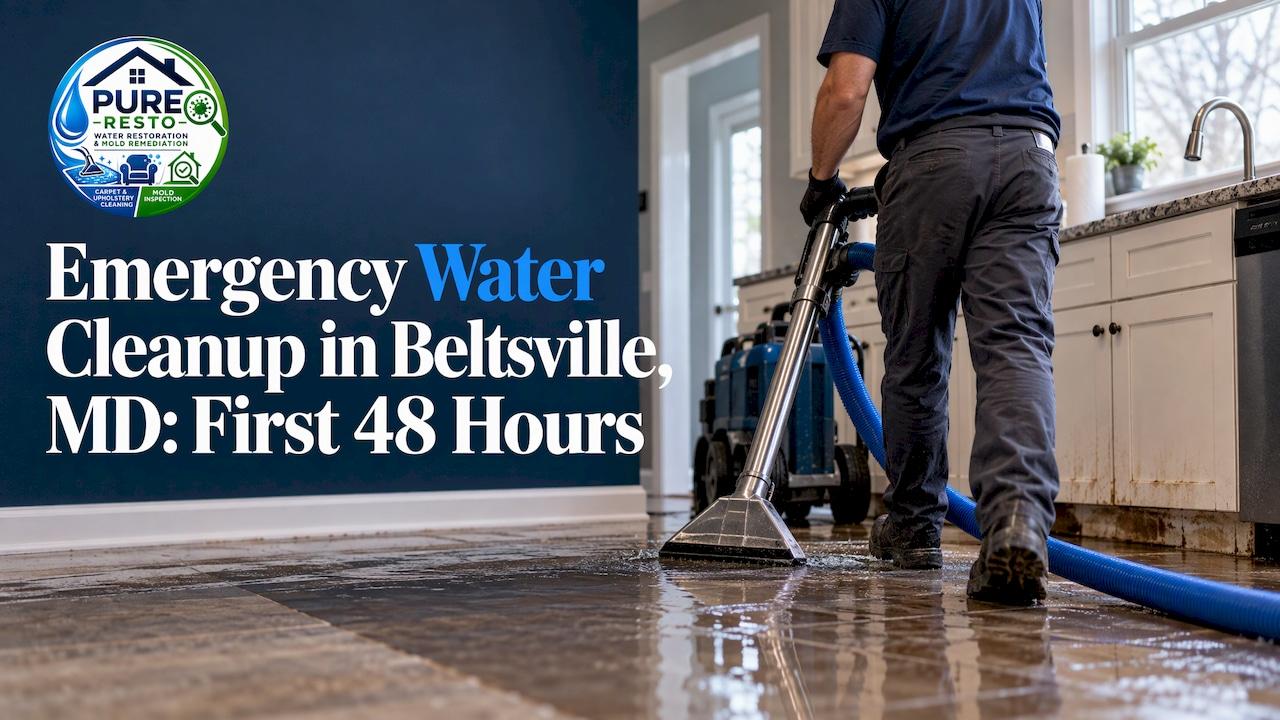
If water is coming into your Beltsville home or business, do three things now: stay out of standing water near electricity, stop the source if you can do it safely, and call a restoration crew that answers around the clock. Mold can begin on wet materials after about a day, so the first 24 to 48 hours decide how big the job gets. This guide covers what to do before help arrives, what a professional crew does, and how to protect your insurance claim.
TL;DR
- Never touch power, switches or electrical equipment while standing in water. Shut off the main power only from a dry spot, or call an electrician.
- Dry the building and its contents within 24 to 48 hours if possible, according to the CDC. Wet materials left longer can grow mold.
- Photograph and video the damage before cleanup begins, and call your insurer before you sign any cleanup agreement.
- Pure Resto offers 24/7 emergency water damage restoration in Beltsville, MD, with a 30-minute response target and direct insurance billing.
Table of Contents
- What counts as an emergency water cleanup
- Your first steps before the crew arrives
- When it is unsafe to enter
- What a 24-hour emergency water cleanup crew does
- Clean water, gray water and floodwater: why the source matters
- The 24 to 48 hour window and mold
- Wet carpet, padding and furniture: save or replace
- Protecting your insurance claim
- Our perspective
- Emergency water cleanup in Beltsville with Pure Resto
- FAQ
- Sources
What counts as an emergency water cleanup
A burst pipe, a failed water heater, a washing machine hose that let go, a sewer backup, a roof leak during a storm or water seeping into a basement all qualify. The size of the puddle is not the test. The test is whether water is moving into walls, subfloors, insulation or contents. Water travels. A small leak under a kitchen sink can wick into cabinets and drywall behind the visible damage.
That hidden spread is why professionals begin with a survey rather than a mop. The IICRC's 2026 position statement on weather-related water damage says an initial response should include a site safety survey, verification of the water source, an assessment of where the water has migrated, identification of immediate secondary-damage concerns, and drying standards and goals.
Your first steps before the crew arrives
You can do a few things safely while you wait. Keep this list short and stop if anything feels unsafe.
- Get everyone out of danger. If you smell gas or suspect a gas leak, leave immediately and do not turn on lights or do anything that could cause a spark, per the CDC.
- Deal with the power. If standing water is present, turn off the main power only from a dry location. If reaching the panel means stepping into water, call an electrician instead.
- Stop the source if it is a plumbing leak. Close the shutoff valve to the fixture or the main water valve, only if you can reach it without entering water.
- Document before you clean. Take photos and video of the damage and affected items.
- Call a 24-hour restoration company. Tell them what the water came from, how long it has been there and which rooms are affected.
- Lift small, valuable items out of the water, such as papers, photos and electronics that are unplugged, and place them on dry surfaces.
When it is unsafe to enter
Electricity and water are the most immediate danger. The CDC says never to turn power on or off, or use electrical equipment, while standing in water, and to have an electrician check the system before power is restored. North Carolina's health department adds that you should not enter a wet building while power is on, and should leave electrical systems off until a licensed electrician has repaired them and the local building inspector approves.
The same state guide lists other hazards that call for caution or professional help: structural damage, gas leaks, hazardous chemicals, asbestos, lead paint, animals, sharp debris and biological contamination. If your Beltsville home was built decades ago, older materials may be part of that picture, which is one more reason to let a trained crew handle demolition rather than tearing out wet walls yourself.
If you have a flooded basement, do not rush to pump it out. The Red Cross advises pumping gradually, about one-third of the water per day, because pulling water out too fast can let soil pressure outside collapse the basement walls.
For your own protection during any cleanup, FEMA recommends long pants, sturdy shoes, goggles, gloves and masks, and staying away from damaged structures and downed power lines.
What a 24-hour emergency water cleanup crew does
Professional restoration follows a sequence, and each step protects the next. The IICRC's S500 standard describes the components of professional water damage restoration: safety, inspections, drying technology, contents restoration, structural restoration and project documentation. Pure Resto is IICRC-certified, and here is how a typical job runs.
1. Assessment and safety
The technician checks the electrical situation, finds the source of the water, and maps how far it has traveled. Moisture meters and thermal imaging help find wet areas you cannot see. This is also when the crew decides what category of water you are dealing with, because that determines the whole plan.
2. Water extraction
Standing water comes out first with pumps and extractors. Removing bulk water quickly matters more than any other single step, because every hour of saturation pushes moisture deeper into framing and subfloor. The CDC's guidance for homeowners also starts with removing standing water and wet materials.
3. Removal of materials that cannot be saved
Some materials are not worth drying. The Red Cross says to discard items that absorbed water and cannot be cleaned or disinfected, including mattresses and carpeting, and to remove drywall and insulation that contacted floodwater. Crews cut out only what has to go, which keeps the rebuild smaller.
4. Structural drying and dehumidification
High-velocity air movers and dehumidifiers pull moisture out of what remains. EPA guidance supports ventilating where safe, opening interior doors and cabinets, removing drawers and shelves, and using fans, dehumidifiers or air conditioning to speed drying when conditions and power permit. A professional crew monitors readings daily and adjusts equipment until the structure reaches its drying goal. Our approach pairs advanced extraction and drying with HEPA filtration, designed to prevent further damage and health hazards.
5. Cleaning, sanitizing and odor control
Once surfaces are dry, affected areas are cleaned and sanitized. If a musty or sewage smell lingers, odor removal addresses the cause rather than covering it up.
6. Contents and documentation
Furniture, clothing, electronics and keepsakes may need cleaning and, if the rooms are being rebuilt, safe storage. Photos, moisture logs and itemized lists also support your insurance claim.
Clean water, gray water and floodwater: why the source matters
Not all water is the same. A supply line that bursts releases clean water. Water from a dishwasher or washing machine may carry soap and some contaminants. Floodwater and sewage can carry bacteria, chemicals and other hazards, as the EPA notes.

The IICRC's 2026 statement says that Category 2 or 3 water intrusions require remediation before restorative drying, with contamination controls and appropriate personal protective equipment, and that an indoor environmental professional may be needed in elevated-risk situations. In plain terms: a contaminated loss is not just a wetter version of a clean one. The crew controls the contamination first, removes porous materials that touched it, and only then dries what is left.
That is why you should not treat a sewage backup or storm flooding as a mop-and-fan job. If you are unsure what the water was, tell the dispatcher so the right crew and protective gear arrive.
The 24 to 48 hour window and mold
The CDC says to dry the home and everything in it as quickly as possible, within 24 to 48 hours if possible. If you cannot, assume mold growth may be present and address both the mold and the underlying moisture problem. The EPA similarly says mold can grow on wood, drywall, carpet and furniture that stay wet for more than 24 hours.
Three practical points follow from that:
- Speed beats perfection. A crew that arrives within hours and starts extraction can keep a loss in the drying category instead of the remediation category.
- Fans are not always a fix. The CDC warns that fans can spread existing mold, and that fans and dehumidifiers should only be used when electricity is safe. If you already see mold, deal with it before blowing air across it. A guide on mold on soffits and moisture makes the same point from the building envelope side: fix the moisture first, then clean safely.
- Do not paint over it. The CDC says painting or caulking over mold does not solve the problem, and never to mix bleach and ammonia, since the combination can create toxic vapors.
Drying also does not end when the surface feels dry. One state guide recommends continuous fans and dehumidifiers for several days, inspecting hidden spots like crawlspaces and wall cavities, and continuing until humidity stays below 50 percent for at least three days. Professional monitoring takes the guesswork out of that.
If you find visible growth or a persistent musty smell after a leak, a mold inspection shows what is there and where, and mold remediation removes it and addresses the moisture behind it.
Wet carpet, padding and furniture: save or replace
Carpet is the question most Beltsville homeowners ask first. The Illinois guide says to remove carpets, padding and upholstered items that cannot be thoroughly cleaned and dried within 24 to 48 hours, or that were exposed to sewage or contaminated floodwater. The Red Cross also lists carpeting among the items to discard when they cannot be cleaned or disinfected.
A rough way to decide:
| Situation | Usual direction |
|---|---|
| Clean-water leak, caught quickly, carpet and pad still intact | Extraction, drying and professional carpet cleaning may save it |
| Water sat for more than a day or two | Padding often has to come out; carpet may need replacement |
| Sewage or contaminated floodwater | Remove and discard porous materials |
| Upholstered sofa or chairs, clean water | Fast professional upholstery cleaning and drying |
Also be patient with the rebuild. The Red Cross says drying structural elements can take weeks or months depending on the damage, and that replacement drywall, carpets and floor coverings should wait until the structure is thoroughly dry. Rebuilding over damp framing is how second claims start.
Protecting your insurance claim
What you do in the first hour affects what you can recover. FEMA's damage-documentation guidance says to photograph inside and outside damage before discarding items, record appliance serial numbers, keep repair receipts and material samples, and consult your insurer before signing cleanup or remediation agreements.
A simple checklist:
- Photos and video of every affected room before anything is moved or thrown out.
- A list of damaged contents with approximate age and value.
- Serial numbers for appliances.
- A small sample of carpet or flooring that you keep.
- Receipts for emergency expenses, and the name and number of your adjuster.
Know what type of loss you have, too. The Insurance Information Institute says standard homeowners and renters policies exclude flood damage, while flood coverage is available separately through the National Flood Insurance Program and some private insurers. A burst pipe is generally a different claim from rising water, so ask your insurer how yours will be classified.
If you do have NFIP coverage, drying promptly matters. The NFIP's recovery checklist notes that those policies do not cover mold damage, and FEMA says policyholders must take reasonable steps within their control to prevent mold growth and spread.
Our perspective
We built Pure Resto around one idea: the first hour is worth more than the next ten. That is why we answer 24/7 and aim to respond within 30 minutes. Water that is extracted and dried early means less demolition, a smaller bill and fewer chances for mold.
We also think restoration should be more than cleanup. A mop and a box fan can make a room look better while moisture stays in the wall. We use advanced extraction, drying and HEPA filtration, and our IICRC certification means we work to recognized industry standards, not guesswork.
Insurance paperwork is the last thing you want to manage in the middle of a flood. We are licensed and insured and work directly with insurance providers to streamline the claims process, so you can focus on your family while we handle the water, the drying and the documentation. Our satisfaction guarantee stands behind the work.
Pure
Emergency water cleanup in Beltsville with Pure Resto
When water hits a home or business in Beltsville, you need a crew, not a callback next week. Pure Resto's water damage restoration covers extraction, drying, sanitizing and contents handling, and we can bill your insurance provider directly. We are based in Bowie, MD, and we serve Beltsville homeowners, property managers and business owners around the clock.
If the damage touched smoke, soot or contents that need to leave the building, we also offer fire and smoke damage restoration and contents cleaning, storage and packout. Call Pure Resto or visit our site to request help now.
FAQ
How fast should emergency water cleanup start?
As soon as it is safe. The CDC recommends drying the home and its contents within 24 to 48 hours if possible, so call a 24-hour crew right away rather than waiting for morning. Our response target is 30 minutes.
Can I handle water cleanup myself in Beltsville?
You can take safe first steps: shutting off the water source, moving small items and documenting damage. Standing water near electricity, contaminated water, wet drywall and hidden moisture call for trained technicians with drying equipment and protective gear.
Does homeowners insurance cover water damage?
It depends on the cause. The Insurance Information Institute says standard homeowners policies exclude flood damage, and flood coverage is purchased separately. Sudden plumbing failures are treated differently, so ask your insurer how your loss will be handled, and keep all your photos and receipts.
What is the difference between water damage restoration and flood restoration?
The difference is mostly the water source. Floodwater can carry bacteria and chemicals, so contamination control and removal of porous materials come before drying. A clean-water pipe break usually moves straight to extraction and drying.
Will wet carpet always need to be replaced?
Not always. Clean-water carpet that is extracted and dried quickly can often be cleaned and kept. Padding, long-soaked carpet and anything touched by sewage or floodwater generally has to be discarded.
Sources
- CDC: Safety Guidelines for Reentering Your Flooded Home
- CDC: Homeowner's and Renter's Guide to Mold Cleanup After Disasters
- North Carolina DHHS: After the Flood, Getting Back Into Your Home Safely
- American Red Cross: Disaster Cleanup and Repair for Your Home
- FEMA: Stay Safe Cleaning Up After a Flood
- IICRC: S500 Standard
- IICRC: Category of Water Damage and Weather (2026)
- EPA: Flood Cleanup to Protect Indoor Air and Your Health
- Illinois DNR: Post-Flood Quick Guide
- FEMA: How to Document Damages After Severe Weather Events
- NFIP: Flood Recovery Checklist
- Triple-I: Settling Insurance Claims After a Disaster
- Mold on Soffits: Fix Moisture First, Then Clean Safely