
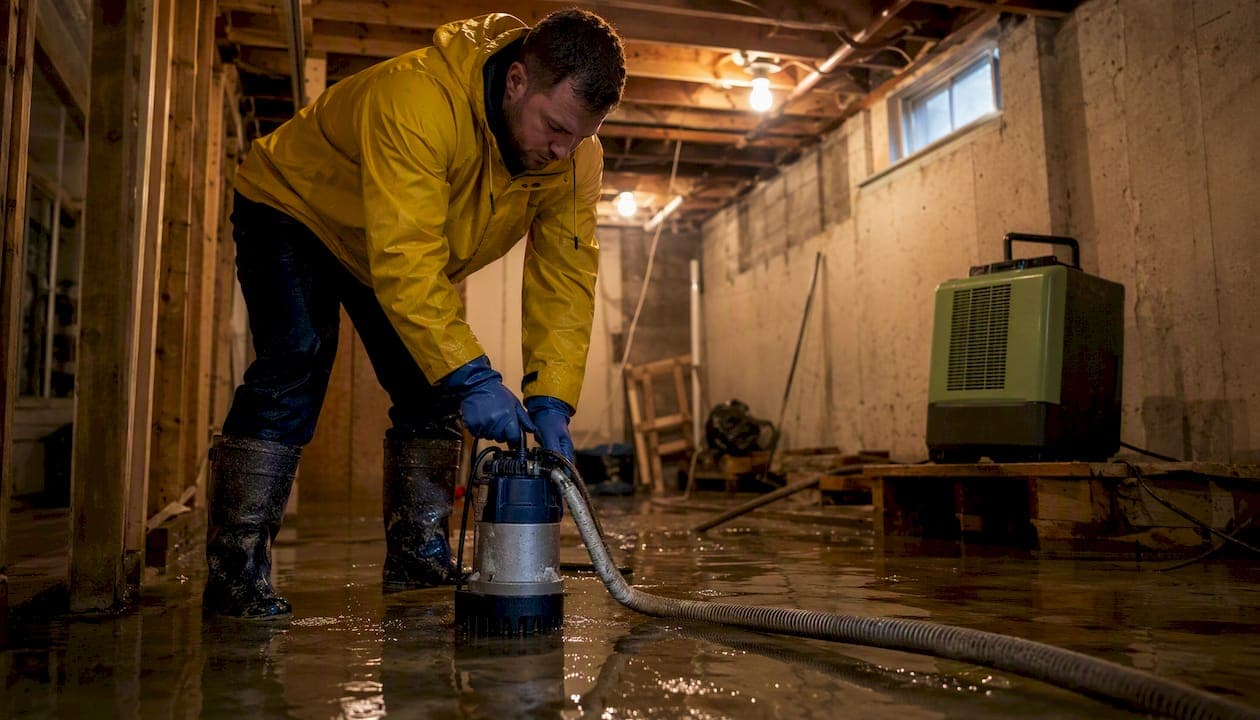
If your basement floods, shut off the main breaker (if you can reach the panel safely), stop the water source, and start removing standing water the moment it's safe to do so. Every hour you wait increases both drying time and the chance of mold taking hold within 24–48 hours.
TL;DR: First-minutes checklist
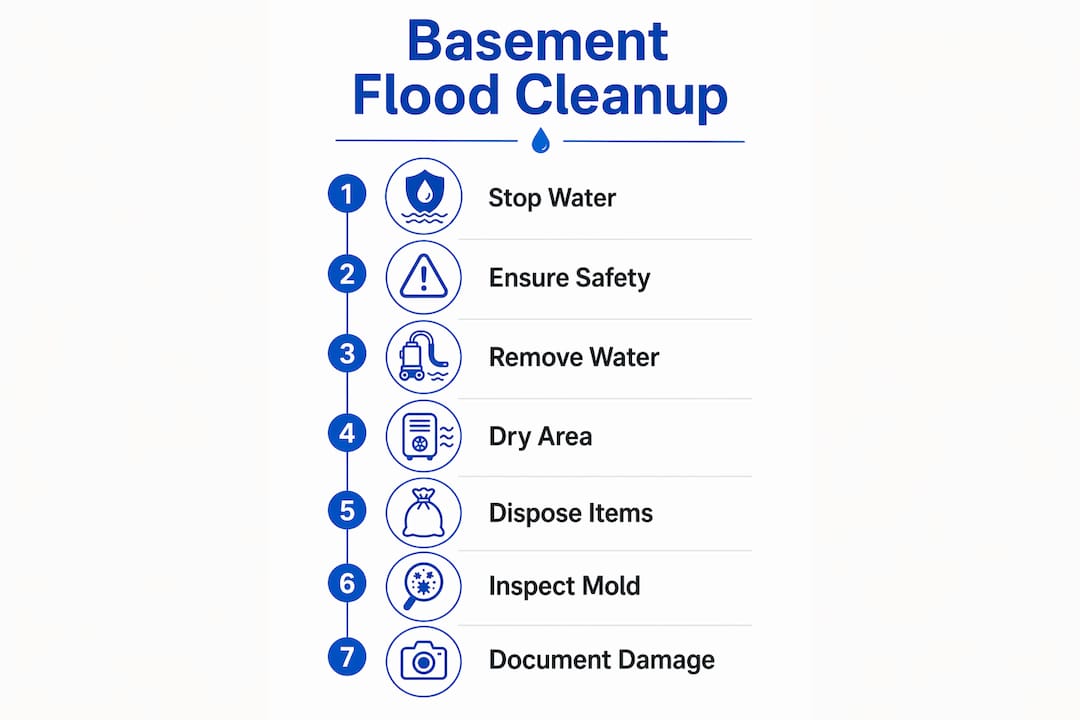
- Shut off the main electrical breaker at the panel — not just individual switches — if you can reach it without stepping through standing water
- Stop the water source: close the main shutoff valve, call your utility, or contact the municipal emergency line for sewer backups
- Call 911 or your gas company if you smell gas or see structural damage
- Document everything with a video walkthrough before touching or moving anything
- Begin water removal with a submersible pump or wet/dry shop vac once electrical hazards are cleared
- Call a professional immediately if the water contains sewage, if the depth exceeds your equipment's capacity, or if you have any doubt about electrical safety
Safety callout: Do not enter standing water if you cannot confirm power is off. Water conducts electricity through paths you cannot see. Sewage-contaminated water carries pathogens that make DIY cleanup genuinely dangerous — call a restoration professional for blackwater events.
Table of Contents
- What should you do in the first 24 hours of a flooded basement?
- What can you keep and what should you throw away?
- How do you actually dry a flooded basement to a safe moisture level?
- How quickly can mold grow, and when do you need professional remediation?
- What PPE do you need for basement flood cleanup?
- How much does basement flood cleanup cost, and how long does it take?
- How do you document flood damage for an insurance claim?
- When should you call a professional restoration company?
- What do professional restorers do that most homeowners can't?
- Key Takeaways
- The mistake most homeowners make after a basement flood
- Purerestomd responds in 30 minutes when your basement floods
- Useful sources and further reading
What should you do in the first 24 hours of a flooded basement?
Time-boxing your response is the single most useful thing you can do. Here is how to structure the first day.
0–1 hour: Safety and containment
- Confirm personal safety before entering. Look for sparking, buzzing, or any sign that water has reached outlets, appliances, or the electrical panel.
- Shut off the main breaker at the panel if you can reach it without wading through water. Turning off a single light switch is not sufficient — water creates conductive paths across circuits.
- Shut the main water supply valve if the source is a burst pipe or appliance failure.
- Call your utility company or the municipal emergency line for sewer backups or gas leaks. Do not re-enter until they clear the scene.
- Evacuate if you detect gas, see cracks in load-bearing walls, or if the water level is still rising fast.
1–6 hours: Document and start water removal
- Record a continuous video walkthrough of every affected area before moving anything. Capture the water source, the flood line on walls, and each damaged item. Video documentation consistently produces stronger insurance outcomes than photos alone.
- Photograph the water meter or shutoff position, the breaker panel, and any visible structural damage.
- List wet items by room, noting approximate value for high-value contents.
- Deploy a submersible pump for standing water deeper than a few inches. For shallower water, a wet/dry shop vac works well. Work from the lowest point outward.
- Use only GFCI-protected extension cords and equipment rated for wet environments. Never run a generator indoors or in an attached garage — carbon monoxide accumulates fast.
6–24 hours: Drying setup and initial triage
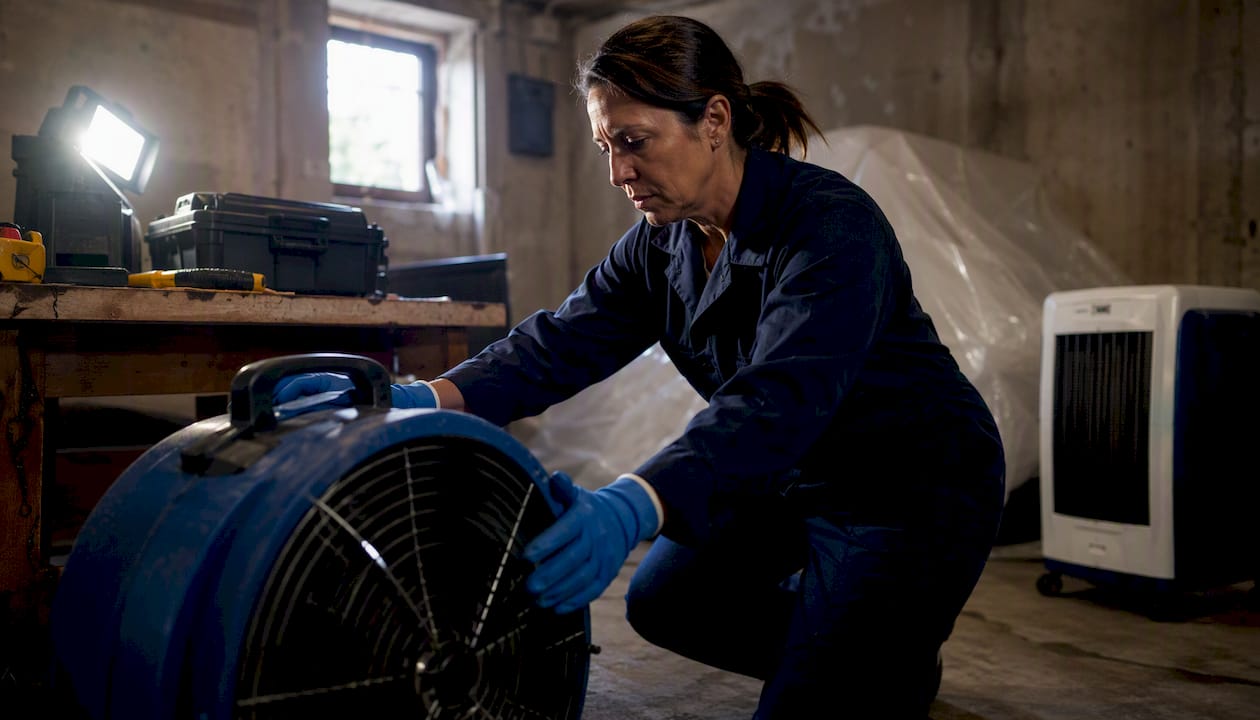
- Once bulk water is removed and the space is electrically safe, set up industrial fans and at least one dehumidifier.
- Begin sorting materials: non-porous items (concrete, tile, metal) can usually be cleaned and kept; porous items soaked for more than 24 hours (carpet padding, drywall, insulation) typically need to go.
- Open windows and doors to improve airflow, but position fans to blow air out rather than circulating contaminated air back into living spaces.
- Keep a running log of every mitigation expense — pump rental, trash bags, dehumidifier rental — with receipts. Many insurers reimburse reasonable mitigation costs.
Equipment checklist for the first 24 hours:
- Submersible pump with discharge hose
- Wet/dry shop vac (at least 12-gallon capacity)
- GFCI-protected extension cords
- Industrial axial fans (at least two)
- Portable LGR dehumidifier
- Moisture meter and hygrometer
- N95 respirator, nitrile gloves, waterproof boots, eye protection
Pro Tip: Place your dehumidifier near the center of the space, not against a wall. Air needs to circulate around the unit to pull moisture efficiently. Empty the reservoir or run a drain hose continuously — a full tank shuts the unit off and stalls your drying timeline.
What can you keep and what should you throw away?
The core rule is simple: non-porous materials can usually be cleaned and saved; porous materials soaked for more than 24–48 hours almost always need to go.
Typically salvageable:
- Concrete floors and block walls (clean, disinfect, and dry thoroughly)
- Ceramic and porcelain tile (check that the substrate beneath is dry)
- Metal shelving, appliances, and structural steel (clean and treat for rust)
- Solid wood furniture (if dried quickly and not warped)
- Hard-sided plastic storage containers (if contents were not contaminated)
Typically discard:
- Carpet padding (absorbs water and harbors mold even when the surface feels dry)
- Drywall below the flood line (paper facing wicks moisture upward beyond the visible wet zone)
- Fiberglass batt insulation (loses R-value when wet and is nearly impossible to dry in place)
- Particleboard and MDF furniture (swells, delaminates, and molds quickly)
- Any item with visible mold, sewage contact, or prolonged immersion beyond 48 hours
Discard triggers to apply to any item:
- Visible contamination or sewage contact: discard immediately
- Soaked for more than 48 hours: discard unless non-porous
- Mold visible on surface: discard porous items; clean and inspect non-porous ones
- Structural materials that cannot be dried in place within 48 hours: remove and replace
Before you haul anything out, video each item you plan to discard. Label bags or piles by room. Keep a written inventory of high-value items with estimated replacement costs — your adjuster will want it.
Pro Tip: If you are unsure about an item, seal it in a heavy-duty plastic bag, label it with the room and date, and set it aside for a professional to assess. Do not throw it away yet, but do not leave it loose in the basement either.
How do you actually dry a flooded basement to a safe moisture level?
Drying a basement after a flood is a moisture-management project, not a surface-cleaning task. Visible cleanliness matters far less than reducing moisture inside wall cavities, under flooring, and in insulation. A basement that looks dry but reads 20% moisture content in the drywall is a mold event waiting to happen.
Equipment roles and sequencing
| Equipment | Primary role | When to deploy |
|---|---|---|
| Submersible pump | Bulk standing water removal | First, before any other equipment |
| Wet/dry shop vac | Shallow water and residue | After pump, before fans |
| Axial fans | Air movement and surface evaporation | After visible residue is cleaned |
| LGR dehumidifier | Moisture extraction from air | Simultaneously with fans |
| Moisture meter | Verify drywall, wood, concrete readings | Throughout drying and at sign-off |
| Hygrometer | Track ambient relative humidity | Continuously during drying |
Measurable targets
Drying is not done when the floor feels dry. It is done when readings confirm it:
- Relative humidity: below 50% in the affected space
- Drywall moisture content: below 1% (most meters read this as "dry" in the green zone)
- Wood framing: below 19% moisture content
- Concrete slab: below 4% by weight (CM meter) or manufacturer's flooring threshold
Expect a minor flood in an unfinished basement to reach safe readings in 3–5 days with good equipment. A moderate event with finished walls can take 1–2 weeks. Severe saturation with structural materials involved often runs 2–4 weeks or longer.
Fan direction and HVAC caution
CDC guidance is clear: position fans to blow air out toward an open window or door, not to recirculate air through the house. Running your central HVAC before ducts have been inspected and cleaned spreads contaminated air to every room. Leave the HVAC off until a professional clears it.
Pro Tip: Professionals routinely remove baseboards and drill small weep holes along the bottom of drywall panels to let air reach the wall cavity. You can do this yourself with a drill and a 1/2-inch bit — it dramatically cuts drying time and costs far less than replacing a wall full of mold-damaged drywall later.
How quickly can mold grow, and when do you need professional remediation?
Mold can begin growing within a day or two of water exposure. Basements are high-risk environments because they combine poor ventilation, organic materials (wood framing, drywall paper), and the kind of sustained humidity that mold thrives in.
Conditions that accelerate mold growth:
- Ambient temperature between 60°F and 80°F (typical basement range)
- Relative humidity above 60%
- Porous materials that stay wet beyond 48 hours
- Limited airflow or a closed, unventilated space
Dos and don'ts for early mold mitigation:
- Do clean visible mold gently with detergent and water before applying any disinfectant — disinfectants require a clean surface and proper contact time to work
- Do keep the space ventilated and dehumidified
- Don't paint or seal over wet or moldy surfaces — it traps moisture and makes remediation harder later
- Don't use a dry-brush or leaf blower on mold — aerosolizing spores spreads contamination
- Don't run the HVAC if ducts were exposed to floodwater
Call a professional remediation company when:
- Mold covers more than 10 square feet (roughly a 3-foot by 3-foot patch) — the EPA threshold for DIY limits
- Any occupant has asthma, a compromised immune system, or respiratory conditions
- Mold is visible inside HVAC ducts or on the air handler
- Porous structural materials were soaked for more than 48 hours and you cannot confirm they are fully dry
- You detect a musty odor but cannot locate the source
From the EPA: "If you have a mold problem in your home, you should clean up the mold promptly and fix the water problem. If you clean up the mold but don't fix the water problem, the mold will come back." Drying the structure is not optional — it is the only thing that actually stops mold from returning.
What PPE do you need for basement flood cleanup?
Floodwater is rarely clean. Even a burst supply pipe can pick up sewage, chemicals, and biological material as it spreads across a basement floor. Protect yourself before you step in.
Minimum PPE for any basement flood cleanup:
- Waterproof rubber or PVC boots (not fabric-lined rain boots — they absorb contaminated water)
- Nitrile or heavy rubber gloves, extended to the wrist
- N95 respirator at minimum; an N100 or P100 half-face respirator for sewage or visible mold
- Safety glasses or goggles (not just reading glasses)
- Disposable coveralls or clothes you can bag and wash immediately in hot water
Critical don'ts:
- Don't use a standard household vacuum on wet debris — it aerosolizes contaminants and can damage the motor
- Don't touch your face, eat, or drink while working in the affected area
- Don't run the HVAC if ducts were exposed to floodwater
- Don't operate power tools in standing water, even with GFCI protection
CDC guidance recommends washing hands thoroughly with soap and clean water after any contact with floodwater, and showering before eating or sleeping. If you have open cuts or wounds, cover them with waterproof bandages before entering the space.
Electrical safety deserves its own emphasis. Turning off a single switch does not isolate a circuit when water is present. Use the main breaker. If the panel itself is in the flooded area or you are unsure whether it is safe to reach, call your utility company to disconnect power at the meter before you enter.
How much does basement flood cleanup cost, and how long does it take?
Costs vary widely based on three factors: the category of water involved, the square footage affected, and how much structural material needs to come out. Here is a realistic breakdown for U.S. homeowners.
| Severity | Description | Typical cost range | Typical timeline |
|---|---|---|---|
| Minor | Clean water, <2 inches, unfinished basement, no structural removal | $500 | 3–7 days |
| Moderate | Gray water or clean water, finished basement, partial drywall/flooring removal | $3,000 | 1–3 weeks |
| Major | Blackwater/sewage, deep flooding, full structural remediation, mold present | — | 3–8 weeks |
These ranges reflect typical U.S. contractor rates and do not include structural repairs, flooring replacement, or contents replacement — those costs stack on top.
Key cost drivers:
- Water category: Clean water (Category 1) is cheapest to remediate; blackwater (Category 3, including sewage) requires full PPE, specialized disposal, and often complete removal of affected porous materials
- Square footage: Larger affected areas mean more equipment, more labor hours, and more disposal
- Structural removal: Cutting out drywall, removing insulation, and pulling flooring adds significant labor and material costs
- Contents packout: If furniture and belongings need professional cleaning and storage, expect to add $1,000–$5,000 or more depending on volume
- Local labor rates: Maryland and the D.C. metro area tend to run above national averages
Timeline is driven by drying, not just cleanup. A contractor cannot replace drywall until moisture readings confirm the framing behind it is dry. Skipping that step can cause mold to grow inside the new wall.
How do you document flood damage for an insurance claim?
Documentation is where most homeowners lose money. Adjusters work from evidence, and the stronger your evidence, the faster and larger your payout tends to be.
Documentation checklist:
- Record a continuous video walkthrough of every affected room before touching anything — capture the water source, the flood line on walls, and each damaged item in context
- Take time-stamped photos of the source (pipe, drain, foundation crack), the water level, and every item you plan to discard
- Create a written inventory of damaged items with estimated replacement values; include brand, model, and age where you know them
- Save every receipt for emergency expenses: pump rental, dehumidifier rental, trash bags, temporary repairs, hotel stays if you had to evacuate
- Keep a log of every call to your insurer, contractor, or utility company, with dates and names
Mitigation duties matter. Most homeowner policies require you to take reasonable steps to prevent further damage. That means starting water removal promptly, covering broken windows or roof damage with tarps, and not leaving wet materials to sit for days. Mitigation expenses like pump rental and temporary repairs are often reimbursable — keep every receipt.
Questions to ask your insurer on the first call:
- Which perils are covered under my policy for this specific event?
- Is sewer backup covered, or do I need a separate rider?
- Does my policy allow direct billing to a restoration contractor?
- What is my deductible for water damage versus flood damage?
- What documentation do you need before I dispose of damaged materials?
Pro Tip: Video is more persuasive than photos because it shows context — the adjuster can see the water level relative to outlets, the extent of saturation, and the condition of materials before you touched them. Shoot it in one continuous take, narrating as you go.
When should you call a professional restoration company?
Some basement floods are manageable with a rented pump and a weekend. Others are not, and misjudging which is which is expensive.
Call a professional immediately if any of these apply:
- The water contains or may contain sewage (dark color, foul odor, backed-up drains) — blackwater events require professional handling because of pathogen risk
- Water depth exceeds what a consumer-grade pump can handle efficiently
- The electrical panel, HVAC system, or structural elements were submerged
- Visible mold covers more than 10 square feet
- The basement has been wet for more than 48 hours before you discovered it
- Any occupant has health conditions that make exposure to mold or contaminated water dangerous
Questions to ask before hiring a restoration company:
- Are your technicians IICRC-certified in water damage restoration (WRT) and applied structural drying (ASD)?
- How do you map moisture — do you use thermal imaging and calibrated moisture meters?
- Do you offer packout and contents cleaning, or only structural drying?
- Do you bill my insurance company directly?
- What is your emergency response time, and is it truly 24/7?
- Can you provide a written scope of work before I sign anything?
Red flags to walk away from:
- Vague verbal estimates with no written scope
- Pressure to sign a contract before any inspection has been done
- No mention of moisture mapping or drying verification
- Refusal to provide IICRC certification numbers or references
- Unusually low bids that do not include structural drying or mold testing
What do professional restorers do that most homeowners can't?
The gap between a DIY dry-out and a professional restoration is not just equipment — it is methodology and documentation.
Services professionals provide that most homeowners cannot replicate:
- Moisture mapping: Thermal imaging cameras and calibrated CM moisture meters locate hidden wet zones behind walls, under slabs, and inside ceiling assemblies. A moisture meter you buy at a hardware store reads surface moisture; professional equipment reads through materials.
- Structural drying plans: Certified restorers calculate the number and placement of air movers and dehumidifiers based on cubic footage, material types, and saturation levels — not guesswork.
- Controlled demolition: Removing only what needs to go, in a way that limits dust and cross-contamination, requires training. Cutting drywall incorrectly can spread mold spores through the entire house.
- Packout and contents cleaning: Furniture, documents, electronics, and textiles can often be restored if handled quickly. Packout services inventory, clean, and store contents in a controlled environment while the structure dries.
- Microbial testing: Post-remediation air and surface sampling confirms mold counts are within acceptable ranges before reconstruction begins.
- HVAC and duct cleaning: Ducts exposed to floodwater carry contamination to every room. Professional cleaning and inspection before restart is not optional.
IICRC standards (specifically S500 for water damage and S520 for mold remediation) define the protocols certified firms follow. Those standards exist because the consequences of incomplete drying are not visible for weeks or months — by the time mold appears inside a wall, the remediation cost is far higher than it would have been on day one.
Why IICRC certification matters: Certified firms document their moisture readings, drying logs, and scope of work in a format insurers recognize. That documentation speeds up claims and protects you if a dispute arises later about whether the work was done correctly.
Professionals also handle direct insurance billing, which removes you from the middle of a process that can otherwise take months. Purerestomd's IICRC-certified technicians arrive within 30 minutes of your call, bring commercial-grade moisture mapping equipment, and bill your insurer directly — so you focus on your family, not the paperwork.
Key Takeaways
Effective basement flood cleanup comes down to three things done fast: eliminate the electrical hazard, stop the water source, and start extraction before the 24-hour mold window closes.
| Point | Details |
|---|---|
| Power and source first | Shut the main breaker and stop the water source before anything else — partial switch-off is not safe. |
| Mold window is 24–48 hours | Mold can begin growing within a day or two; porous materials soaked beyond that threshold usually need removal. |
| Dry to measurable targets | Aim for relative humidity below 50% and wood framing below 19% moisture content — "dry to the touch" is not enough. |
| Document before you discard | Time-stamped video and a written inventory protect your insurance claim; save every mitigation receipt. |
| Purerestomd for Maryland homeowners | Purerestomd provides 24/7 emergency water extraction, IICRC-certified structural drying, and direct insurance billing across Maryland. |
The mistake most homeowners make after a basement flood
The conventional wisdom says "act fast and dry it out." That part is right. What most guides miss is the second half: drying to a measurable standard, not just a visual one.
Homeowners who handle the first 24 hours well — pump out the water, run fans, pull the wet carpet — often stop there. The basement looks fine. It smells a little musty, but they attribute that to the flood. Six weeks later, they are dealing with mold inside the walls that no one can see from the outside.
The musty smell is not a residual odor. It is mold already growing in the wall cavity, behind the drywall that looked perfectly dry on the surface. A moisture meter on the face of the drywall might read acceptable. The framing behind it, where the paper backing wicked water upward, reads 25%.
The other underestimated factor is sewage. A lot of basement floods involve some degree of sewer backup, even when the primary source was a burst pipe or heavy rain. Homeowners often do not recognize it because the water does not look obviously contaminated. If your floor drain backed up during the event, treat the entire cleanup as a Category 3 event: full PPE, professional remediation, and no DIY shortcuts.
Early professional assessment is not an admission that you cannot handle it. It is the decision that prevents a $3,000 cleanup from becoming a $25,000 mold remediation six months later.
Purerestomd responds in 30 minutes when your basement floods
When you are standing in two inches of water at 2 AM, the last thing you need is a voicemail. Purerestomd's 24/7 emergency team in Maryland picks up, dispatches, and arrives within 30 minutes — with commercial submersible pumps, LGR dehumidifiers, thermal moisture mapping equipment, and IICRC-certified technicians ready to work.
Services for flooded basements include emergency water extraction, structural drying with documented moisture logs, mold inspection and remediation, packout and contents cleaning, and direct insurance billing so you are not fronting costs while your claim processes. Whether the event is a burst pipe, a sump pump failure, or a sewer backup, the process starts the same way: a rapid assessment, a written scope, and equipment on-site the same night.
To request emergency response, call Purerestomd directly and have your address, a brief description of the source, and your insurance policy number ready. Get emergency help now — the sooner extraction starts, the lower the total restoration cost.
Useful sources and further reading
The following authoritative sources informed this guide. Refer to them for official guidance on safety, disinfection, insurance, and professional standards.
- CDC — Reentering Your Flooded Home: Safety protocols for PPE, fan direction, and HVAC reuse after flooding. cdc.gov/floods/safety
- EPA — Flood Cleanup and Indoor Air Quality: Guidance on cleaning before disinfecting, mold thresholds, and protecting indoor air quality. epa.gov/emergencies-iaq
- FEMA — Flood Insurance and Risk: Overview of the National Flood Insurance Program, flood maps, and homeowner coverage options. fema.gov/flood-insurance
- King County Public Health — Cleaning a Basement After a Flood: Practical step-by-step guidance on disinfection, material disposal, and safety. kingcounty.gov
- Wirecutter — How to Clean a Flooded Basement: Expert-reviewed guide covering water removal, drying, documentation, and when to call professionals. nytimes.com/wirecutter
- City of Columbus — What to Do if Your Basement Floods: Municipal guidance on bleach disinfection, sewer backup contacts, and cleanup steps. columbus.gov
- Purerestomd — 24/7 Emergency Restoration in Maryland: Local emergency water damage restoration, mold remediation, and direct insurance billing. purerestomd.com