
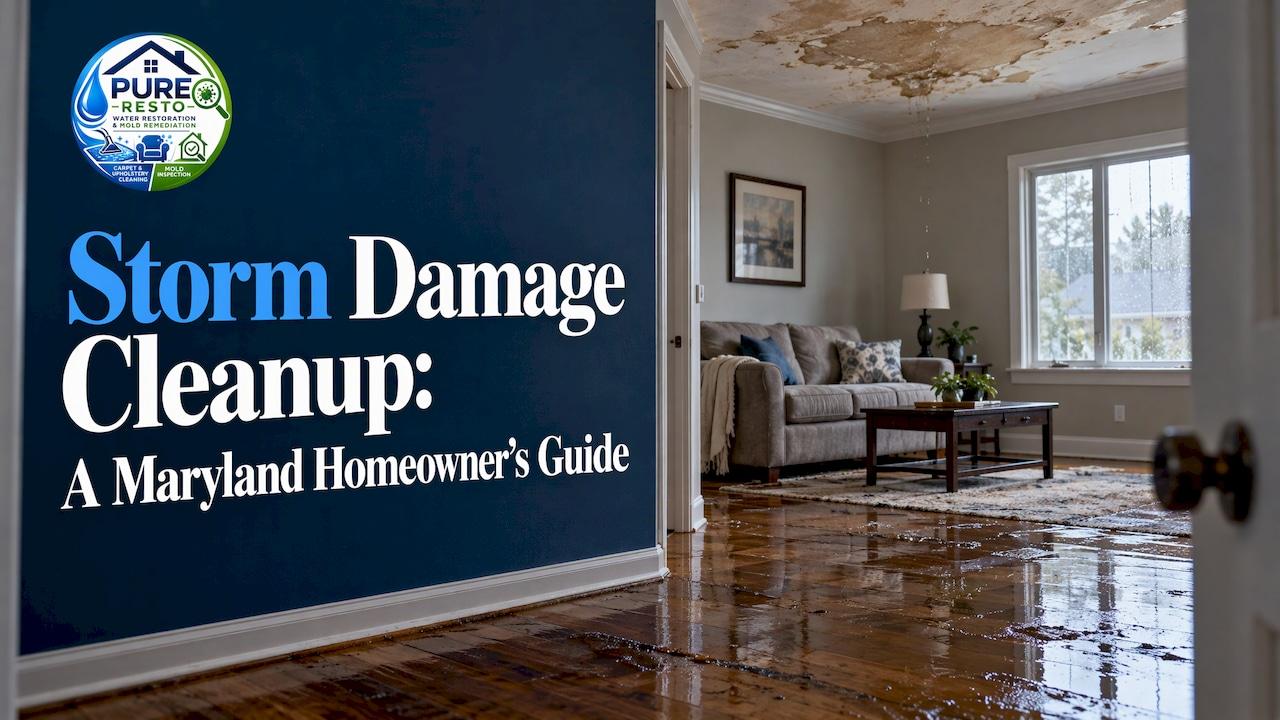
Storm damage cleanup goes in a set order. Make the house safe, document everything, call your insurer, then remove water and start drying within 24 to 48 hours. Hauling debris and tearing out soaked materials comes after that. If water has reached drywall, carpet or a basement, bring in a certified restoration crew quickly, because mold can start in that window. This guide is for homeowners in Bowie, Silver Spring, Rockville, Bethesda, College Park, Laurel and nearby Maryland communities, and Washington, DC.
TL;DR
- Check for safety hazards first: gas smell, downed power lines, unstable structure, and nails and debris underfoot.
- Photograph or video every damaged item and call your insurer before you throw anything away or start repairs.
- Clean and dry the home within 24 to 48 hours. If you can't, assume mold is starting.
- Flood water is generally not covered by a standard homeowners policy. Wind, hail and falling-object damage may be.
- Call a certified pro when water has soaked walls, flooring, insulation or a basement. We respond within 30 minutes, 24/7.
Table of Contents
- Start with safety, not cleanup
- Document everything before you clean
- Who pays: insurance and FEMA in Maryland
- The first 48 hours: dry it out
- What to handle yourself and what to hand off
- Perspective: why speed and equipment change outcomes
- When to call a professional
- Local help across our service area
- Storm damage? We can be there in 30 minutes
- FAQ
- Sources
Start with safety, not cleanup
Most cleanup injuries are avoidable. The National Weather Service cites a study of a tornado in Marion, Illinois, where 50 percent of injuries happened during rescue, cleanup and other post-storm activity, and nearly a third came from stepping on nails. So walk the property slowly and wear sturdy boots.
Before you go inside
- Gas. If you smell gas, turn off the main valve, open windows and leave immediately. Don't go back until you're told it's safe.
- Light. Use a flashlight, never a candle or torch, to avoid fire or explosion.
- Power lines. OSHA's cleanup guidance warns about overhead and underground lines while clearing debris. Use wood or fiberglass ladders, and keep equipment well away from lines. FEMA is blunt: never touch a downed power line.
- Structure. The same OSHA publication says not to work in or around a flood-damaged building until a registered professional engineer or architect has certified it as safe. If you see sagging ceilings, shifted walls or a cracked foundation, stay out and call a professional.
- Lifting. OSHA advises against lifting materials over 50 pounds per person and recommends teams of two or more for bulky objects. Use a stick or pole to probe flooded areas for holes before you step in.
If a basement has taken on water, electricity and water make a dangerous mix. Our guide to basement flood safety walks through the immediate steps. For heavy water, how a basement's plumbing and drainage work helps you understand where water is coming from and what is safe to touch.
Document everything before you clean
The order matters for your claim. FEMA tells homeowners to photograph or video every damaged item before cleaning and keep every receipt. Insurance regulators say the same thing. The Arizona Department of Insurance notes that starting repairs before the insurer evaluates the damage could lead to a denied claim, so call first. Policy rules differ by state, but the principle holds anywhere: show the loss, then clean.
A simple documentation routine:
- Shoot wide photos of each room, then close-ups of each damaged item and surface.
- Record a slow video walkthrough, narrating what you see.
- Photograph the exterior: roof, siding, windows, fallen trees and fences.
- Keep damaged items you can safely store until the adjuster has seen them, or photograph them thoroughly before disposal.
- Save every receipt for emergency repairs, hotel stays and supplies.
Who pays: insurance and FEMA in Maryland
What homeowners insurance usually covers
Coverage depends on your policy, so read it and call your agent. In general, some homeowners policies may cover wind, hail or falling-object damage. Interior rain damage may not be covered unless the rain came through a roof or wall damaged by wind or hail. Mold and rot are typically excluded, though some insurers offer extra coverage.
Flood is a separate matter. Standard homeowners policies do not cover flood or rising water, which is why flood insurance through the National Flood Insurance Program exists. The same North Carolina Department of Insurance brochure notes that most homeowners policies pay additional living expenses while the home is being repaired. Ask your agent whether yours does.

Maryland-specific tips
The Maryland Insurance Administration suggests making sure your adjuster has your current phone number, being present when the adjuster visits, getting multiple contractor bids to compare with the adjuster's report, and saving proof that you paid your deductible. It also says price gouging after a disaster is illegal and can be reported to the Office of the Attorney General or the Maryland Department of Labor. You can reach the MIA at 800-492-6116.
If you have an NFIP policy, the Flood Recovery Checklist warns that it does not cover mold, so start drying right away. It also says to check an adjuster's identification, including a driver's license and Flood Control Number, to avoid recovery scams.
Will FEMA pay for storm cleanup?
Only in a federally declared disaster, and only partly. FEMA's Individuals and Households Program offers up to $44,800 for Housing Assistance and $44,800 for Other Needs Assistance in federal fiscal year 2026. The amounts adjust each October 1. FEMA's fact sheet states that it does not duplicate insurance payments or restore a home to its pre-disaster condition. Treat FEMA as a supplement, not a plan. Your insurance claim is the main path.
The first 48 hours: dry it out
Speed is the whole game. The CDC advises cleaning and drying your home within 24 to 48 hours after the storm or flood ends: open doors and windows, run fans on wet areas, and throw away what can't be cleaned or dried quickly. Its mold guidance adds that if you couldn't dry the home in that window, you should assume mold is growing. Painting or caulking over mold won't stop it.
We cover this race in detail in our guide to stopping mold in 24 to 48 hours and in dehumidifier use after water damage.
A practical cleanup sequence
- Remove standing water. Use a wet vacuum or pump. The Red Cross says to pump a flooded basement gradually, about one-third of the water per day, to avoid structural damage.
- Move out what's wet. Remove damaged items, mud and trash.
- Tear out what can't be saved. Drywall and insulation that touched flood waters should come out, per the Red Cross. Texas A&M advises opening flooded walls even if they look fine, and leaving them open until fully dry, which can take up to a month.
- Clean hard surfaces. Use hot water and detergent, then disinfect.
- Dry everything. Fans and dehumidifiers, once electricity is safe to use. The Red Cross notes that drying structural elements can take weeks or months.
What to throw away
The CDC's list of items to discard if they can't be cleaned and dried quickly includes mattresses, carpeting and padding, rugs, upholstered furniture, stuffed animals, pillows, books and paper products. Texas A&M adds that flood-soaked carpet pads should always be discarded, and that waterlogged carpets and pads should come out within 48 hours.

That applies to flood water. Carpet that got wet from a clean source, such as rain through a damaged roof, is a different case, and a trained technician can often tell you what is salvageable. Our carpet cleaning and upholstery cleaning services are built for the in-between cases.
If you clean mold yourself
For small surface growth, the CDC says to use 1 cup of household bleach per 1 gallon of water, never in a closed space, and to wear goggles, an N-95 respirator and gloves. Never mix bleach and ammonia. Where mold has already started, the CDC also says not to run fans, which can spread it. Mold inside walls or across larger areas is a job for remediation. See what to expect from mold remediation.
What to handle yourself and what to hand off
A good rule: do the surface work, hand off anything involving water you can't see.
| Task | Reasonable for you | Better for a restoration pro |
|---|---|---|
| Photographing damage, calling insurer | Yes | No |
| Bagging small debris, clearing yard | Yes, with gloves and boots | Large limbs near structures or lines |
| Tarping a small roof opening | Only if you can do it safely from the ground or a stable surface | Steep or damaged roofs |
| Wet vacuuming a few ounces to a few gallons | Yes | Water in more than one room |
| Wet drywall, insulation, subfloor | No | Yes, extraction and structural drying |
| Flooded basement | Not while power is on | Yes |
| Visible mold beyond a small patch | No | Yes, containment and HEPA filtration |
| Smoke or odor after lightning fire | No | Yes |
Large debris is its own category. If a fallen tree or broken fence leaves a pile too big for curbside pickup, options and rules for debris removal explain how dumpster-style hauling generally works. Check your own county or municipality for local pickup rules.
Perspective: why speed and equipment change outcomes
We see the same pattern after every storm: the visible mess is rarely the real problem. The real problem is the moisture that sits in drywall, insulation, subfloors and padding after the surface looks dry.
That is why we arrive fast and focus on extraction and drying first. Our crews use advanced extraction, drying and HEPA filtration techniques to stop further damage and protect air quality, and we are IICRC-certified. We believe restoration beats simple cleanup: a home that is dried properly is a home you do not have to tear apart twice.
We also handle the paperwork side. We work directly with insurance providers to streamline the claims process, so you can focus on your family while we document and restore.
Pure
When to call a professional
Call right away if any of these apply:
- Water has reached walls, insulation, subfloors or a finished basement.
- You can't dry the space within 24 to 48 hours.
- You see or smell mold, or the house smells musty after water exposure.
- Contents are wet or smoke-affected and need cleaning, packout or secure storage.
- Your insurer needs an itemized scope of work.
Basement water is the most common trouble spot. Our basement flood cleanup guide covers the steps in order. If smoke or fire came with the storm, for example from a lightning strike, see our fire and smoke damage restoration service and odor removal.
If you do hire help, compare bids against the adjuster's report, keep your receipts, and confirm the contractor's licensing and insurance.
Local help across our service area
We serve Bowie, Crofton, Lanham, Glenn Dale, Greenbelt, College Park, Beltsville, Laurel, Silver Spring, Rockville, Potomac, North Potomac, North Bethesda, Bethesda and Washington, DC. Local pages give details for your area:
- Water damage: Lanham, MD and Washington, DC
- Fire and smoke: Silver Spring, Lanham and Washington, DC
- Carpet: Greenbelt, Silver Spring and Washington, DC
Storm damage? We can be there in 30 minutes
Pure Resto is an IICRC-certified, licensed and insured restoration company based in Bowie, MD. We offer 24/7 emergency water damage restoration, mold inspection and remediation, contents cleaning and secure storage, and carpet and upholstery cleaning for homes and businesses. Our response time is 30 minutes, and we bill insurance providers directly.
If mold is already a worry, start with a mold inspection or read about mold remediation in Maryland. To book help now, visit purerestomd.com.
FAQ
Who is responsible for cleaning up after a storm?
You are responsible for your own property, including debris and water damage inside the home. Your insurer may pay for covered losses, and FEMA may help in declared disasters. Public crews handle roads and, in some cases, curbside debris, so check with your county or city for its rules.
Does homeowners insurance cover storm cleanup?
Often it covers damage from wind, hail or falling objects, but flood damage is not covered and requires separate NFIP flood insurance, per state insurance regulators. Call your insurer before you repair, clean or dispose of anything, and ask about your specific policy.
How soon should I start drying after storm damage?
Within 24 to 48 hours. The CDC says that if the home can't be dried in that window, you should assume mold is growing. Open windows, run fans and call a restoration company if walls, flooring or a basement are wet.
Will FEMA pay for storm cleanup?
Possibly, but only when a federal disaster is declared and you're eligible. FEMA assistance doesn't duplicate insurance and is meant to make a home safe and sanitary, not fully restore it. File your insurance claim first.
Sources
- NWS: Safety After the Storm
- OSHA: Cleanup Hazards
- FEMA: Stay Safe Cleaning Up After a Flood
- Arizona Department of Insurance: Insurance & Storms or Disasters
- North Carolina Department of Insurance: After Disaster brochure
- Maryland Insurance Administration: What to Do After a Natural Disaster
- NFIP Flood Recovery Checklist
- South Carolina EMD: Help for Individuals
- FEMA Individual Assistance Overview
- CDC: Guidelines for Cleaning Safely After a Disaster
- CDC: Cleaning Safely After a Disaster (mold)
- CDC: Homeowner's and Renter's Guide to Mold Cleanup
- Red Cross: Disaster Cleanup & Repair For Your Home
- Texas A&M: Cleaning Flood-damaged Homes
- Construction debris removal: options, costs and rules