

When your basement floods, do these five things first: get everyone out of the basement, do not re-enter until power is confirmed off, call 911 if anyone is in danger, contact your electric utility to disconnect service, then call your insurer and a restoration emergency line.
Your immediate call list:
- 911 if anyone is trapped or injured
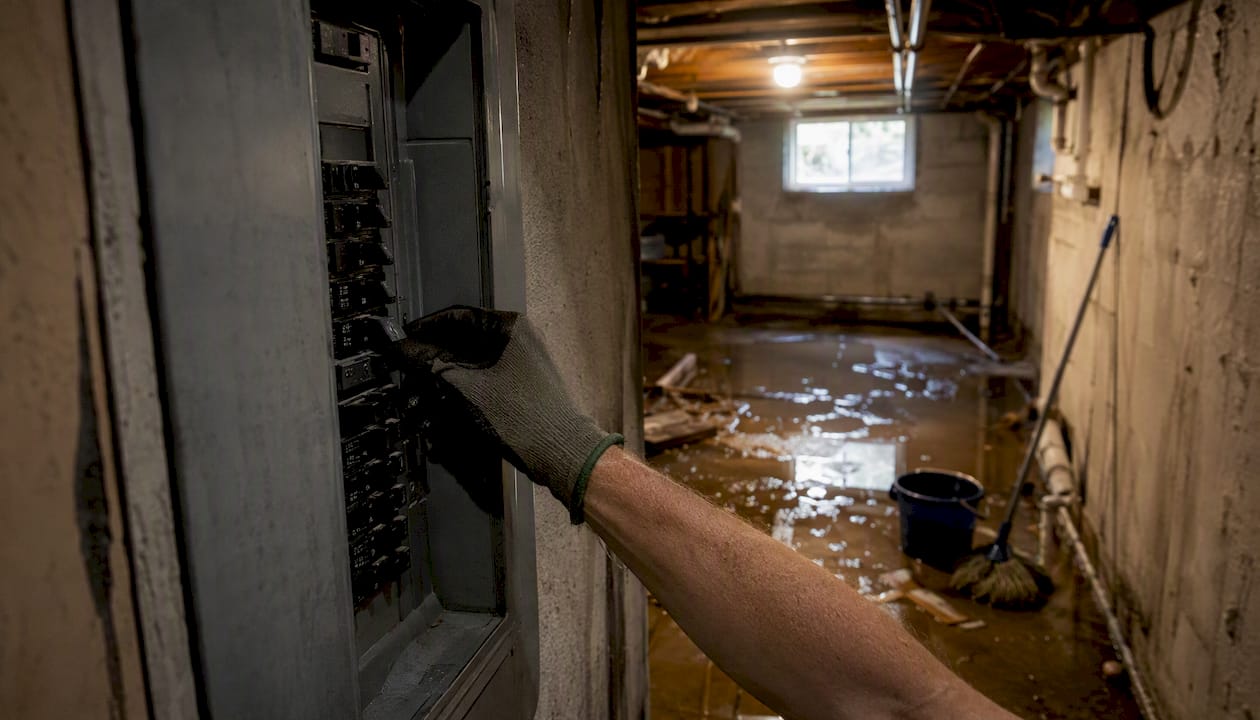
- Your electric or gas utility to disconnect service remotely (never touch a breaker panel standing in water)
- Your insurance company to open a claim and document the event
- A licensed restoration emergency line for water extraction and drying
Pro Tip: Even if the water looks clean, treat it as contaminated. Sewage backups, lawn chemicals, and household cleaners mix invisibly with floodwater.
Do not go back downstairs to grab belongings. Do not flip breakers while standing on wet flooring. Those two mistakes send more homeowners to the ER than the flood itself.
Key Takeaways
Basement flood safety comes down to one rule: protect people first, then property, and never let speed override the 72-hour mold window or the electrical hazard check.
| Point | Details |
|---|---|
| Evacuate and cut power first | Get everyone out and call your utility to disconnect service before re-entering. |
| Treat all floodwater as contaminated | Even clear water can carry sewage, bacteria, and chemicals — wear full PPE. |
| Pump out slowly | Limit water removal to 2–3 feet per day to avoid hydrostatic foundation collapse. |
| Act within 72 hours | Mold colonization begins within 24–72 hours; professional drying must start fast. |
| Purerestomd for Maryland homeowners | IICRC-certified, 30-minute emergency response, direct insurance billing available. |
Table of Contents
- Why basement flood safety starts before you step inside
- How to document damage and notify your insurer
- Stopping the water: what you can safely do right now
- Removing standing water: DIY options and when to call a pro
- How to dry your basement and prevent mold
- Cleaning, disinfecting, and what to throw away
- How to reduce your risk of future basement flooding
- When should you hire a restoration specialist, electrician, or plumber?
- A restoration professional's perspective on what homeowners get wrong
- Purerestomd responds in 30 minutes when your basement floods
- Sources
- FAQ
Why basement flood safety starts before you step inside
Standing water in a basement is not just an inconvenience. It is a combination of three serious hazards that can kill or cause lasting illness.
Electrical hazards. Water conducts electricity. If your electrical panel, outlets, or any appliance is submerged or even splashed, the water around it may be energized. Never use electrical tools or appliances in standing water, and wait for a licensed electrician to confirm power is off before you or anyone else re-enters. Utilities like Xcel Energy explicitly advise customers not to disconnect electricity or natural gas themselves — call the utility so they can cut service remotely and safely.
Contamination. Floodwater routinely carries raw sewage, bacteria, pesticides, and industrial chemicals. According to the CDC's floodwater safety guidance, contact with contaminated water can cause wound infections, gastrointestinal illness, and other serious health problems. Clear-looking water is not safe water. Even a small cut on your hand becomes a serious infection risk.
Structural damage. Saturated soil exerts enormous lateral pressure on basement walls. Cracks that were hairline before the flood can widen under that load. Weakened block or poured-concrete walls can bow inward, and floor joists above standing water absorb moisture rapidly. Watch for new cracks, bowing walls, or doors that suddenly won't close — those are signs the structure is moving.
Health symptoms to watch for after any flood exposure: skin rashes or wound infections, nausea, diarrhea, respiratory irritation, or persistent coughing. Mold-related symptoms (sneezing, eye irritation, worsening asthma) can appear within days if drying is delayed.
How to document damage and notify your insurer
Start documenting before you start cleaning. Insurers need a clear record of what the flood damaged, and courts have dismissed claims for lack of evidence. You can photograph from the doorway or top of the stairs without entering an unsafe space.
Photo checklist:
- Wide shots of each wall and the floor from the doorway
- Close-ups of water lines on walls (these show depth)
- Serial numbers on appliances, HVAC equipment, and electronics
- Damage to structural elements: cracks, bowing, staining
- Timestamps on every photo (your phone does this automatically)
Municipal guidance from Columbus, Ohio recommends documenting damage with photos before any cleanup begins and notifying your insurer promptly. Keep a written inventory alongside your photos.
| Item to document | What to capture |
|---|---|
| Appliances and electronics | Brand, model, serial number, visible damage |
| Furniture | Material type, dimensions, purchase year, estimated value |
| Flooring and walls | Material, square footage affected, water line height |
| Personal property | Description, approximate purchase date, replacement cost |
When you call your insurer, have your policy number ready, the date and approximate time flooding began, and the cause if you know it (sewer backup, storm, pipe burst). Ask specifically whether your policy covers sewer backup — standard homeowners policies often do not, and a separate rider is required.
Pro Tip: Do not throw anything away before your adjuster visits or gives written approval. Even damaged items are evidence. Photograph everything you must discard for safety reasons before it leaves the property.
Stopping the water: what you can safely do right now
If the flood came from a burst pipe or failed appliance rather than groundwater, shutting off the main water supply stops the source immediately. The main shutoff valve is usually near the water meter, often in a utility room or along the front foundation wall. Turn it clockwise to close.
Do not walk through standing water to reach the shutoff valve if there is any chance the basement is energized. Wait until the utility confirms power is off.
Step-by-step for safe initial mitigation:
- Confirm power is off (utility confirmation, not your own breaker flip).
- Identify the water source: pipe, sewer backup, groundwater intrusion, or storm drain.
- If it is a pipe and the shutoff is safely reachable, close the main valve.
- Check your sump pump: if it is running but not keeping up, check the discharge line for blockage or freezing.
- If you have a battery backup sump pump and the primary failed, verify the backup is active.
- Divert surface water away from foundation openings using sandbags or rolled towels at window wells — only if you can do so from outside without entering the basement.
If the source is a sewer backup or rising groundwater, there is no shutoff that will help. That situation calls for professional extraction immediately. Attempting to pump sewage-contaminated water yourself without proper PPE and containment spreads pathogens through the rest of your home.
UNL Extension's flood guidance warns that pumping a flooded basement too quickly can cause foundation failure as hydrostatic pressure equalizes. If you are waiting for pros, do not start pumping aggressively on your own.
Removing standing water: DIY options and when to call a pro
For clean water from a burst pipe with confirmed power off, a shop-vac or submersible utility pump can handle modest amounts. For anything else, the calculus changes fast.
| Factor | DIY (clean water, power off) | Professional restoration |
|---|---|---|
| Water source | Pipe burst, appliance leak | Sewer backup, groundwater, storm |
| Depth | Under 2 inches | Over 2 inches or any structural risk |
| Contamination | None confirmed | Any sewage, chemical, or unknown source |
| Electrical risk | Confirmed clear | Any doubt about panel or appliance submersion |
| Speed | Slower, limited equipment | Industrial pumps, faster extraction |
PPE required for any DIY water removal:
- Rubber boots (knee-high, waterproof)
- Nitrile or rubber gloves
- Safety goggles
- N95 respirator at minimum if any mold is visible
One critical safety note: gasoline-powered pumps and generators must never run inside a basement. Carbon monoxide accumulates in enclosed spaces within minutes. Run any gas-powered equipment outdoors, downwind, and well away from windows and doors.
Discharge water away from your foundation, not toward a neighbor's property or back toward your home. Direct it to a storm drain, street gutter, or a low point in your yard at least 10 feet from the house.
Disaster education guidance from UNL reinforces that electric pumps should only be used after power is confirmed off, and municipal disposal rules apply to where you direct the water.
Pro Tip: If you see any sewage odor, dark or murky water, or floating debris you cannot identify, stop and call a restoration company. Contaminated water removal requires containment protocols that DIY equipment cannot provide.
How to dry your basement and prevent mold
Mold can begin colonizing wet materials within 24–72 hours of a flood. That window is the most important timeline in post-flood recovery.
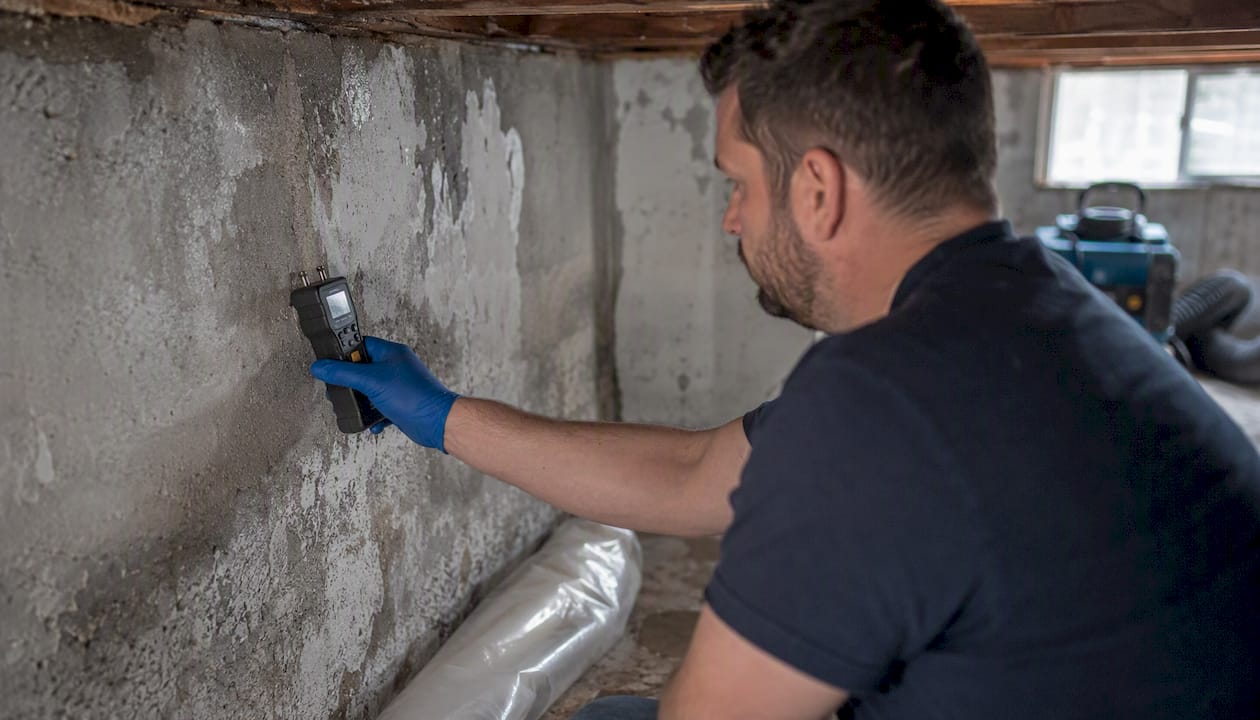
Restoration experts note that visible water is only part of the problem. Hidden moisture behind drywall and under flooring causes structural decay and mold growth that a dehumidifier alone cannot address. A moisture meter or the plastic-sheet test (tape a 12-inch square of plastic to a dry-looking wall; condensation underneath after 24 hours means moisture is still migrating) can reveal what your eyes miss.
Controlled pump-out rate matters. UNL Extension advises limiting pump-out to 2–3 feet of water per day and monitoring foundation walls for movement. Pumping faster risks hydrostatic collapse as exterior soil pressure overwhelms the suddenly unsupported wall.
| Material | Salvageable? | Action |
|---|---|---|
| Concrete block or poured walls | Usually yes | Clean, disinfect, dry thoroughly |
| Vinyl or ceramic tile | Usually yes | Remove, dry subfloor, reinstall |
| Hardwood flooring | Sometimes | Dry quickly; cupped boards may need replacement |
| Carpet and pad | Rarely | Remove and discard; pad is almost never salvageable |
| Drywall (below water line) | No | Cut out and replace; it holds moisture and mold |
| Fiberglass batt insulation | No | Remove and discard; it retains water and mold |

Once water is removed, run industrial dehumidifiers and air movers continuously. Residential dehumidifiers help but are often undersized for a flooded basement. Professionals use units rated for commercial drying that can remove many gallons of moisture per day from the air and building materials. For flood-damaged subfloor replacement, the subfloor must reach acceptable moisture content before any new flooring goes down.
Cleaning, disinfecting, and what to throw away
Once the space is dry enough to enter safely, cleaning follows a specific sequence: remove debris, clean surfaces, then disinfect. Disinfecting a dirty surface does not work — the organic matter neutralizes the disinfectant before it can act.
PPE for cleanup:
- Rubber or nitrile gloves (heavy-duty)
- Rubber boots
- Safety goggles or face shield
- N95 respirator or better if mold is present
Disinfecting steps:
- Remove all debris and standing mud.
- Scrub hard surfaces with soap and water.
- Apply a bleach solution: 1 cup of unscented liquid chlorine bleach per gallon of water for most surfaces.
- Let the solution sit for at least 10 minutes before rinsing.
- Dry the surface completely.
Discard without exception:
- Any food that contacted floodwater, including canned goods with damaged seals
- All medications that were submerged or splashed
- Porous items that cannot be fully dried and disinfected: mattresses, upholstered furniture, stuffed animals, particleboard furniture
- Cosmetics and personal care products that were submerged
Columbus municipal guidance specifically calls out discarding wet food and medications as a non-negotiable step. When in doubt, throw it out.
Dispose of chemical containers (paint, solvents, pesticides) through your municipality's hazardous waste program, not in regular trash or down drains. Many counties in Maryland hold periodic hazardous waste collection events.
How to reduce your risk of future basement flooding
Prevention is cheaper than restoration. Most basement flooding comes from one of three sources: surface water that grades toward the foundation, overwhelmed or failed sump pumps, and sewer backups. Each has a practical fix.
Prioritized upgrades:
- Regrade soil away from foundation: the ground should slope away at least 6 inches over the first 10 feet from your house. This is the single highest-return fix for most homes.
- Clean gutters and extend downspouts: gutters clogged with debris dump water directly against your foundation. Downspout extensions should discharge at least 4–6 feet from the house.
- Install a sump pump with battery backup: a primary sump pump fails exactly when you need it most, during a power outage in a heavy storm. A battery backup unit keeps pumping when the grid goes down.
- Add a backflow preventer (check valve): this prevents municipal sewer water from backing up into your basement drain during heavy rain events when the sewer system surcharges.
- Consider perimeter (French) drains: interior or exterior perimeter drains collect groundwater before it reaches your floor and direct it to the sump pit.
Pro Tip: Regrading and gutter maintenance cost very little compared to waterproofing systems. Do those two things first. If you still get water after a heavy rain, then evaluate interior drainage solutions.
For water damage restoration tips that go deeper on sequencing repairs after a flood, that resource covers the order of operations from extraction through finish work.
When should you hire a restoration specialist, electrician, or plumber?
Some situations are not judgment calls. Call certified professionals immediately when:
- Floodwater is dark, murky, or has a sewage odor (black water or gray water)
- Any electrical panel, outlet, or appliance was submerged
- You see new cracks in foundation walls or walls that appear to bow
- Standing water exceeds 2 inches and you cannot identify a clean source
- Humidity remains high and musty odor persists more than 72 hours after water removal
Credentials to look for:
- IICRC certification (Institute of Inspection, Cleaning and Restoration Certification): the industry standard for water damage restoration technicians. Ask for the technician's IICRC certificate number.
- Licensed electrician: required before any power is restored to a flooded space. Do not accept "handyman" electrical work after flood exposure.
- Licensed plumber: for sewer backup diagnosis, backflow preventer installation, or pipe repair.
Questions to ask any restoration company before hiring:
- Are your technicians IICRC-certified in water damage restoration?
- Do you handle direct insurance billing?
- What is your response time for emergency calls?
- Will you provide a written scope of work and moisture readings before and after drying?
- Do you offer mold inspection if hidden moisture is found?
What a restoration pro actually does: they extract standing water with industrial pumps, set commercial air movers and dehumidifiers, use thermal imaging and moisture meters to find hidden moisture, remove unsalvageable materials, document everything for your insurer, and conduct or refer mold inspection if the drying timeline was delayed. That documentation protects your insurance claim.
A restoration professional's perspective on what homeowners get wrong
The calls that break my heart are the ones that come in four days after the flood. The homeowner ran a box fan, thought the basement looked dry, and went back to normal life. Two weeks later, they have black mold on every wall stud and a remediation bill three times what the original restoration would have cost.
What homeowners consistently underestimate is that drywall acts like a sponge. That is a mold incubator. The only way to know is a moisture meter reading or a thermal imaging scan — neither of which a homeowner typically owns.
The realistic timeline: water extraction takes hours, structural drying takes 3–5 days with professional equipment, and a mold clearance inspection should follow. If you are doing this yourself with consumer equipment, double that estimate and check moisture readings daily. If the numbers are not dropping, call for help before the 72-hour window closes.
Purerestomd responds in 30 minutes when your basement floods
When standing water is in your basement and you need someone there fast, Purerestomd's 24/7 emergency team in Maryland mobilizes within 30 minutes of your call. That response time is not a marketing claim — it is the difference between drying out in 3 days and tearing out walls for 3 weeks.
Purerestomd handles the full scope: emergency water extraction, industrial drying, contents cleaning and secure storage, and mold inspection when hidden moisture is a concern. Direct insurance billing means you are not fronting costs and chasing reimbursement. IICRC-certified technicians document every moisture reading and every step for your adjuster.
Call Purerestomd's emergency line now or request an inspection online to get a team dispatched today.
Sources
These are the primary authorities cited throughout this article:
- Safety Guidelines: Floodwater | Floods | CDC
- What to do if your basement floods
- Entering and Cleaning Up Flooded Homes — UNL Extension
- What to Do if Your Basement Floods — City of Columbus
This article is general information, not a substitute for advice from a qualified doctor. Consult a qualified healthcare professional about your own circumstances before acting on anything here.
FAQ
What is the first thing to do when a basement floods?
Get everyone out of the basement immediately and call your electric utility to disconnect service before anyone re-enters. Do not flip breakers yourself if you must wade through water to reach the panel.
Is a flooded basement dangerous?
Yes. Standing water can be electrically energized, contaminated with sewage and pathogens, and structurally destabilizing. The CDC advises treating all floodwater as contaminated regardless of appearance.
How long does it take to dry out a basement after a flood?
With professional industrial drying equipment, structural drying typically takes 3–5 days. Consumer dehumidifiers and fans can take significantly longer, and hidden moisture behind walls may persist even when surfaces feel dry.
How can I protect my basement from future flooding?
The highest-return steps are regrading soil away from your foundation, cleaning gutters and extending downspouts, and installing a sump pump with battery backup. A backflow preventer addresses sewer backup risk specifically.
When should I call a professional restoration company?
Call immediately if floodwater is dark or has a sewage odor, if any electrical equipment was submerged, if you see new foundation cracks, or if humidity and musty odor persist beyond 72 hours after water removal. Look for IICRC-certified technicians. Purerestomd serves Maryland homeowners with 24/7 emergency response and direct insurance billing.