
Yes, a dehumidifier helps after water damage — but only once standing water is gone, and only when the right type of unit runs continuously until measurable moisture targets are met. Running one over a flooded floor does nothing useful. The sequence matters as much as the equipment.
Before you plug anything in, work through this checklist:
- Cut power to the affected area at the breaker if there is any chance water reached outlets, switches, or the panel. Do not re-energize until an electrician clears it.
- Stop the water source. Shut off the supply valve, call your utility, or patch the breach.
- Extract standing water first. Use a submersible pump, wet-dry vacuum, or call a water extraction service. A dehumidifier cannot process bulk water.
- Put on PPE (gloves, N95 mask, rubber boots) if the water came from a toilet, sewer, or outdoor flooding. Assume contamination until proven otherwise.
Call professionals immediately if the water is contaminated (sewage or floodwater), if structural materials are visibly saturated, or if there are any unresolved electrical hazards. Those situations go beyond what a consumer unit can safely address.
Pro Tip: Set a timer on your phone the moment the incident happens. Mold can begin colonizing within 24–48 hours, so your clock starts now, not when the water stops.
Key Takeaways
A dehumidifier after water damage works only when extraction comes first, the right unit size is matched to the loss, and drying continues until moisture meter readings confirm structural materials have returned to baseline.
| Point | Details |
|---|---|
| Extract before you dehumidify | Standing water must be removed before a dehumidifier can contribute to structural drying. |
| Match unit capacity to the loss | Consumer units handle small, clean leaks; LGR or commercial rentals are needed for structural or multi-room events. |
| Use the 24–48 hour window | The EPA recommends drying within 24–48 hours to prevent mold; start extraction and dehumidification immediately. |
| Stop on data, not appearance | Confirm wood framing at 16–19% MC and ambient RH matching unaffected areas before shutting off equipment. |
| Purerestomd for Maryland homes | IICRC-certified, 30-minute response, direct insurance billing for water damage restoration across Maryland. |
Table of Contents
- How does a dehumidifier speed up structural drying?
- How to set up a dehumidifier after water damage
- How long should you run a dehumidifier after water damage?
- Can a dehumidifier prevent mold after water damage?
- When is a dehumidifier not enough?
- Electrical and health safety before you power up
- Consumer unit, rental, or professional: which makes sense for you?
- How to monitor drying progress and document it for insurance
- What restoration practice actually looks like
- Purerestomd is ready when DIY drying reaches its limit
- Sources
- FAQ
How does a dehumidifier speed up structural drying?
The physics is straightforward. When wet materials like drywall, hardwood, or carpet padding are surrounded by humid air, evaporation slows or stops entirely. Lower the humidity in the room and you restore the vapor-pressure difference that pulls moisture out of those materials and into the air. The dehumidifier then captures that airborne moisture and removes it from the space. That cycle, repeated continuously, is what dries a structure.
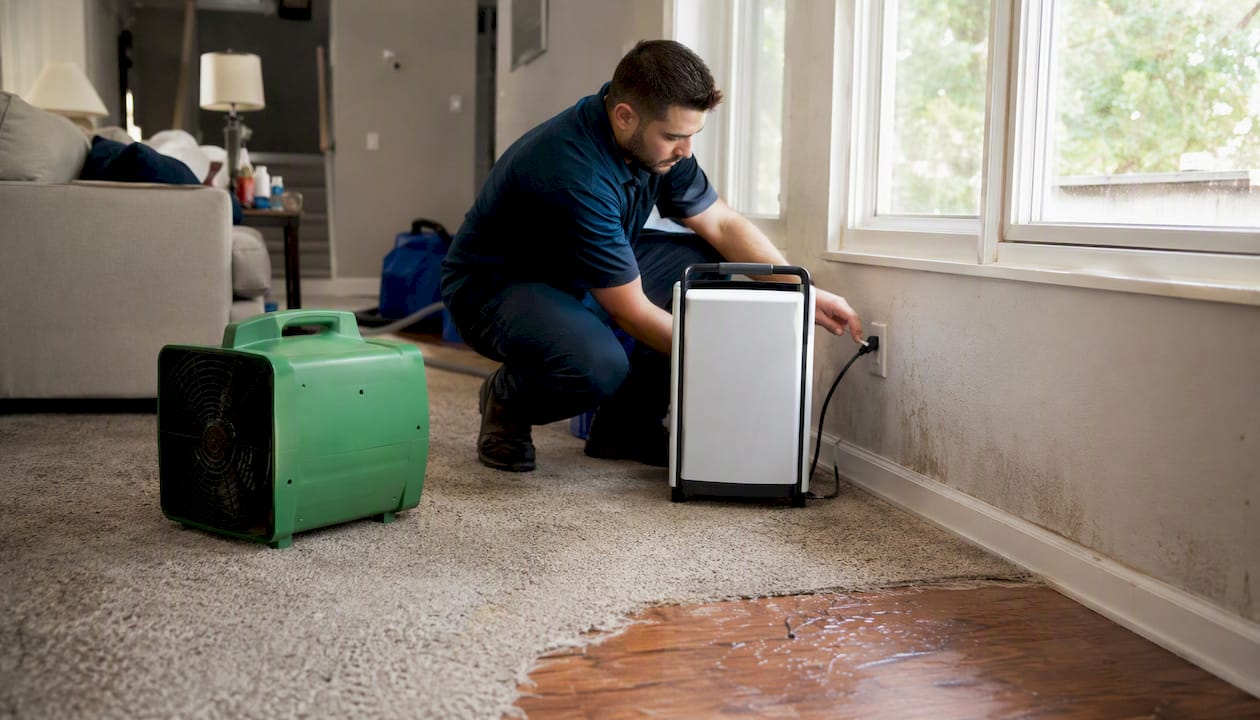
Dehumidifiers support structural drying by removing moisture from the air so wet materials can keep releasing trapped water, but they do not replace extraction or sanitation. Think of it as a three-step sequence: extract bulk water first, use air movers to accelerate surface evaporation, then run the dehumidifier to capture what the air movers lift. Skip extraction and you are asking a dehumidifier to do a job it was never designed for.
Where dehumidifiers genuinely help:
- Drying framing lumber, drywall, and subfloor after extraction
- Reducing humidity in enclosed spaces like crawl spaces and closets
- Preventing secondary moisture migration to unaffected materials
Where they fall short:
- Hidden cavities behind walls (requires injectidry or structural drying panels)
- Saturated concrete slabs (slow release, needs extended runtime and sometimes heat)
- Any space where standing water remains
Consumer refrigerant vs. LGR/desiccant units
| Type | Typical removal capacity | Best operating temp | Best use case |
|---|---|---|---|
| Consumer refrigerant | 30–70 pints/day (AHAM rated) | Above 65°F | Small leaks, finished spaces, warm conditions |
| LGR commercial unit | 100–200+ pints/day | Down to ~33°F | Structural drying, basements, large losses |
| Desiccant | Variable; effective at very low grain | Below 40°F | Cold unheated spaces, crawl spaces in winter |
Restoration-grade LGR dehumidifiers remove substantially more moisture per day than consumer units and include features like pump basins and low-temperature performance suited to structural drying. A consumer unit running in a saturated basement is like bailing a boat with a coffee cup.
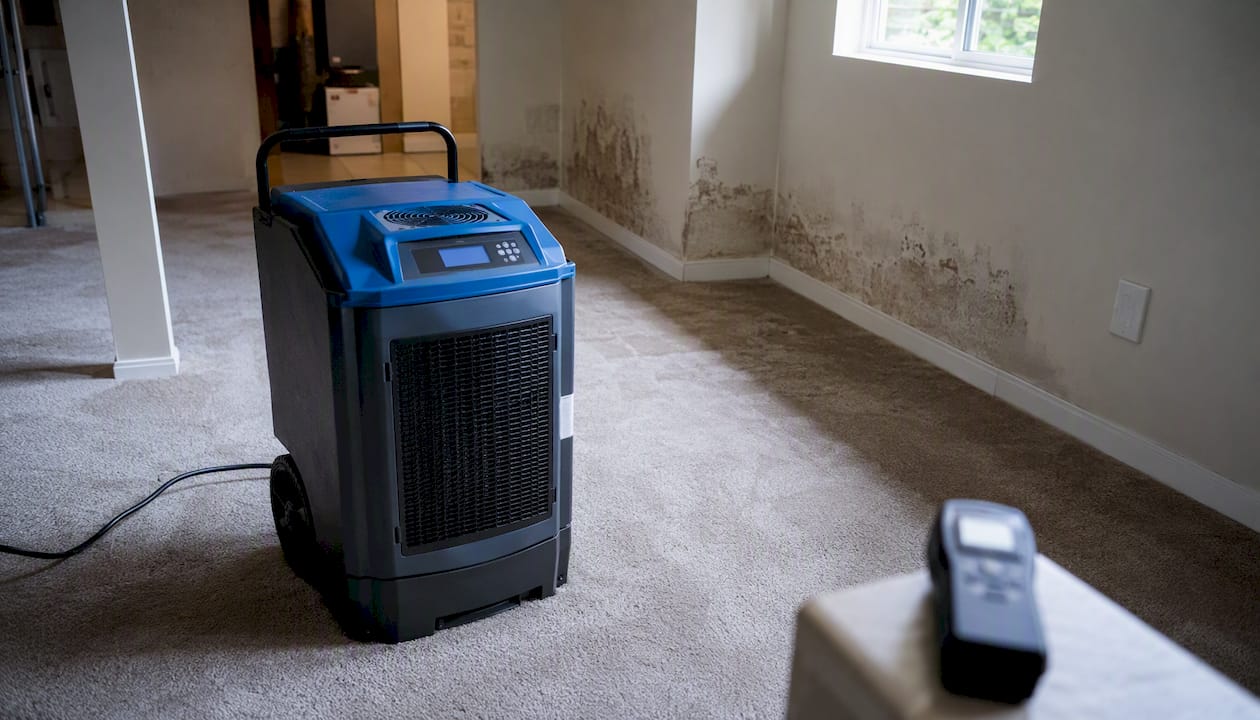
How to set up a dehumidifier after water damage
Follow these steps in order. Skipping ahead is the most common reason drying stalls.
- Confirm electrical safety. Breaker off for the affected zone. Verify with a non-contact voltage tester before touching any outlet or switch.
- Remove all standing water. Pump or wet-vac until no pooled water remains on floors or in low spots.
- Pull saturated materials you plan to discard. Wet carpet padding, for example, rarely dries adequately in place and traps moisture under the carpet.
- Place air movers (fans) across wet surfaces. Position them at a low angle, blowing across the floor or wall surface, not directly at it. One air mover per 50–100 square feet of wet surface is a common field ratio.
- Position the dehumidifier centrally in the affected space or in the doorway between wet and dry zones. Keep at least 6 inches of clearance on all sides for airflow. For multi-room events, use one unit per room or rent multiple units.
- Route continuous drainage. Connect the drain hose to a floor drain, utility sink, or sump pit. If gravity drainage is not possible, use a condensate pump to lift water to a drain. Emptying a bucket every few hours is not a reliable plan for a 5-day drying job.
- Set the unit to its lowest RH setting or "continuous" mode. During active structural drying, you want the unit working at full capacity, not cycling on and off at a comfort humidity level.
- Record your starting readings. Note ambient relative humidity (RH) with a hygrometer and surface moisture with a meter before you leave the room.
Keep interior doors closed and windows shut during active drying. Outdoor air in Maryland summers often carries 70–80% RH. Venting to the outside during active drying reintroduces the humidity you just removed and can add hours or days to your timeline. Open windows only when outdoor RH is measurably lower than indoor RH.
Pro Tip: Tape a piece of plastic sheeting over doorways to unaffected rooms. Containing the drying zone forces the dehumidifier to work on a smaller air volume, which drops RH faster and reduces the load on the unit.
How long should you run a dehumidifier after water damage?
Most contained water-loss events need about 3–5 days of continuous dehumidification. Serious flooding and saturated structural materials can extend drying to 7–14+ days depending on materials, temperature, and equipment capacity.
Those ranges assume the right equipment is running continuously from the start. A single consumer unit in a 1,500-square-foot basement flood is not the same as two LGR units in a single bathroom leak.
Variables that push drying time longer:
- Material type. Hardwood floors and concrete slabs release moisture slowly. Drywall dries faster but hides moisture in the paper facing.
- Temperature. Evaporation slows in cold spaces. Below 65°F, a standard refrigerant unit loses efficiency and can ice over.
- Ventilation. A sealed, contained zone dries faster than a drafty one with uncontrolled air exchange.
- Water volume and saturation depth. A quarter-inch of water on a sealed tile floor is a different job than two inches on carpet over wood subfloor.
- Unit capacity. An undersized unit runs continuously but never pulls RH down far enough to keep evaporation moving.
Do not stop based on how the room looks or smells. Stop based on instruments. Take readings at the same locations at the same time each day and look for a consistent downward trend over at least 48 hours before shutting off equipment.
Can a dehumidifier prevent mold after water damage?
Proper, timely dehumidification helps prevent mold, but it must start after extraction and hit measurable moisture goals within the first 24–48 hours. That window is not a suggestion.
The EPA recommends drying water-damaged areas within 24 to 48 hours to help prevent mold growth. Mold spores are already present in virtually every home. What they need to colonize is moisture and a surface. Remove the moisture fast enough and you deny them the conditions to establish.
Dehumidifiers are one of the most effective tools for preventing mold after water damage when combined with rapid extraction and drying within that EPA window. The problem is that most homeowners start dehumidifying too late, use an undersized unit, or stop too soon because the floor looks dry.
Watch for these signs that dehumidification alone is not working:
- Visible mold growth (any color, any surface) appearing within 48–72 hours
- Persistent musty or earthy odor that does not diminish as RH drops
- Moisture meter readings that are not declining after 48 hours of continuous operation
- Condensation reappearing on walls or windows after equipment runs overnight
- Soft or discolored drywall that does not firm up as ambient RH falls
If any of these appear, assume remediation is likely needed and stop treating this as a DIY drying job. A mold inspection at that point is not optional.
When is a dehumidifier not enough?
Call professionals when water is contaminated, structural materials are saturated beyond what consumer equipment can address, moisture readings are not falling within industry drying windows, or any safety concern remains unresolved.
IICRC standards define drying completion by measurable moisture targets in structural materials, not by elapsed time or visual inspection. When a homeowner's equipment cannot hit those targets, the structure is not drying — it is sitting wet.
Escalate to a professional restoration contractor when:
- Water came from a toilet, sewer backup, or outdoor flooding (Category 2 or 3 water)
- Moisture meter readings in walls or subfloor are not declining after 48–72 hours
- The affected area exceeds what one or two consumer units can realistically cover
- Insulation, structural framing, or wall cavities are saturated
- You smell mold or see discoloration on walls, ceilings, or under flooring
- Any electrical concern has not been cleared by a licensed electrician
Professional restoration contractors bring industrial LGR dehumidifiers capable of removing 100–200+ pints per day, multiple high-velocity air movers, injectidry systems for wall cavities, and calibrated moisture meters that map the full extent of saturation. They also document everything, which matters when you file an insurance claim. The EPA's 24–48 hour mold-prevention benchmark is the standard professional crews work against from the moment they arrive.
Electrical and health safety before you power up
Confirm electrical safety before re-energizing anything in a water-damaged space. If there is any doubt, wait for a licensed electrician or call a restoration crew that can assess the space first.
Electrical precautions:
- Use only GFCI-protected outlets for all drying equipment. If the affected area does not have GFCI outlets, use a GFCI extension cord or adapter.
- Do not run multiple high-draw appliances (dehumidifier plus air movers) on a single 15-amp circuit. A dehumidifier can draw 7–10 amps; add two air movers and you are at or over the circuit limit.
- Check for wet outlets, switches, or junction boxes before restoring power. Water inside an electrical box is an immediate hazard.
- After a power outage, confirm the dehumidifier restarted automatically. Many units resume on the last setting, but some require a manual restart.
Health precautions:
- Treat any water from a sewer backup, toilet overflow, or outdoor flood as contaminated. Wear rubber gloves, rubber boots, and an N95 or P100 respirator before entering.
- Ventilate briefly when applying any antimicrobial or cleaning product, then close the space again to resume controlled drying.
- Do not run equipment unattended overnight in a space with unresolved electrical concerns.
Pro Tip: If you are using a condensate pump to drain the dehumidifier, check the pump's reservoir and float switch every 12 hours for the first day. A stuck float will overflow the bucket and add water back to the space you are trying to dry.
Consumer unit, rental, or professional: which makes sense for you?
Small, contained, clean-water leaks can often be managed with a consumer unit. Structural or contaminated events almost always need rented restoration equipment or a professional crew.
| Equipment type | Typical capacity | Operating temp range | Best for |
|---|---|---|---|
| Consumer refrigerant | 30–70 pints/day | 65°F and above | Small leaks, single rooms, warm finished spaces |
| LGR commercial rental | 100–200+ pints/day | Down to ~33°F | Structural drying, basements, multi-room losses |
| Desiccant rental | Varies; low-grain effective | Below 40°F | Cold crawl spaces, unheated garages in winter |
Household dehumidifiers lose efficiency below certain temperatures and can ice over; desiccant units or commercial LGR units are the better choice for cold or low-grain conditions. The Dri-Eaz LGR 6500XLi, for example, includes remote monitoring and adaptive performance features that consumer units simply do not have.
Feature checklist when renting or buying:
- Continuous drain port (not just a bucket)
- Built-in or compatible condensate pump
- AHAM-rated pints/day at 80°F/60% RH (the standard test condition)
- Low-temperature performance rating
- Auto-restart after power loss
- Portability: casters and a handle matter on a 90-pound commercial unit
On cost: Renting a commercial dehumidifier typically runs $50–$100 per day at equipment rental centers. A professional restoration crew brings multiple units, air movers, and moisture documentation as a package. For losses that involve structural materials, the documentation alone often justifies the cost when dealing with an insurance claim. Controlling indoor humidity is also a longer-term investment in your home's health beyond any single incident.
How to monitor drying progress and document it for insurance
Monitor ambient RH with a hygrometer and material moisture with a pin or non-penetrating moisture meter. Record readings daily. Stop equipment based on data, not on how the room feels.
Instruments you need:
- Hygrometer: Measures ambient relative humidity. Place one in the drying zone and one in an unaffected room as a baseline.
- Non-penetrating (pinless) moisture meter: Scans surface moisture in drywall, wood floors, and subfloor without leaving holes. Good for mapping the extent of damage.
- Pin-type moisture meter: Penetrates the surface for accurate readings in framing lumber and thick materials. More precise for structural drying decisions.
- Data logger (optional): Records RH and temperature continuously. Worth renting for jobs that run longer than 5 days.
Targets to track:
| Material | Active drying target | Completion target |
|---|---|---|
| Ambient air (RH) | 40–45% during active drying | Match unaffected room baseline |
| Wood framing | Below 19% MC | 16–19% MC, consistent over 48 hrs |
| Drywall | Declining daily | Match unaffected wall section |
| Subfloor (wood) | Declining daily | Match unaffected area nearby |
Documentation checklist for insurance:
- Date and time-stamped photos of all equipment placement and drainage routing
- Daily moisture meter readings at the same marked locations
- Photos of any visible damage before and after extraction
- Notes on water source, time of discovery, and initial response steps
- Copies of any contractor or technician visit notes
What restoration practice actually looks like
Professionals judge drying completion by moisture content targets and steady readings, not by how the room looks or smells.
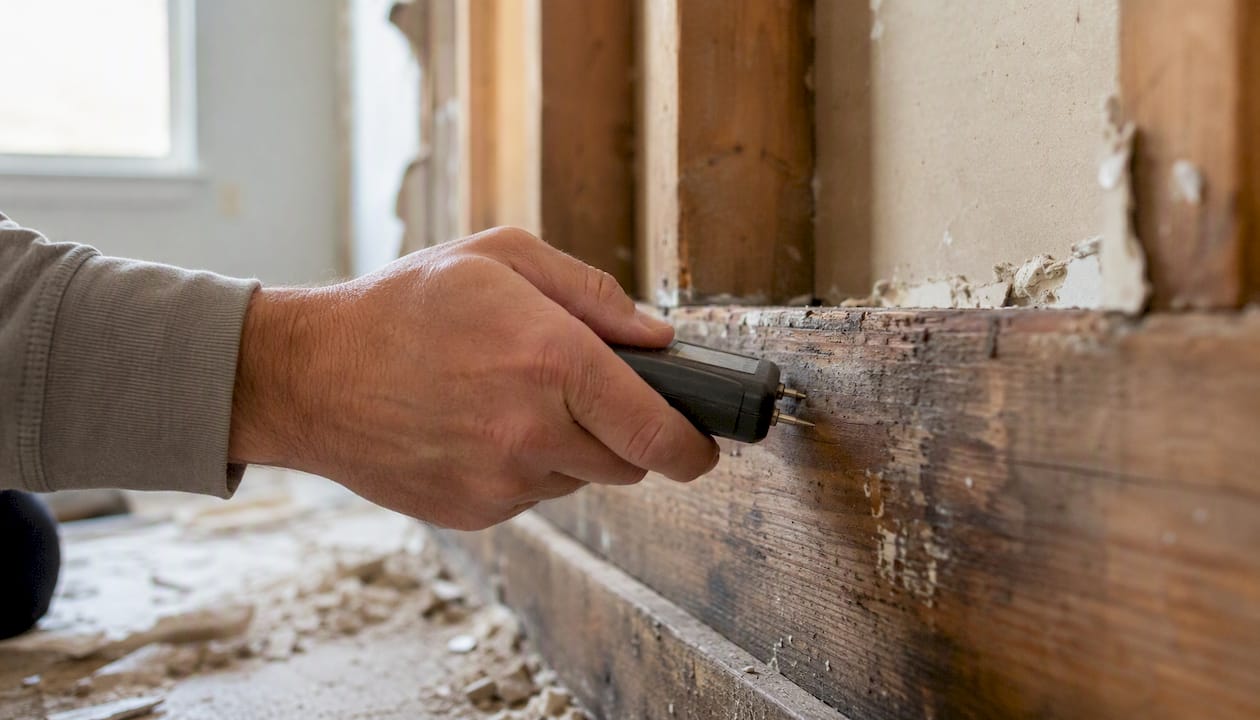
A small appliance leak under a kitchen sink, caught within a few hours, typically dries with one consumer or mid-range unit in 3–5 days if the cabinet base and subfloor are not saturated. A basement flood from a sump failure covering 800 square feet of carpet over wood subfloor is a different job entirely: multiple LGR units, several air movers, and 10–14 days of continuous operation with daily moisture mapping.
In practice, that means a homeowner running a 50-pint consumer unit in a 1,200-square-foot basement flood will see RH plateau rather than fall. The unit is not failing; it is just overwhelmed. That plateau reading, documented over two days, is the data point that justifies calling a restoration contractor and supports an insurance claim for professional services.
Pro Tip: Mark your moisture meter test locations with a small piece of painter's tape and a date. Taking readings at the same exact spot each day is the only way to confirm a genuine downward trend rather than natural variation across the surface.
What the Pure Resto team sees most often
The single most common mistake homeowners make is starting the dehumidifier before extraction is complete. Running a unit over standing water does not accelerate drying; it just runs up your electricity bill while the water sits. The second most common mistake is stopping equipment after two days because the floor feels dry to the touch, when the subfloor and framing behind the walls are still holding significant moisture.
One practical habit that changes outcomes: take a moisture meter reading in an unaffected wall or floor section on day one and use that as your target. You are not done until the affected materials match that baseline, confirmed over two consecutive days.
Purerestomd responds within 30 minutes to water damage calls across Maryland, 24 hours a day. When readings are not moving and the clock is ticking toward that 48-hour mold threshold, that response time is the difference between a drying job and a remediation job.
Purerestomd is ready when DIY drying reaches its limit
Water damage that involves structural saturation, contaminated water, or a missed drying window is not a job for a consumer dehumidifier and a YouTube tutorial. Purerestomd provides 24/7 emergency water damage restoration across Maryland with a 30-minute response time, IICRC-certified technicians, industrial extraction and dehumidification equipment, and direct insurance billing so you are not managing paperwork while your home is still wet.
Services that matter after a water event: emergency water extraction, commercial-grade dehumidification, moisture mapping, and mold inspection and remediation if the drying window was missed. When you call, have this information ready: the affected area in square feet, the time since the incident, whether the water source was clean or contaminated, and photos if you have them. That information lets the team arrive with the right equipment the first time.
Call Purerestomd now or request service online at Purerestomd to get a certified technician on site before the 48-hour mold clock runs out.
Sources
The sources below back the key figures and recommendations in this article.
- Protecting Indoor Air and Your Health During Flood Cleanup | US EPA
- Role of Dehumidifiers in Water Damage Restoration | Semper Fi Yuma
- Dehumidifier After a Water Leak or Flood: How to Use It for Water Damage | Basement Moisture Lab
- How Long to Run a Dehumidifier After Water Damage | Quik Response
The dehumidifiers and allergen control guide from Pure & Co provides additional context on how sustained humidity reduction connects to long-term indoor air quality after a water event.
FAQ
How long should a dehumidifier run after water damage?
Most contained leaks require 3–5 days of continuous operation; serious flooding with saturated structural materials can take 7–14+ days. Stop based on moisture meter readings, not elapsed time.
Will a dehumidifier help with water damage?
Yes, once standing water is extracted. A dehumidifier lowers ambient humidity so wet materials continue releasing trapped moisture, but it cannot process bulk water and does not replace extraction or sanitation.
How can you tell if water damage is permanent?
Warped hardwood floors, stained or crumbling drywall, and soft subfloor that does not firm up after drying are signs of permanent damage. A moisture meter reading that stays elevated after a full drying cycle confirms the material has not recovered.
How quickly does mold grow after water damage?
Mold can begin colonizing within 24–48 hours under favorable conditions, which is why the EPA recommends completing drying within that window. Visible growth, a musty odor, or moisture readings that are not falling after 48–72 hours of continuous drying are all triggers to call a professional for a mold inspection.