
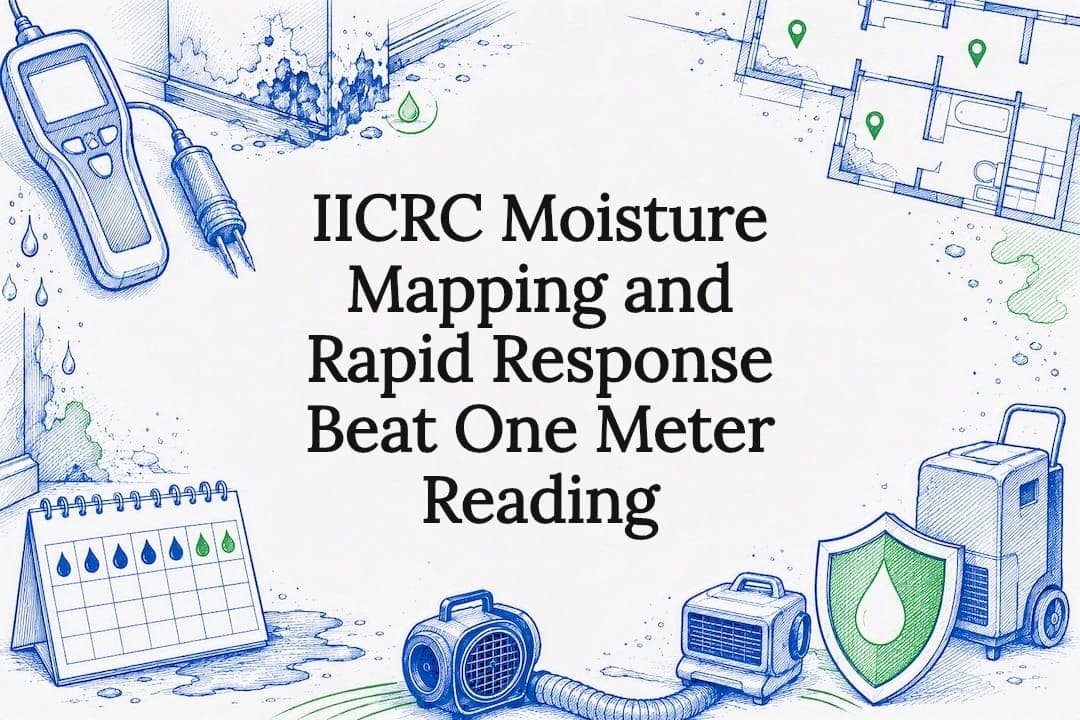
A moisture meter for walls, in a restoration context, is not a gadget you buy at a hardware store. It is one tool inside a documented moisture assessment that maps wet areas room by room, ties readings to photos and timestamps, and verifies drying against a written standard. If you have an active leak, wet spots in more than one room, an open insurance claim, or a musty smell you can't place, call a restoration professional rather than testing walls yourself.
TL;DR:
- Moisture maps include detailed, labeled readings with photos and timestamps to trace water movement and verify drying progress.
- Documentation must be continuous and verified, as insurance claims rely on timestamped records to avoid denial or reduction of coverage.
- A layered inspection process involves non-invasive scans, pin probes, thermal imaging, borescope checks, and baseline readings for accurate moisture assessment.
- Daily psychrometric logging and final verification readings are crucial to confirm the structure has reached the drying goal before removing equipment.
- Prompt response and proper documentation—certified technicians, moisture maps, and inspection reports—are essential to prevent mold growth and ensure effective drying.
Table of Contents
- What Does a Professional Moisture Map Include?
- Why Do Standards and Insurers Require Documented Readings?
- How Do Professionals Actually Measure Moisture in Walls?
- What Happens During a Professional Inspection Visit?
- What Should You Ask Before Hiring for a Moisture Assessment?
- How Pure Resto Approaches Moisture Mapping
- Get an Immediate Moisture Assessment From Pure Resto
- Sources
- FAQ
What Does a Professional Moisture Map Include?
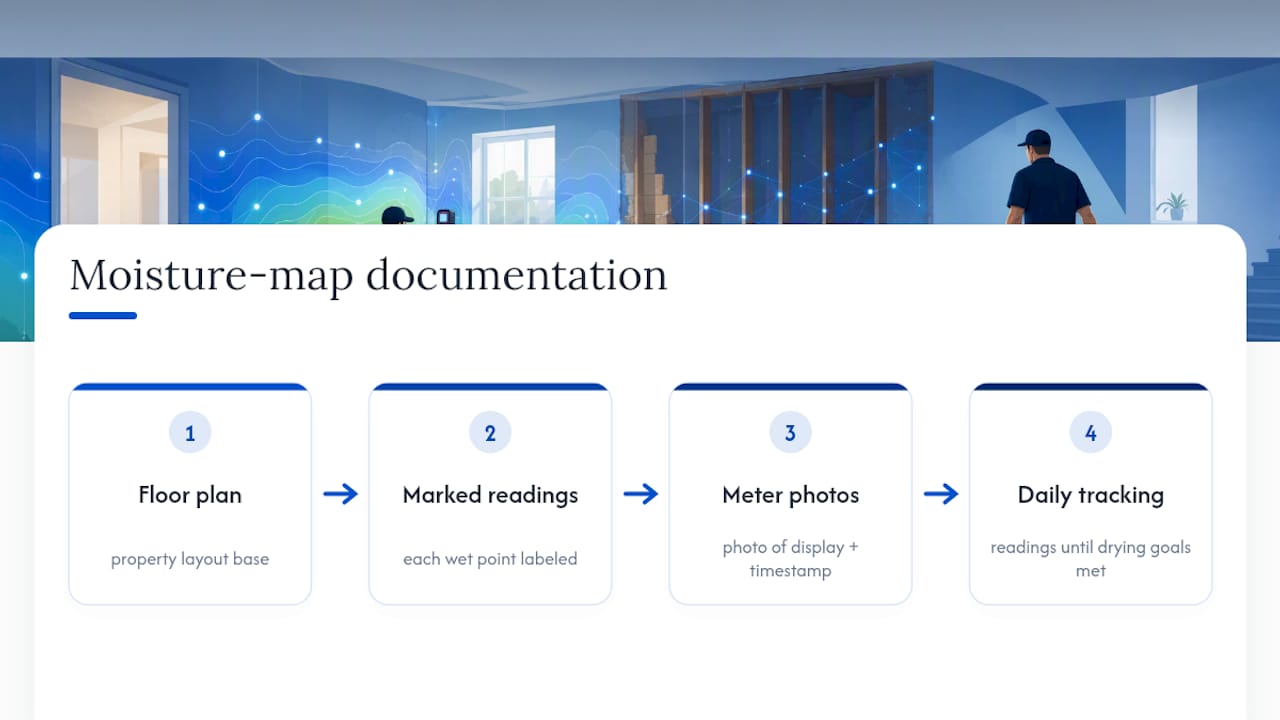
A moisture map is a floor plan of your property with every wet reading marked and labeled. Technicians walk each room, note which walls, baseboards, or ceiling panels tested wet, and record the exact reading at each point. That map does more than confirm water got in. It traces the path water traveled, showing whether a bathroom leak also reached a bedroom closet two rooms away or stayed contained to a single wall cavity.
Each marked point gets a photo of the meter display, a room label, and a timestamp, which turns a scattered set of numbers into a record an adjuster can follow line by line. That labeling matters because insurance job-scope protocols increasingly expect photographic proof tied to specific locations, not a technician's word that a wall "tested wet."
A single reading tells you a spot is damp today. A continuous record, taken daily until drying goals are met, tells you whether the structure is actually drying or just appears dry between visits. That distinction is why restoration companies build moisture maps instead of handing homeowners a single number.
Why Do Standards and Insurers Require Documented Readings?
The ANSI/IICRC S500 standard for professional water damage restoration requires a documented drying goal, a stated verification methodology, and a continuous chain of evidence from first inspection to final sign-off. Recent revisions to the standard push moisture maps and atmospheric readings from a nice-to-have into a core deliverable.
Insurance adjusters have followed that shift. Many now expect a timestamped history of moisture readings before they approve mitigation costs or release payment for equipment run time, and a technician's memory of "it felt dry" doesn't satisfy that bar.
Skipping documentation carries real costs:
- Claims can be reduced or denied when there's no continuous record connecting the initial reading to the final verification.
- Adjusters increasingly reject claims that lack a timestamped measurement history from notification through final drying.
- Wall cavities that look dry on the surface but stay damp inside can grow mold within 24 to 72 hours, and a missed cavity reading is often how that window gets missed. If you're not sure how fast that clock runs, this breakdown of the 24 to 48 hour mold window walks through what happens hour by hour.
How Do Professionals Actually Measure Moisture in Walls?
The workflow is layered, and each layer catches something the previous one might miss. Here's the typical sequence a technician follows on a wall assessment:
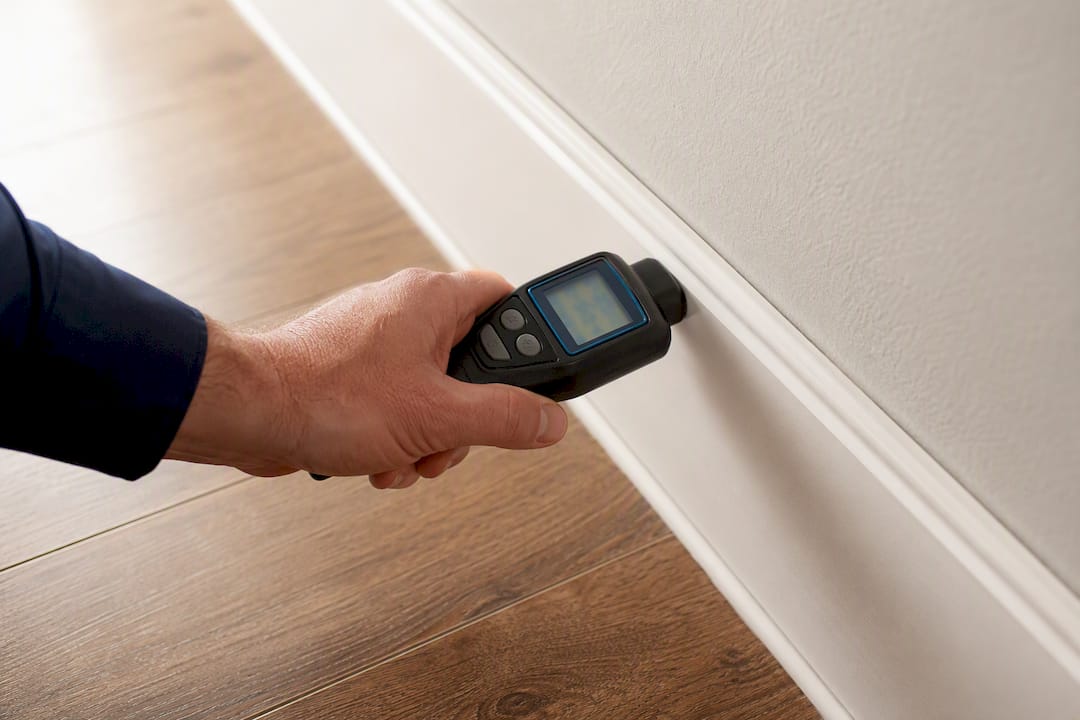
- Pinless scan first. A pinless meter is pressed flat against drywall or plaster to get a quick, non-invasive read across a wide area without leaving marks, which is how the affected zone gets mapped before anything is opened up.
- Pin verification at suspect points. Where the pinless scan flags elevated moisture, an insulated pin probe checks depth-specific readings, since pinless meters average a footprint through the material while pins confirm what's happening at a specific depth.
- Thermal imaging to narrow the search. An infrared camera picks up the cold spots that evaporation creates on a wet wall, which helps technicians decide exactly where to probe instead of guessing.
- Borescope or small openings when needed. If cavity saturation is suspected, a small hole or a borescope through a toe kick lets a technician see inside without tearing out a full wall section.
- Baseline dry-control readings. A reading from an unaffected room in the same structure establishes what "dry" looks like in that specific building, because without a baseline, an adjuster can argue an elevated reading was already there before the loss.
- Daily psychrometric logging. Technicians typically record five points per drying chamber each day: outside air, the affected area, an unaffected area, HVAC output, and dehumidifier exhaust, building the atmospheric record that shows drying progress over time.
Drywall readings are relative reference numbers, not an absolute percentage of water content, which is why the baseline step matters as much as the reading itself.
Pro Tip: Ask whether the technician photographs the meter display at each marked point with a visible timestamp. If the answer is vague, the report you eventually see may not hold up if the claim gets contested.
What Happens During a Professional Inspection Visit?
The first visit typically runs through a set sequence: a visual walkthrough of affected rooms, thermal imaging to spot hidden moisture, pinless scanning across walls and floors, pin verification at flagged points, and a borescope check if cavity saturation seems likely.
By the end of that visit, you should have a written record, not just a verbal summary. Expect these deliverables:
- A room-by-room moisture map with every reading location marked and labeled.
- Photographs of the meter display at each reading point, timestamped.
- Daily psychrometric logs from each drying chamber until the structure hits target.
- A written drying-goal statement defining what "dry" means for your specific structure.
- Final verification readings confirming the goal was met before equipment comes out.
Timelines vary by how much water intruded and what materials absorbed it, but most jobs move through an initial inspection, several days of daily monitoring, and a final verification visit once readings stabilize at baseline. Response speed matters here more than most homeowners realize. The gap between a leak happening and a technician arriving is often the gap between a contained drying job and one that spreads into cavities and adjacent rooms, which is part of why dehumidification timing and daily monitoring during the drying phase gets tracked so closely.
What Should You Ask Before Hiring for a Moisture Assessment?
Not every company that shows up with a meter is running an insurance-grade process. Before you sign anything, run through this checklist:
- Ask for IICRC certifications. A certified technician has trained on S500 procedures, not just how to press a meter against a wall.
- Request a sample moisture map. A legitimate provider can show you what a completed map and report look like before they start your job.
- Ask how psychrometric logging works. Daily readings across multiple points per chamber is the standard; a company that checks once and leaves isn't building a defensible record.
- Confirm calibration practices. Meters drift out of accuracy over time, and a company should be able to tell you how often theirs are checked.
- Ask about their intrusive inspection policy. If cavity saturation is suspected, will they open a toe kick or use a borescope, or do they stop at surface readings?
Red flags to walk away from: a single spot reading with no map, refusal to open a wall cavity when moisture patterns suggest hidden saturation, no written drying goal, and no documented chain of evidence from start to finish. If cavity moisture is part of the concern, understanding the S500 thresholds for cavity drying helps you judge whether a contractor's answer holds up.
How Pure Resto Approaches Moisture Mapping
We built our process around one idea: a moisture reading is only useful if someone can act on it later, whether that's a homeowner, an adjuster, or a technician returning the next day. Restoration providers who respond quickly to active losses help limit the gap between a pipe bursting and technician arrival, which can prevent a contained problem from turning into a cavity full of trapped water.
Professional inspections typically follow IICRC-aligned documentation: a room-by-room moisture map, timestamped meter photos, and daily psychrometric logs until a written drying goal is reached. Some providers handle direct insurance billing to simplify the process for homeowners.
— Pure
Get an Immediate Moisture Assessment From Pure Resto
If you're staring at a damp wall right now wondering whether it's serious, the honest answer is that you can't tell from a visual check alone. Expert restoration services can provide homeowners and property managers with a quicker path to an answer than waiting on a general contractor or doing DIY tests: a certified technician on-site quickly, a documented moisture map before any repair decisions are made, and assistance with insurance billing to help manage costs during claim processing.
On dispatch, we run a full moisture assessment: pinless and pin readings, thermal imaging, intrusive checks where cavity saturation looks likely, and daily logs until your structure verifies dry. If drying uncovers affected carpet or upholstery, our carpet cleaning and remediation service in Lanham handles it without bringing in a second contractor. Have your address, a rough timeline of when the water damage started, and your insurance policy number ready when you call. Reach out through Pure Resto's Maryland service line to get a technician scheduled.
Sources
This article draws on the ANSI/IICRC S500 standard for documentation and drying-goal requirements, the Anatomy of a Water Damage Inspection guide for psychrometric logging practices, and an industry guide to drywall moisture readings for pin versus pinless interpretation. For related reading, see how wall cavity drying thresholds work and what happens if you're weighing options for selling a water-damaged property instead of restoring it.
FAQ
What Is a Professional Moisture Map?
A moisture map is a room-by-room floor plan marking every wall or surface reading a technician took, labeled and photographed with a timestamp to build a defensible record for insurance review.
How Often Should Moisture Readings Be Taken During Drying?
Technicians typically log psychrometric readings daily, often five points per drying chamber, until the structure reaches its documented drying goal and verification readings confirm it.
Why Do Drywall Moisture Readings Vary Between Meters?
Drywall readings are relative reference values, not absolute percentages, so professionals pair pinless scanning with insulated pin verification and a baseline dry-control reading to interpret them accurately.
When Does a Wall Need to Be Opened for Inspection?
Intrusive inspection, like a small opening or borescope check, becomes necessary when surface readings and thermal imaging suggest moisture trapped inside a wall cavity that a surface meter can't confirm.
How Fast Should a Restoration Company Respond to a Leak?
Faster response limits how far water spreads before drying begins. Pure Resto aims to start assessment and mapping quickly across its Maryland service area to prevent secondary damage.