
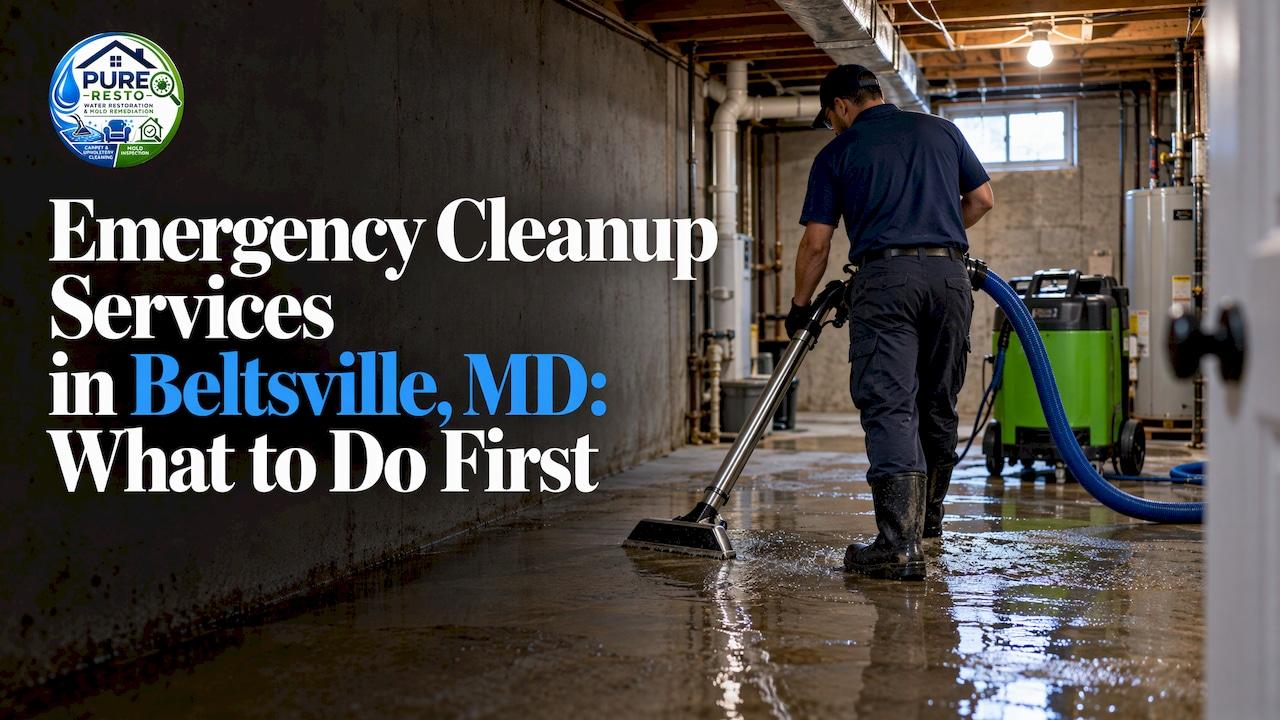
If water, smoke or mold has hit your Beltsville home or business, the fastest way to limit the damage is to call a certified crew that can be on site quickly, then protect yourself and document everything while it travels. Pure Resto is an IICRC-certified restoration company based in Bowie, MD, with 24/7 emergency response, and our crews typically arrive within 30 minutes. This guide covers what to do in the first hour, what professional cleanup involves, and how to hire and work with your insurer without costly mistakes.
TL;DR
- Stay out until it is safe, stop the source if you can do so safely, and photograph or video all damage before anything is moved.
- Time matters: the Maryland Attorney General warns that delay can lead to much more costly recovery, including mold damage.
- Call your insurance agent early, but you choose the restoration company, and you are the one who signs the contract.
- Ask any contractor for IICRC certification, licensing, insurance and a written scope of services before work starts.
- For Beltsville water, mold, fire or carpet emergencies, Pure Resto responds 24/7 and bills insurers directly.
Table of Contents
- The first hour: protect people, then property
- Why speed changes the bill
- What professional emergency cleanup involves
- Working with your insurance company
- How to choose an emergency cleanup company in Beltsville
- Homes, rentals and businesses
- Reducing further damage while you wait
- When to call us
- Our perspective
- FAQ
- Sources
The first hour: protect people, then property
Safety comes before cleanup. The Maryland Department of Insurance's post-disaster claims guide tells homeowners to wait until state or local authorities say it is safe to re-enter, to make essential repairs that prevent further damage (boarding a window, tarping a roof), to keep every receipt for those repairs, and to photograph or video damaged areas and belongings.
In practice, that means:
- Get everyone out of unsafe areas. If water is near outlets, appliances or a panel, or the structure looks compromised, stay out and leave the power off until it has been checked.
- Stop the source. A burst supply line, a failed water heater or a leaking appliance can often be isolated at the shutoff valve. Storm or sewer water cannot be stopped this way, so move on to the next step.
- Document before you move anything. Wide shots of each room, close-ups of damage, serial numbers on affected electronics. Your insurer will want this.
- Call a restoration crew. The sooner water is extracted, the less it travels into drywall, subfloors and insulation.
- Keep receipts. Emergency repair costs are generally part of what you give your insurer.
If you want a Beltsville-specific walk-through of the first two days, our guide to emergency water cleanup in Beltsville lays it out hour by hour.
Why speed changes the bill
The Maryland Attorney General's consumer guide on restoration companies states that response time is crucial and that any delay can lead to much more costly recovery, salvage and reconstruction, including mold damage. The CDC's cleanup guidance points the same way: dry the home within 24 to 48 hours if possible, air it out, and discard items that cannot be cleaned or dried quickly.
That 24 to 48 hour window is the reason we built our service around a 30-minute typical response. Extraction and drying equipment that starts running the same day stops moisture from settling into building materials.
What professional emergency cleanup involves
Emergency cleanup is not a mop and a few fans. Here is what each type of loss typically calls for, and what we bring.
Water damage and flooded basements
For a flooded basement, the Red Cross disaster cleanup guide says to pump water out gradually, about one-third per day, because removing it too quickly can let pressure from saturated soil collapse basement walls. It also notes that structural elements can take weeks or months to dry fully before drywall and carpet are replaced.
That is why a controlled process matters. Our water damage work relies on advanced extraction and drying equipment to stop further damage. Our guides on basement flood cleanup and basement flood safety go deeper on the steps. If your property is in Beltsville, start with our water damage restoration in Beltsville page.
A few safety points while you wait for the crew:
- Treat floodwater as contaminated. The CDC says floodwater can carry dangerous bacteria from sewage and industrial waste, and that eating or drinking contaminated items is what makes people sick. Wash open cuts and treat them with antibiotic ointment before exposure.
- Protect yourself in cold water. The CDC advises insulated clothing and frequent breaks when working in water cooler than 75°F.
- Throw out exposed food and medicine. The Red Cross says this includes sealed cans.
- Do not use flooded appliances. Have a professional check them first.
Mold inspection and remediation
Mold often follows water by a day or two, and it can also come from a slow leak you never saw. If you see or smell it after a leak, a mold inspection establishes where it is and how far it has spread, so the cleanup is scoped correctly. Our crews then handle mold remediation using HEPA filtration techniques to address the air-quality hazard that mold creates. Beltsville homeowners can see our mold remediation in Beltsville page.
If you are cleaning a small area yourself in the meantime, the CDC's guidance is to use 1 cup of household bleach per 1 gallon of water, never in a closed space, with goggles, an N-95 respirator and protective gloves. Larger or hidden growth, or any mold after sewage or floodwater, is a job for a certified crew.
Fire and smoke damage
Smoke and soot reach rooms the fire never touched. Our fire and smoke damage restoration in Beltsville service covers the cleanup, and odor removal addresses lingering smell. Furniture, clothing and keepsakes can be handled through contents cleaning, storage and packout, which keeps them out of the way while the structure is repaired.

Carpet and upholstery
Wet or heavily soiled carpet is a common emergency casualty. Montgomery County Fire & Rescue advises drying rugs and carpets thoroughly in warm, dry air with a fan, since moisture at the base of the tufts can cause rot, and suggests a qualified carpet-cleaning professional. We offer professional carpet cleaning and upholstery cleaning for emergency losses and for households whose carpets simply need a deep clean after years of use.
Working with your insurance company
Most emergency cleanups in Beltsville involve a claim, and Maryland has clear consumer guidance on how to handle it. The Attorney General's six-step process says to:
- Call your insurance agent first.
- Review your policy's cleanup responsibilities.
- Walk through the home with the restoration company and photograph the damage.
- Sign a contract listing all services before work begins.
- Request documentation showing drying progress.
- Understand that after you sign, you, not the insurer, are responsible for paying the restoration company.
Two more points from the Restoration Industry Association's homeowner tips: very few insurance policies require you to use an insurer-referred restoration company, and you should ask any contractor about relationships with insurers that could affect an independent damage evaluation.
One legal line is worth knowing. Under the Maryland advisory reflected in the NAIC template notice, contractors may estimate and discuss a loss and recommend filing a claim, but may not investigate, appraise, negotiate or prepare a claim for you unless licensed as a public adjuster by the state. We are fully licensed and insured and work directly with insurance providers to streamline the claims process, including direct billing.
If you manage a property and want to vet vendors on coverage, this contractor insurance checklist is a helpful companion to the questions below.
How to choose an emergency cleanup company in Beltsville
Beltsville has many companies answering 24/7 phone lines. Use the Maryland Attorney General's and the RIA's advice as your filter:
| Ask | Why it matters |
|---|---|
| Are you IICRC certified? | The Attorney General recommends asking. Our technicians are IICRC-certified. |
| Are you licensed and insured? | The RIA advises verifying both. We are fully licensed and insured. |
| How fast can you be here? | Delay raises cost. Our crews typically arrive within 30 minutes. |
| Will you bill my insurer directly? | It spares you from fronting the cost. We handle claims directly with insurance providers. |
| Is the scope in writing? | Sign a contract listing all services before work, and keep a copy. |
| Will you document drying progress? | The Attorney General says to request it. |
| What guarantee backs the work? | We offer a satisfaction guarantee and written workmanship standards. |
If the damage is serious enough that you are weighing a sale of the property, this overview of selling a water-damaged house explains the options, though most homeowners are better served by restoring first.
Homes, rentals and businesses
Homeowners can usually call us directly. Property managers responsible for tenants' safe living conditions and business owners facing downtime need the same speed, plus documentation for owners and insurers. We serve residential and commercial properties across Maryland, including Beltsville and nearby Greenbelt, College Park, Laurel, Hyattsville and Lanham.
Reducing further damage while you wait
The CDC's advice, in short: open doors and windows and run fans to air the home out, remove drywall and insulation contaminated with sewage or floodwater, discard what cannot be dried or cleaned quickly, and fix roof, wall or plumbing leaks promptly. For storm losses specifically, our storm damage cleanup guide for Maryland homeowners covers the extra steps. If water came through the roof, this piece on attic water damage repair explains what is involved above the ceiling.
When to call us
Call us for any of these in Beltsville: standing water or a wet basement, a leak that has soaked drywall or flooring, visible or suspected mold, smoke or soot after a fire, or carpet and upholstery that cannot be dried or cleaned on your own. Our water damage restoration team answers 24/7, and you can reach everything we do from purerestomd.com.
We pair extraction, drying and HEPA filtration with direct insurance billing, backed by a satisfaction guarantee, so you can focus on your family or your business instead of paperwork.
Our perspective
Most of what turns a bad day into an expensive one happens in the first 48 hours. Water that sits soaks into drywall and subfloors, and mold follows. That is why we built Pure Resto around 24/7 response and a typical arrival within 30 minutes.
We also believe cleanup should mean restoration, not a quick dry-out. Certified technicians, extraction and drying equipment, and HEPA filtration are how we try to prevent further damage and health hazards, and preventative measures are part of how we approach every job.
And we think the paperwork should not fall on you while your home is in disarray. That is why we work directly with insurance providers and put our workmanship standards in writing.
Pure
FAQ
How fast can an emergency cleanup crew get to Beltsville?
Our emergency crews typically arrive within 30 minutes, any time of day, because we operate 24/7. The Maryland Attorney General notes that response time is crucial, since delays can make recovery much more costly.
Should I call my insurance company or the restoration company first?
The Maryland Attorney General's guide says to call your insurance agent first. Then call a restoration company right away so water extraction is not delayed. We can work directly with your insurer to streamline the claim.
Do I have to use the company my insurer recommends?
Not usually. The Restoration Industry Association says very few policies require an insurer-referred restoration company, so you can choose a certified provider yourself. Check your own policy wording to be sure.
How long does water take to dry out?
The CDC advises drying a home within 24 to 48 hours if possible. The Red Cross notes that structural elements can take weeks or months to dry fully in serious floods, which is why professional drying and documentation matter.
Sources
- Maryland Department of Insurance: Post-Disaster Claims
- Maryland Attorney General: Consumer Guide on Restoration Companies
- CDC: Guidelines for Cleaning Safely After a Disaster
- American Red Cross: Disaster Cleanup and Repair
- Restoration Industry Association: Tips for Homeowners
- NAIC: Template notice to contractors