
RCV pays what it actually costs to replace your damaged property today, with no deduction for age or wear. ACV pays that same replacement cost minus depreciation, so an older item gets you less cash. For most primary homes and anyone with real furniture, electronics, or a finished basement, RCV is the safer bet, even though it usually costs more per year. ACV can make sense for a rarely-used vacation property or thin personal belongings where lower premiums matter more than a full rebuild.
TL;DR:
- Most homes benefit from RCV coverage because it pays full replacement costs without depreciation, especially for roofs, appliances, and furniture nearing end-of-life.
- ACV policies devalue items based on age and condition, often leaving homeowners with much less than their property's current market replacement value.
- RCV costs more annually but provides a stronger safety net, whereas ACV can be suitable for low-value contents or infrequently used vacation properties.
- Caps on replacement costs and extra limits for antiques or collectibles can reduce the effective payout under RCV policies, requiring careful policy review.
- To maximize coverage, homeowners should verify whether their policy uses ACV or RCV for different property components and consider upgrading to RCV where it offers significant benefits.
Table of Contents
- ACV vs. RCV Home Insurance: What ACV Actually Pays You
- ACV vs. RCV Home Insurance: How RCV Payouts Actually Work
- Comparing ACV and RCV Payouts on Real Losses
- Premiums, Deductibles, and Payout Timing You Need to Understand
- How to Check Whether Your Policy Uses ACV or RCV
- Should You Choose ACV or RCV? A Quick Checklist
- Why We Push Homeowners to Plan for Full Recovery, Not Just a Payout
- What to Do the Moment You Have a Covered Loss
- Sources
- FAQ
ACV vs. RCV Home Insurance: What ACV Actually Pays You
Actual Cash Value is replacement cost minus depreciation, and depreciation is calculated from an item's age, condition, and expected lifespan. Insurers typically assign a useful-life estimate to a category of property (a roof, a washing machine, a couch) and reduce the payout by however much of that lifespan has already passed.
Say your laptop, bought five years ago for $1,200, gets ruined in a flood. If insurers estimate a five-year useful life for laptops, that machine could be treated as fully depreciated, leaving you with little more than your deductible covered. A 20-year-old roof works the same way: if roofing has a 20-year expected life, the insurer may treat it as worth close to nothing, even though replacing it today costs full market price.
- ACV commonly applies to roofs, HVAC systems, carpeting, and appliances
- Some property types get ACV treatment even when the rest of your policy is written on RCV
- State insurance offices confirm this mixed treatment is standard, not a sign of a bad policy
Statistic: Depreciation schedules mean a properly maintained but decades-old roof can be valued at a small fraction of its replacement cost, according to state consumer guidance.
ACV vs. RCV Home Insurance: How RCV Payouts Actually Work
RCV pays to repair or replace damaged property with materials of like kind and quality at current market prices, with no deduction for age. That single difference is why RCV policies tend to leave homeowners in a far better financial position after a total loss.
RCV isn't one uniform product. Standard RCV pays up to your policy limit. Extended RCV adds a cushion above the limit to cover cost overruns after a widespread disaster drives up labor and materials. Guaranteed RCV goes further and covers the full rebuild cost regardless of your stated limit, though it's less common and usually requires an updated home valuation.
- Insurers typically pay ACV first, then release the depreciation holdback once you complete repairs
- You'll need receipts or contractor invoices to collect that second, supplemental check
- Some policies set a time window, often 180 days to two years, to submit proof of completed work
Comparing ACV and RCV Payouts on Real Losses
Numbers make the difference to a home, concrete. Here's what changes when the same loss runs through an ACV policy versus an RCV policy.
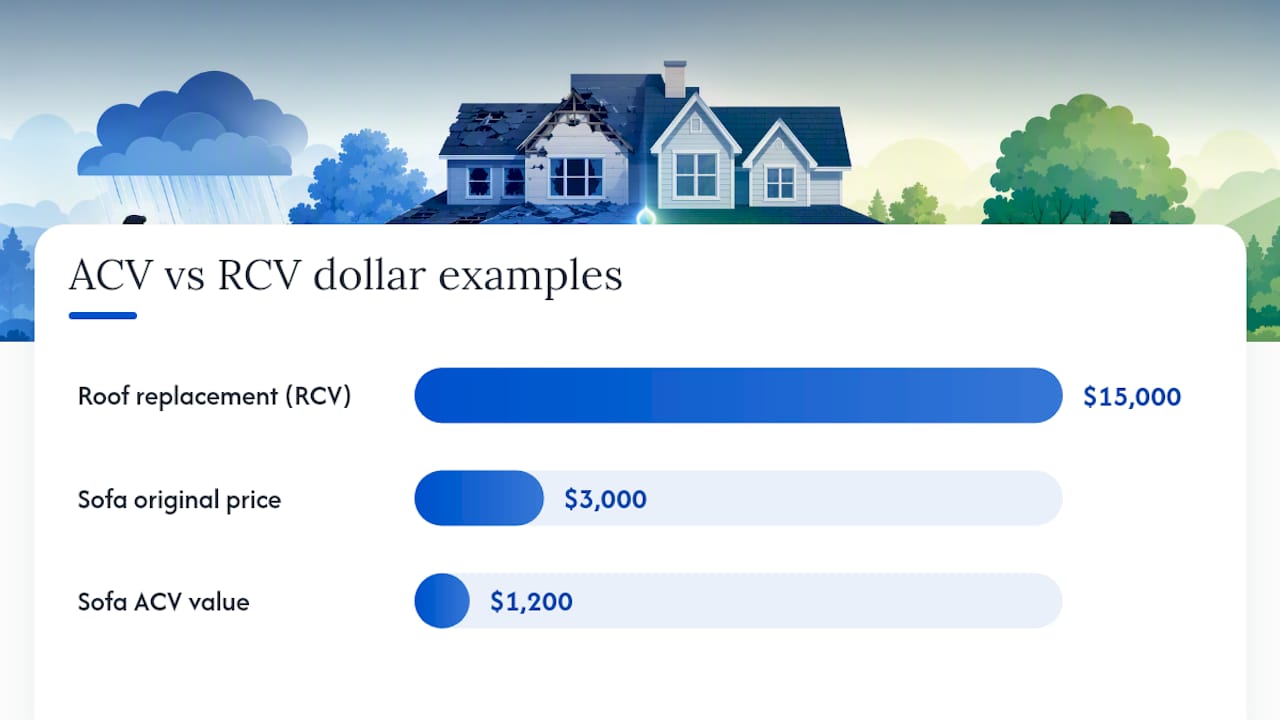
- The 20-year-old roof. Replacing it today costs $15,000. Under ACV, if the insurer treats the roof as fully depreciated, you might collect only a few thousand dollars after your deductible. Under RCV, you'd collect close to the full $15,000, minus the deductible.
- The living room set. A five-year-old sofa and TV combo originally worth $3,000 might be valued at $1,200 under ACV after depreciation. RCV pays what it actually costs to buy comparable replacements now, which is often more than the original price given inflation on furniture and electronics.
- The whole-house loss. A total fire or flood is where the gap compounds across every room. ACV policies stack depreciation on a roof, floors, cabinets, and every piece of furniture at once, while RCV rebuilds the house and replaces belongings at current cost, subject to your limits.
Watch for caps even on RCV policies: roofs are frequently excluded from full replacement cost and paid at ACV regardless of the rest of the policy, and antiques or collectibles often carry separate scheduled limits rather than standard RCV treatment, per state consumer offices.
Statistic: Consumer guidance from NerdWallet shows upgrading personal property coverage from ACV to RCV can raise premiums by anywhere from a few hundred to a couple thousand dollars a year, depending on your home's value and ZIP code.
Premiums, Deductibles, and Payout Timing You Need to Understand
RCV costs more because the insurer is promising to pay full replacement value instead of a depreciated figure, and that promise carries more risk on their end. The premium gap varies by carrier and region, but it's rarely proportional to how much more protection you actually get in a bad year.
Coinsurance clauses matter more than most homeowners realize. Many dwelling policies include an 80% rule: if you insure your home for less than 80% of its rebuild cost, the insurer can reduce your payout on a partial loss, even under RCV. Underinsuring to save on premiums can backfire the moment you file a claim.
- Deductibles apply the same way under both models, subtracted from whichever payout figure applies
- On ACV claims, a deductible eats into an already-reduced number, shrinking your check further
- On RCV claims, the deductible comes off a larger base, so the percentage impact feels smaller
Coinsurance shortfalls cost homeowners far more than a slightly higher deductible ever will.*
How to Check Whether Your Policy Uses ACV or RCV
- Pull your declarations page and look for the phrase "actual cash value" or "replacement cost" next to your dwelling and personal property sections. They're often listed separately, and it's common to have RCV on the dwelling but ACV on contents.
- Look for endorsement codes or riders labeled "extended replacement cost" or "guaranteed replacement cost." These add-ons rarely show up in the base declarations summary.
- Call your agent and ask directly: "Is my personal property settled at ACV or RCV, and does my roof have any ACV exclusion regardless of my dwelling coverage?"
- Ask what it costs to convert personal property from ACV to RCV, and whether an extended replacement cost endorsement is available on your dwelling coverage, per guidance from state insurance departments.
Should You Choose ACV or RCV? A Quick Checklist
Your answer depends less on general advice and more on your specific home and habits.
- How old is your home, and are major systems (roof, HVAC, plumbing) nearing the end of their expected life?
- How much would it cost to replace your furniture, electronics, and clothing at today's prices, not what you paid?
- Can your budget absorb a higher annual premium in exchange for a stronger safety net?
- Would a partial payout leave you unable to fully repair or rebuild after water or fire damage?
| Situation | Better fit |
|---|---|
| Primary residence, full-time occupied | RCV |
| Seasonal or rarely-used vacation home | ACV may be acceptable |
| High-value furniture, electronics, or renovations | RCV |
| Minimal contents, tight premium budget | ACV |
| Older roof or systems nearing end of life | RCV, if available for that component |
Why We Push Homeowners to Plan for Full Recovery, Not Just a Payout
We've walked into too many homes after a flood or fire where the insurance check didn't come close to covering the actual rebuild. That gap between what a policy pays and what recovery costs is where families get stuck for months. Faster, fully documented restoration work shortens that gap and keeps out-of-pocket costs down, which is exactly why our 30-minute emergency response and IICRC certification matter the moment a claim gets filed.
— Pure
What to Do the Moment You Have a Covered Loss
Whether your policy pays ACV or RCV, the clock starts the moment water hits your floor or smoke fills a room. Purerestomd is the team homeowners across Bowie, Crofton, Laurel, Glen Burnie, and the rest of Maryland call first, because slow mitigation turns a manageable claim into a bigger one.

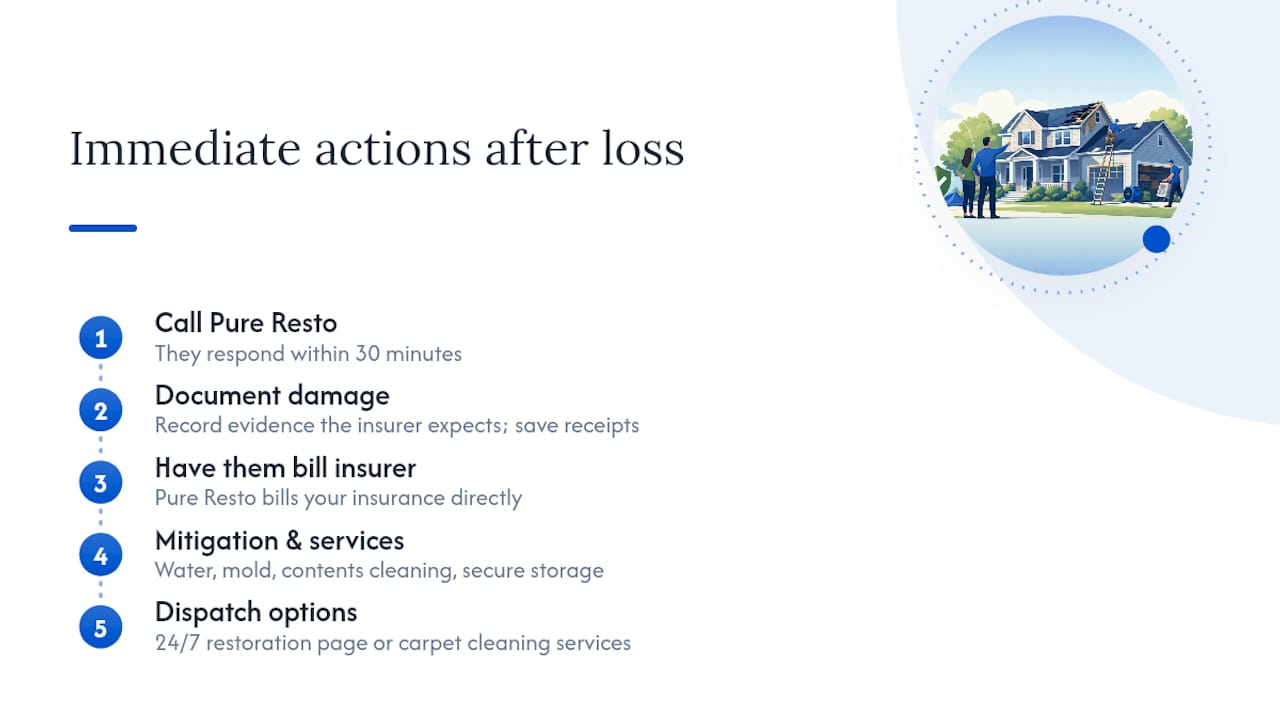
We show up within 30 minutes of your call, document the damage the way your insurer expects to see it, and bill your insurance company directly so you're not fronting restoration costs while a claim gets processed. That documentation matters just as much on an ACV policy, where every receipt you can produce helps push a supplemental RCV payment through faster, as on a straightforward RCV claim. Our IICRC-certified technicians handle emergency water damage restoration, mold remediation, and contents cleaning and secure storage, all under one roof, so you're not coordinating three different contractors during the worst week of the year.
If you're dealing with active water damage right now, visit Pure Resto's 24/7 restoration page to get a technician dispatched immediately, or check out our carpet and upholstery cleaning services in Pasadena, MD if your claim involves contents that survived the initial loss but need professional cleaning to avoid a total-loss write-off.
Sources
For official definitions and payout rules, the NAIC's consumer explainer on ACV versus RCV is the clearest starting point, alongside its homeowners insurance shopping tool. Because coinsurance rules, caps, and endorsement availability vary by state, confirm the specifics with your own state insurance department before you make a coverage decision.
- What’s the difference between actual cash value coverage and replacement cost coverage? | NAIC
- ACV vs RCV - Office of Public Insurance Counsel (OPIC)
- Actual cash value vs. replacement cost | NerdWallet
FAQ
Is it better to have ACV or RCV?
RCV is better for most primary homes because it pays full replacement cost without depreciation, though ACV can work for low-value contents or rarely-used properties where lower premiums matter more.
How can I tell if my homeowners policy is ACV or RCV?
Check your declarations page for the terms "actual cash value" or "replacement cost" listed next to your dwelling and personal property coverage, then confirm with your agent since the two sections are often settled differently.
What is the actual cash value of a 20-year-old roof?
It depends on the roofing material's assigned useful life, but a roof near or past that expected lifespan can be valued at a small fraction of its full replacement cost under an ACV settlement.
What's better, RCV or ACV insurance?
RCV generally offers stronger financial protection because it replaces damaged property at current prices, while ACV trades that protection for a lower premium and higher out-of-pocket risk after a claim.