

Water damage restoration costs between $450 and $16,000 nationally, with most homeowners landing near the $3,867 national average — and the single factor that moves a job from the low end to the high end is the category of water involved. Clean water from a burst pipe is a fundamentally different job than sewage backup, and contractors price them accordingly.
Mitigation alone typically runs $3–$7.50 per square foot. A small clean-water loss in a bathroom might total around $1,000. A contaminated basement flood with structural damage can push past $10,000 before repairs even begin.
What a typical restoration bill includes:
- Mitigation: Water extraction, industrial drying, moisture mapping, and containment
- Demolition: Removal of saturated drywall, flooring, insulation, or cabinetry that cannot be dried in place
- Mold prevention/remediation: Antimicrobial treatment, air scrubbing, and testing when mold is present
- Repair/build-back: Replacing drywall, flooring, trim, and any structural elements removed during demo
- Contents handling: Pack-out, cleaning, and secure storage of furniture and personal property
Mitigation and repair are two separate line items. Many homeowners receive a mitigation-only bid first and mistake it for the total project cost.
Key Takeaways
Water damage restoration costs range from $450 to $16,000 nationally, with the water category, response speed, and square footage determining where your job lands in that range.
| Point | Details |
|---|---|
| National cost range | Most jobs fall between $450 and $16,000; the national average is about $3,867. |
| Biggest cost driver | Water category (clean/gray/black) determines PPE, demo depth, and per-sq-ft price. |
| Response window | Acting within 24–48 hours prevents mold and can save thousands in remediation costs. |
| Insurance action | Document before touching anything; use an IICRC-certified contractor for insurer-accepted moisture logs. |
| Purerestomd | 24/7 IICRC-certified emergency response in Maryland with direct insurance billing and 30-minute arrival. |
Table of Contents
- What does water damage restoration cost at a glance?
- How does water type change the cost of cleanup?
- How do per-square-foot rates and severity classes affect your quote?
- What do repairs typically cost by room and repair type?
- What factors change your final restoration bill?
- How does homeowners insurance handle water damage claims?
- How do you get an accurate estimate and choose the right contractor?
- What does a typical restoration timeline look like?
- Why credentials and response speed reduce your total cost
- The one thing you should do in the first 30 minutes
- Purerestomd responds in 30 minutes, day or night, across Maryland
- Sources
- FAQ
What does water damage restoration cost at a glance?
The table below covers the three main cost tiers contractors use when scoping a job. Regional labor rates and material costs shift these figures, so a quote in rural Maryland will differ from one in a high-cost metro area. Always get local estimates before budgeting.
Sources: Bob Vila, Angi, Palm Build
Why the two-phase split matters: Mitigation stops the damage. Repair restores the home. A contractor who quotes only mitigation is not quoting you a finished house. Ask every bidder to specify which phases their number covers.
Regional variance is real. Labor costs in the Mid-Atlantic and Northeast run higher than national averages, while rural markets in the South and Midwest tend to come in lower. Material costs for hardwood flooring, tile, and specialty drywall also vary by region and current supply conditions.
How does water type change the cost of cleanup?
Water category is the dominant cost driver in restoration pricing. The IICRC S500 standard classifies water into three categories based on contamination level, and each one requires a different scope of work, safety protocol, and price.
Category 1: Clean water
Sources include burst supply lines, overflowing sinks, and appliance malfunctions with no contamination. This is the least expensive scenario because no biocide treatment or special PPE is required for most of the work.
- Typical per-sq-ft mitigation range: $3–$4
- Example total: $1,000–$4,000 for a mid-size loss
- Drying time: 3–5 days with proper equipment
- Risk: Clean water degrades to gray water within 24–48 hours if untreated
Category 2: Gray water
Gray water comes from washing machines, dishwashers, toilet overflow (without feces), and HVAC condensate. It carries biological and chemical contaminants that require protective equipment and antimicrobial treatment.
- Typical per-sq-ft mitigation range: $4–$6.50
- Example total: $2,500–$7,500 for a mid-size loss
- Additional steps: Biocide application, enhanced PPE, more aggressive demo of porous materials
- Risk: Degrades to black water quickly; delay raises both cost and health risk
Category 3: Black water
Sewage backups, floodwater from rivers or storm drains, and any water that has sat long enough to grow pathogens fall into Category 3. This is the most expensive and most hazardous scenario.
- Typical per-sq-ft mitigation range: $6–$7.50+
- Example total: $3,000–$16,000+ depending on size and structural involvement
- Additional steps: Full hazmat-level PPE, complete demo of all porous materials (drywall, insulation, carpet), biocide treatment, air scrubbing, post-remediation testing
- Risk: Serious health hazard; DIY cleanup is not appropriate
Safety callout: The EPA recommends that homeowners avoid entering spaces with standing floodwater or sewage backup without proper protective equipment. For Category 2 and Category 3 losses, call a licensed restoration contractor before attempting any cleanup. The health risks from pathogens and airborne contaminants are not worth the cost savings.
How do per-square-foot rates and severity classes affect your quote?
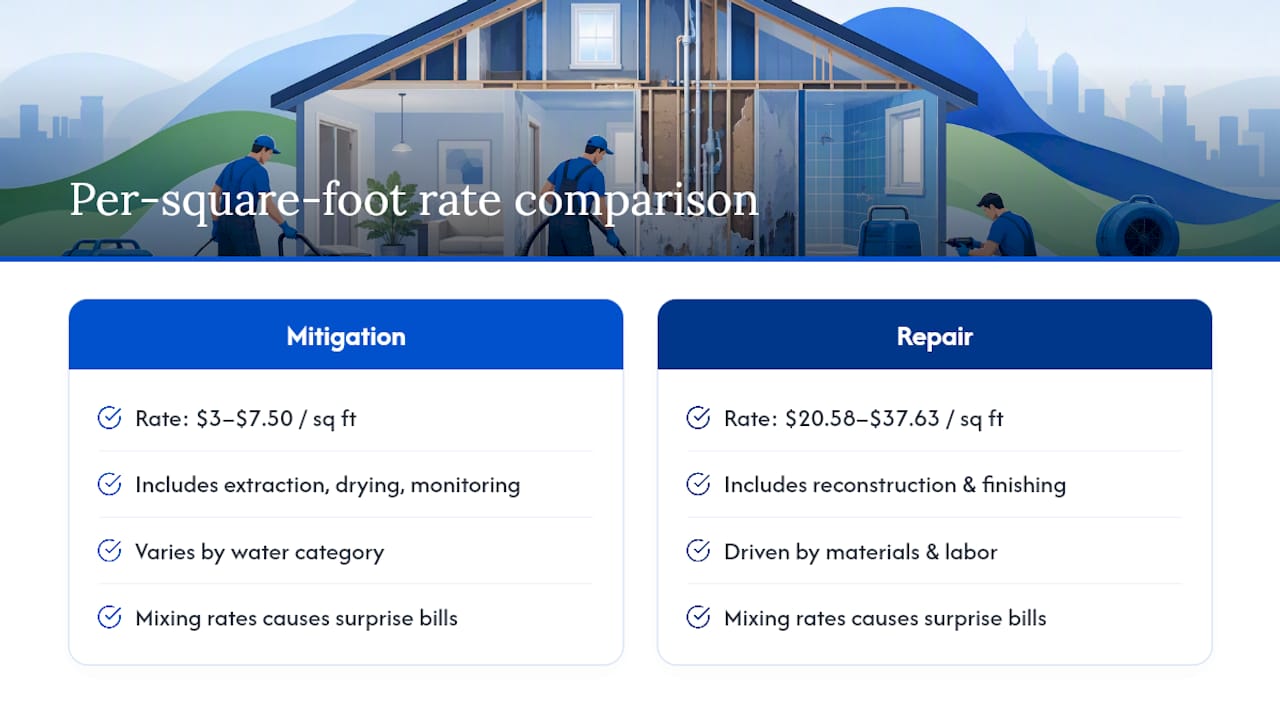
Restoration contractors price jobs using two separate per-square-foot rates: one for mitigation and one for repair. Mixing them up is one of the most common reasons homeowners feel blind sided by a final bill.
Mitigation rates cover extraction, drying equipment, monitoring, and containment: typically $3–$7.50 per square foot depending on water category. Repair/build-back rates cover the physical reconstruction after demo: HomeWyse's 2026 calculator puts mid-range repair work at $20.58–$37.63 per square foot, which reflects the cost of materials, labor, and finishing.
Restoration classes I–IV
The IICRC also classifies jobs by severity, which directly affects drying time and equipment costs:
- Class I: Minimal absorption, small area. Drying time: 1–3 days. Lowest cost.
- Class II: Entire room affected, water wicked into walls. Drying time: 3–5 days. Moderate cost.
- Class III: Ceilings, walls, and floors saturated. Drying time: 5–10 days. High cost.
- Class IV: Specialty drying required for concrete, hardwood, or plaster. Drying time: varies significantly. Highest cost.
Example calculations
500-sq-ft mitigation-only job (Category 1, Class II): 500 sq ft × $4.50/sq ft = $2,250 for mitigation
500-sq-ft full restoration job (Category 2, Class III): 500 sq ft × $6/sq ft = $3,000 mitigation + 500 sq ft × $28/sq ft = $14,000 repair = $17,000 total
That gap between a simple dry-out and a full rebuild is why getting a scope-of-work breakdown in writing matters before signing anything.
Hidden costs contractors may add: Contents pack-out and storage, deodorization, disposal fees for demolished materials, specialty equipment surcharges for Class IV drying, and post-remediation air quality testing. Ask for these as line items, not bundled into a lump sum.
Thermal imaging cameras and industrial dehumidifiers are standard tools for professional restoration, and their use reduces the risk of hidden moisture pockets that cause mold weeks after a job closes.
What do repairs typically cost by room and repair type?
Room location and the type of repair drive costs as much as square footage does. A basement flood is a different financial event than a bathroom leak, even at the same size.
By room:
- Basement: $500–$10,000+. The widest range of any room because basements flood from multiple sources (sump failure, foundation seepage, sewage backup) and often involve finished walls, HVAC equipment, and electrical panels.
- Bathroom: $1,000–$4,500. Typically involves subfloor damage, tile removal, and vanity or fixture replacement.
- Kitchen: $1,500–$6,000. Appliance leaks and dishwasher failures can saturate cabinets and subfloor; cabinet replacement alone adds $2,000–$5,000.
- Living area/bedroom: $1,000–$5,000. Flooring and drywall are the primary costs; structural damage is less common unless the source is above (roof or upstairs plumbing).
- Roof/ceiling: $800–$4,500. Roof leaks cause ceiling staining, insulation saturation, and drywall replacement; structural sheathing damage raises the upper end.
- HVAC/ductwork: $500–$3,000. Ducts that flood or accumulate moisture require cleaning, antimicrobial treatment, and sometimes replacement.
By repair type:
- Drywall replacement: $300–$1,500 per room depending on extent
- Hardwood floor replacement: $6–$12 per sq ft installed
- Carpet replacement: $3–$7 per sq ft installed
- Tile replacement: $7–$15 per sq ft installed
- Plumbing repairs: $150–$2,000 depending on pipe access and scope
- Sump pump replacement: $500–$1,500 installed
- Appliance repair/replacement: $200–$2,000+ depending on the unit
Mold remediation adds $1,500–$6,000 on average when drying is delayed or contamination is confirmed. According to the EPA, mold can begin growing on damp materials within 24–48 hours, which is why the 24–48-hour response window matters so much financially. A job that requires mold remediation on top of standard restoration can easily double the total bill.
Scenario examples:
- 1-inch basement flood from a burst pipe (clean water, 400 sq ft): Mitigation $1,200–$2,000, drywall and flooring repair $2,000–$4,000. Total: $3,200–$6,000.
- Sewage backup in a finished basement (200 sq ft): Full demo, biocide treatment, and rebuild can reach $8,000–$14,000 given Category 3 protocols.
What factors change your final restoration bill?
Most of the variance between a $1,500 job and a $12,000 job comes down to eight variables. Understanding them helps you read a contractor's line items and anticipate where costs might grow.
- Water category: As covered above, the single largest driver. Black water jobs cost two to three times more than clean water jobs of the same size.
- Square footage affected: More area means more equipment, more labor hours, and more materials. Costs scale roughly linearly until structural damage enters the picture.
- Structural damage: Saturated framing, compromised foundations, or damaged load-bearing walls require engineering assessments and specialized labor.
- Time to response: Every hour of delay allows water to migrate further and absorption to deepen. Palm Build's 2026 data confirms that acting within 24–48 hours often prevents mold and substantially reduces total cost.
- Materials involved: Hardwood floors, plaster walls, and custom cabinetry cost far more to replace than standard drywall and vinyl flooring.
- Mold presence: Confirmed mold requires remediation protocols, air testing, and clearance sampling on top of standard restoration.
- Contents: Furniture, electronics, and personal property that need pack-out, cleaning, and storage add $500–$3,000 or more.
- HVAC and ductwork: Flooded ducts require cleaning and treatment; contaminated systems can spread pathogens throughout the home.
- Disposal fees: Demolished materials must be hauled and disposed of; fees vary by volume and material type.
- Permits: Structural repairs, electrical work, and plumbing replacements often require permits. Permit costs vary by municipality but typically run $100–$500 per trade.
Pro Tip: Stop the water source immediately, document everything with photos and video before touching anything, and call a licensed restoration contractor within 24 hours. Those three actions alone can reduce your total bill by thousands by preventing secondary damage and strengthening your insurance claim.
Local code requirements can also add cost. Some jurisdictions require licensed electricians to inspect and certify any wiring that was submerged before a home can be reoccupied. Ask your contractor which permits apply to your specific loss before work begins.
How does homeowners insurance handle water damage claims?
Most standard homeowners policies cover sudden and accidental water damage, such as a burst pipe or appliance failure. What they typically exclude: gradual leaks, maintenance failures, and flood damage from external water sources. Flood damage requires a separate National Flood Insurance Program (NFIP) policy or private flood coverage.
The distinction between "flood" and "water damage" matters enormously for claims. A pipe that bursts and floods your basement is a covered water damage event under most HO-3 policies. A river that overflows and floods your basement is a flood event and requires separate flood insurance.
Claims checklist:
- Stop the water source if it is safe to do so (shut off the main supply valve or call a plumber).
- Document all damage with photos and video before moving or removing anything.
- Call your insurance company to open a claim and get a claim number.
- Begin mitigation immediately. Policies require you to take reasonable steps to prevent further damage; delaying mitigation can give an insurer grounds to deny secondary damage.
- Hire a licensed, IICRC-certified contractor for mitigation. Get a written scope of work and daily moisture logs.
- Collect at least two written estimates for repair/build-back work.
- Keep all receipts for emergency expenses (hotel, meals if displaced) as these may be covered under Additional Living Expenses (ALE).
- Submit documentation to your adjuster: photos, contractor estimates, moisture reports, and receipts.
On deductibles: Your water damage deductible is the amount you pay out of pocket before insurance covers the rest. Most homeowners policies carry deductibles of $500–$2,500 for standard water damage claims, though some policies use percentage-based deductibles tied to the home's insured value. Confirm your deductible before filing; for small losses near or below the deductible, paying out of pocket may be smarter than filing a claim that raises your premium.
Direct billing: Many licensed restoration contractors bill insurers directly, which removes the homeowner from the payment loop and speeds the process. Ask any contractor you consider whether they handle direct insurance billing and whether they have experience working with your specific carrier.
IICRC-certified contractors and thorough moisture documentation reduce insurer disputes and speed claim approvals, per Bob Vila's cost analysis. An adjuster who receives a moisture map, daily drying logs, and a certified contractor's scope of work has everything needed to approve a claim quickly.
Common exclusions to watch for:
- Gradual leaks or seepage (a slow drip behind a wall for months)
- Mold resulting from a pre-existing condition
- Sewer backup (often requires a separate endorsement)
- Flood from external water sources
How do you get an accurate estimate and choose the right contractor?
Get at least three written estimates before committing to any contractor. Make sure every bid covers the same phases and line items before comparing numbers.
Checklist to give every contractor:
- Written scope of work specifying mitigation, demo, and repair phases separately
- Equipment list (number and type of dehumidifiers, air movers, air scrubbers)
- Drying plan with target moisture levels and monitoring schedule
- Moisture mapping methodology (thermal imaging, pin meters, hygrometers)
- Demo protocol: what gets removed, what stays, and why
- Contents handling plan: what is packed out, where it is stored, and how it is protected
- Warranty or guarantee on workmanship
- Timeline with start date and estimated completion
Questions to ask every contractor:
- Are you licensed in this state and insured for general liability and workers' compensation?
- Do you hold IICRC certification (WRT, ASD, or AMRT)?
- Do you handle direct insurance billing, and have you worked with my carrier before?
- What is your emergency response time, and do you operate 24/7?
- What moisture readings do you use to confirm a structure is dry, and will you provide written documentation?
- What is your estimated timeline from mitigation start to project completion?
- Can you provide references from jobs of similar size and water category?
Red flags:
- Door-to-door solicitation immediately after a storm or disaster (storm chasers)
- No moisture readings or drying logs offered
- Pressure to sign a contract immediately before you can review it
- Lump-sum bids with no line-item breakdown
- No IICRC certification or proof of insurance
- Asking you to sign over insurance benefits before work begins (Assignment of Benefits fraud)
Thermal imaging and industrial-grade drying equipment are not optional extras — they are how professionals find moisture that a visual inspection misses. A contractor who skips moisture mapping is leaving you exposed to mold claims months after the job closes.
Pro Tip: Ask for a copy of the moisture map and daily drying logs at the end of the job. These documents prove the structure was dried to IICRC standards and are your best protection if mold appears later.
For detailed guidance on what a thorough flood inspection and damage report should include, La Rocks Renovations' flood inspection guide is a useful reference for understanding what documentation professionals produce.
What does a typical restoration timeline look like?
Restoration is not a single event. It is a sequence of phases, and each phase has to be completed before the next can begin. Homeowners who understand the timeline can plan temporary housing, work schedules, and insurance documentation more effectively.
-
Emergency mitigation (Day 1): Water extraction, initial drying equipment placement, containment of affected areas, and moisture baseline readings. This phase begins within hours of the call for a qualified contractor. Duration: 4–12 hours on-site.
-
Active drying and monitoring (Days 1–5+): Industrial dehumidifiers and air movers run continuously. A technician returns daily or every other day to take moisture readings and adjust equipment. Duration: 3–5 days for Class I–II losses; 7–10 days for Class III–IV losses.
-
Demo and removal (Days 2–5): Saturated materials that cannot be dried in place (drywall, insulation, carpet, cabinetry) are removed. For Category 3 losses, all porous materials in the affected area are removed. Duration: 1–3 days depending on scope.
-
Mold remediation (if required, Days 3–10): If mold is confirmed or the drying delay exceeded 48 hours, remediation runs concurrently with or immediately after demo. Air scrubbers run during this phase. Duration: 2–5 days for contained mold; longer for widespread growth.
-
Repair/build-back (Days 7–30+): Once the structure passes moisture clearance testing, reconstruction begins. Drywall, flooring, painting, trim, and fixture reinstallation happen in sequence. Duration: 1–3 weeks for a mid-size loss; 4–8 weeks for large structural repairs.
-
Final verification (End of project): Post-remediation air quality testing, final moisture readings, and a walkthrough with the homeowner and adjuster. This step produces the documentation needed to close the insurance claim.
Timeline by loss size:
- Small loss (1 room, clean water): 1–2 weeks total
- Medium loss (multiple rooms, gray water): 3–5 weeks total
- Large loss (whole-floor or structural, black water): 6–12 weeks total
Factors that extend timelines include high ambient humidity (common in Maryland summers), black water contamination requiring full demo, confirmed mold requiring clearance testing, structural repairs requiring permits and inspections, and material lead times for specialty flooring or custom cabinetry. For a deeper look at what basement demolition and rebuild after significant flooding actually involves, La Rocks Renovations' basement flood repair guide walks through the scope of heavy demo jobs.
Why credentials and response speed reduce your total cost
The contractor you call in the first hour shapes the entire financial outcome of a water damage event. Credentials, equipment, and response time are not marketing language. They are the variables that determine whether a $3,000 mitigation job stays at $3,000 or grows into a $10,000 mold remediation.
What to look for in a restoration contractor:
- IICRC certification: The Institute of Inspection, Cleaning and Restoration Certification sets the industry standard for training and methodology. Look for WRT (Water Restoration Technician), ASD (Applied Structural Drying), and AMRT (Applied Microbial Remediation Technician) credentials. Insurers prefer IICRC-certified contractors because their documentation reduces disputes.
- 24/7 emergency availability: Water damage does not wait for business hours. A contractor who cannot respond at 2 AM on a Sunday is not a viable emergency option.
- 30-minute response time: The faster extraction begins, the less water migrates into walls, subfloors, and structural cavities. Every additional hour of saturation raises the probability of mold and increases the scope of demo.
- Direct insurance billing: Contractors who bill insurers directly remove the homeowner from the payment loop and reduce the administrative burden during an already stressful event.
- Contents handling and secure storage: A full-service provider packs out, cleans, and stores furniture and personal property, protecting it during the reconstruction phase.
Purerestomd's 24/7 emergency restoration services cover water damage mitigation, mold inspection and remediation, contents handling, and secure storage for both residential and commercial properties in Maryland.
The one thing you should do in the first 30 minutes
Stop the source. That is it. Before you call your insurer, before you move furniture, before you take a single photo: find the shutoff and stop the water.
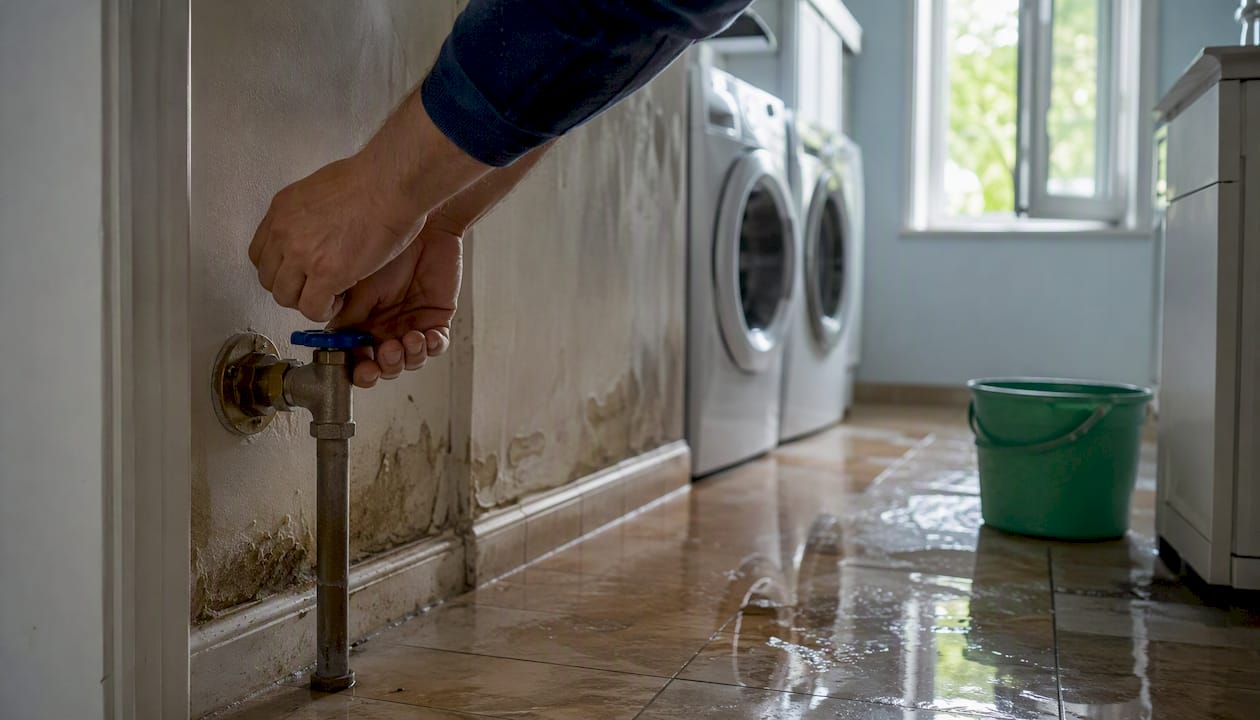
Every minute a supply line runs unchecked, water migrates further into walls, under floors, and into cavities that take days to dry. A job that could have been a $2,000 mitigation becomes a $6,000 full-demo project because the source ran for four hours before anyone noticed. Mold risk climbs sharply after 48 hours, and mold remediation adds thousands to a bill that was already painful.
Once the source is stopped, document everything with your phone before touching anything else. Then call a licensed restoration contractor. The sequence matters: stop, document, call. Getting that order right is the difference between a manageable claim and a months-long ordeal.
Purerestomd responds in 30 minutes, day or night, across Maryland
When water damage hits, the clock starts immediately. Purerestomd gives Maryland homeowners and property managers a 30-minute emergency response, 24 hours a day, 7 days a week. That speed is not a tagline. It is the margin between a contained mitigation job and a full mold remediation.
Purerestomd's IICRC-certified technicians handle the complete scope: water extraction, industrial drying, moisture mapping, mold inspection and mold remediation in Adelphi and across Maryland, contents pack-out and secure storage, and direct insurance billing. You get one point of contact from the first call through the final clearance test. No chasing contractors. No assembling documentation for your adjuster after the fact.
To get an emergency response or schedule a mold inspection, contact Purerestomd now. Service covers residential and commercial properties throughout Maryland.
Sources
The cost ranges and safety guidance in this article draw from national cost aggregators, EPA regulatory guidance, and the IICRC S500 standard. Figures represent 2026 national averages and per-square-foot benchmarks synthesized across mitigation-only and full-restoration scopes.
- How Much Does Water Damage Restoration Cost? 2026 Data | Angi
- EPA: Flood cleanup and indoor air quality resources
- How Much Does Water Damage Restoration Cost? - Bob Vila
- Cost to Repair Water Damage - 2026 Cost Calculator (Customizable)
FAQ
What is the average cost for water damage restoration?
The national average is approximately $3,867, with most jobs ranging from $450 to $16,000 depending on water category, square footage, and whether mold remediation is required.
Why is water damage restoration so expensive?
The cost reflects two separate phases: mitigation (extraction, drying, moisture monitoring) and repair (demo, reconstruction, finishing). Category 2 and Category 3 water losses add biocide treatment, full demo of porous materials, and specialized PPE, which push costs significantly higher than a simple clean-water dry-out.
How much does it cost per square foot to repair a water-damaged floor?
Mitigation runs $3–$7.50 per square foot; repair and build-back for mid-range work runs approximately $20.58–$37.63 per square foot, per HomeWyse's 2026 benchmarks. Flooring material (hardwood vs. carpet vs. tile) is the primary variable within that repair range.
Is it worth buying a house with water damage?
It can be, provided you get a full professional inspection, confirmed moisture readings, and a written remediation scope before closing. Unresolved water damage leads to mold, structural deterioration, and costly repairs. Factor the full restoration estimate into your offer price and confirm the source has been permanently fixed.
Does homeowners insurance cover water damage restoration costs?
Most standard HO-3 policies cover sudden and accidental water damage (burst pipes, appliance failures) but exclude gradual leaks, maintenance failures, and flood damage from external sources. Flood damage requires a separate NFIP or private flood policy. Your water damage deductible applies before coverage kicks in, typically $500–$2,500 for most policies.