

Most water damage denials come down to one of two things: the insurer decided your loss was gradual instead of sudden, or you're missing the documentation to prove otherwise. Either way, your first 72 hours matter more than anything else in the process.
Do this now, before anything else:
- Get the denial in writing if you only received a phone call, and ask the adjuster to cite the exact policy provision.
- Photograph and preserve every piece of damaged material, including the failed pipe, hose, or fitting.
- Pull together every mitigation receipt, contractor invoice, and dated photo you already have.
The sections below walk through why insurers deny these claims, what evidence actually reverses a denial, and when to bring in a public adjuster, an attorney, or your state's insurance regulator.
Key Takeaways
Overturning a water damage denial almost always comes down to replacing the insurer's assumption about timing with dated, professional evidence that shows the loss was sudden or properly mitigated.
| Point | Details |
|---|---|
| Read the denial letter first | Identify the exact exclusion or policy provision cited before you respond. |
| Preserve failed materials | Never discard damaged parts or drywall until they're photographed and documented. |
| Get a written cause-of-failure report | A signed plumber or contractor letter carries far more weight than a verbal explanation. |
| Escalate strategically | Use a public adjuster for scope disputes, an attorney for coverage denials, and your state DOI for bad-faith concerns. |
| Call in professional mitigation fast | Purerestomd provides IICRC-aligned moisture mapping and mitigation reports that document your loss the same day it happens. |
Authoritative resources to consult next
Before you appeal, download your complete policy and every endorsement. Then check these official resources: FEMA's flood insurance program, Floodsmart for flood risk tools, EPA mold guidance, the Insurance Information Institute for coverage norms, and your own state's Department of Insurance for complaint procedures.
This article is general information, not a substitute for advice from a qualified lawyer. Consult a qualified legal professional about your own circumstances before acting on anything here.
Table of Contents
- Why Was My Water Damage Claim Denied?
- What Are the Most Common Reasons Insurers Deny Water Claims?
- What Evidence Overturns a Water Damage Denial?
- How Do You Appeal a Denied Water Damage Claim?
- How Long Does the Appeal Process Take?
- How Can Homeowners Reduce the Risk of Future Denials?
- Can Mold Alone Prove My Claim Was Long-Term?
- How Pure Resto Supports a Denied or Disputed Claim
- Sources
- FAQ
Why Was My Water Damage Claim Denied?
Insurance adjusters draw a hard line between "sudden and accidental" water damage and "gradual or maintenance-related" damage, and that single distinction decides more claims than any other factor. A burst pipe that floods your basement in an afternoon is sudden. A slow drip behind a wall that's been soaking your subfloor for eight months is gradual, and gradual damage sits outside coverage on nearly every standard homeowners policy.
The frustrating part is that two losses can look identical by the time you notice them, yet get classified completely differently. A supply line that ruptures overnight typically gets covered. The same line, if it had been visibly weeping for months before it let go, often gets denied as a maintenance failure. A sewer backup during a storm might be covered only if you purchased a specific endorsement; without it, the same water intrusion is excluded entirely.
Before you argue with the adjuster, pull your actual policy and check these sections:
- Perils Insured Against — what causes of loss are named explicitly.
- Exclusions — look for phrases like "constant or repeated seepage" or "wear and tear."
- Conditions — timing and notice requirements that could affect your claim.
- Endorsements — separate riders for water backup, sump pump failure, or service lines.
What Are the Most Common Reasons Insurers Deny Water Claims?
Beyond the sudden-versus-gradual divide, a handful of recurring issues account for most water damage denials, according to guidance compiled by restoration and claims professionals.
- Source-of-loss disputes — the insurer's inspector attributes the water to a different cause than you believe caused it.
- Maintenance or neglect findings — the adjuster points to corrosion, mineral buildup, or visible prior staining as evidence you knew about the problem.
- Flood exclusion — standard homeowners policies never cover flooding; that risk sits entirely with the National Flood Insurance Program or a private flood policy.
- Sewer or sump backup without an endorsement — a common and expensive gap in coverage.
- Late notice or missed proof-of-loss deadlines — waiting too long to report can void an otherwise valid claim.
- Insufficient documentation — no photos, no receipts, no professional report to back your version of events.
A denial letter built on boilerplate language ("damage resulted from long-term seepage") is often a starting position, not a final legal conclusion — on most all-risk policies, once you show a covered loss occurred, the burden shifts to the insurer to prove an exclusion actually applies. That burden-shifting matters enormously when you're deciding whether to push back.
What Evidence Overturns a Water Damage Denial?
The homeowners who get denials reversed almost always do one thing the same way: they replace the insurer's assumption with better documentation. Here's the order that works.
- Get the denial letter and match it against your policy. Find the exact section, paragraph, and exclusion cited.
- Photograph and video everything before you touch it. Wide shots, close-ups, and anything with a visible timestamp.
- Save every mitigation receipt. Water extraction, drying equipment rental, emergency plumber visits.
- Get a written cause-of-failure report from a plumber or contractor. A verbal "yeah, that pipe just gave out" means nothing without a signature and a date.
- Commission a professional moisture map. An IICRC S500-aligned mitigation report with time-stamped moisture readings carries far more weight than your own photos.
- Preserve the failed part. Do not throw away the burst fitting, the rotted supply line, or the damaged drywall until it's been documented. Once it's in a dumpster, you've lost your best physical evidence.
- Pull maintenance records. Past plumber visits, water heater service, or inspection reports that show you weren't ignoring a known problem.
Pro Tip: Ask the insurer, in writing, for the adjuster's full inspection notes and photos. Insurers rarely volunteer this, but you're entitled to see what evidence they're basing the denial on, and it's often thinner than you'd expect.
How Do You Appeal a Denied Water Damage Claim?
Reversing a denial is a documentation exercise first and a legal one second. Work through it in this order.
- Read the denial letter line by line and annotate it. Note every factual claim you dispute.
- Request your complete policy, including all endorsements, if you don't already have a current copy.
- Ask for the adjuster's file in writing — inspection notes, photos, and the basis for the coverage determination.
- Build an exhibit list: denial letter, policy citation, your moisture map, contractor letter, receipts, and photos.
- Submit a formal written appeal by certified mail, referencing your claim number and stating the remedy you want.
Whether you need outside help depends on what's actually in dispute:
- Hire a public adjuster when the fight is over the scope or dollar value of an accepted claim, not whether it's covered at all.
- Consult an attorney when the insurer denied coverage outright or the policy language is genuinely ambiguous.
- File a complaint with your state Department of Insurance when you suspect bad faith, missing disclosures, or a denial letter that doesn't cite specific policy language.
How Long Does the Appeal Process Take?
Set your expectations before you start, because this isn't fast.
- Insurers typically issue an initial coverage decision within a few weeks of your claim, but internal appeals often run 30 to 90 days.
- A state DOI complaint can add several more weeks for a formal review.
- Lawsuits over denied claims are governed by statutes of limitations that vary by state, sometimes just one or two years from the date of loss.
- Independent moisture mapping and a plumber's cause-of-failure letter typically run a few hundred dollars combined, small money against a five-figure repair bill.
- Public adjusters usually work on contingency, taking a percentage of the settlement; attorneys may charge a flat consultation fee or work on contingency for larger disputes.
An independent opinion is almost always worth the cost when the claim itself is worth thousands more than the report.
How Can Homeowners Reduce the Risk of Future Denials?
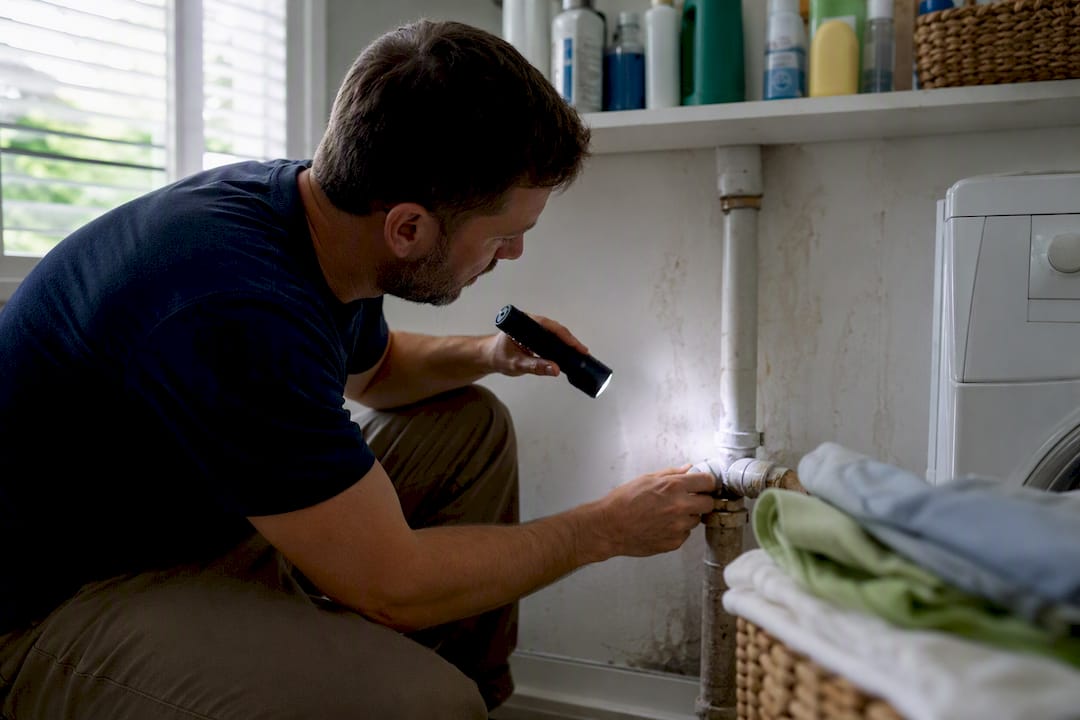
Prevention beats appeal every time. Inspect exposed plumbing twice a year, replace supply hoses on washing machines and dishwashers every five years, and service your water heater annually. Photograph and date any repair the moment you make it.
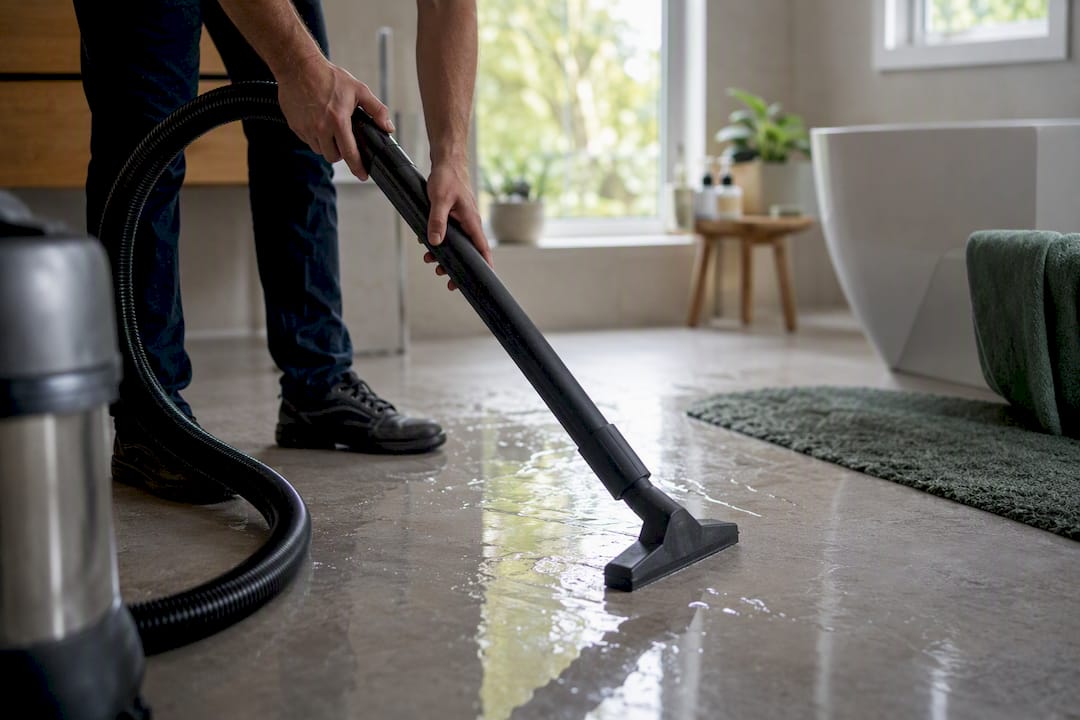
If a leak happens anyway: shut off the water immediately, extract standing water, and start drying within 24 to 48 hours. Document each step and keep every receipt. A $50 leak sensor or smart shut-off valve near your water heater or under sinks can also become powerful proof that you responded fast, which matters if a future claim ever gets questioned.
Can Mold Alone Prove My Claim Was Long-Term?
No, and this is one of the most common insurer arguments homeowners fail to push back on. Mold can begin to germinate within 24 to 72 hours of water intrusion. Finding mold during an inspection proves water sat for a couple of days, not that you ignored a leak for six months.
Several states also require insurers to be specific. California's 10 CCR §2695.7 requires insurers to list every factual and legal reason for a denial and cite the exact policy section, paragraph, and item relied on. If your denial letter is vague, that regulation (or your own state's equivalent) is grounds to demand a rewritten explanation or file a formal complaint.
The evidence packages that reverse "gradual damage" denials most consistently combine four things:
- A dated, professional moisture map.
- A written cause-of-failure letter from a plumber or contractor.
- Your mitigation receipts.
- The preserved failed part itself.
A restoration pro's take on the mistakes that sink appeals
The two mistakes I see most: homeowners toss the burst fitting or soaked drywall before anyone documents it, and they accept a verbal explanation from a plumber instead of a signed one. If you remember nothing else, remember this: get an IICRC S500 mitigation report started the same day you find the damage. It's the single piece of paper that does the most work later.
How Pure Resto Supports a Denied or Disputed Claim
Purerestomd is the difference between fighting a denial with your own phone photos and fighting it with a documented, IICRC-aligned case file. Our teams respond in 30 minutes across our Maryland service area, running professional moisture mapping, mold inspection, and mitigation the same day water hits your floors.
That timing matters because insurers weigh contemporaneous documentation far more heavily than anything assembled after the fact. Our technicians generate time-stamped moisture readings, photograph and preserve failed materials before disposal, and hand you a mitigation report built to the standard adjusters recognize. We also bill most jobs directly to your insurer, so you're not fronting restoration costs while your appeal is pending. If you're staring at a denial letter right now, call Pure Resto to start documentation before any more evidence disappears.
Sources
- 10 CCR §2695.7 — California Fair Claims Settlement Practices Regulations
- Water Damage Claim Denied? Common Reasons Explained | Allied
- FEMA — Flood Insurance
- Insurance Information Institute — Facts & Statistics: Homeowners and Renters Insurance
FAQ
Why would a water damage claim be denied?
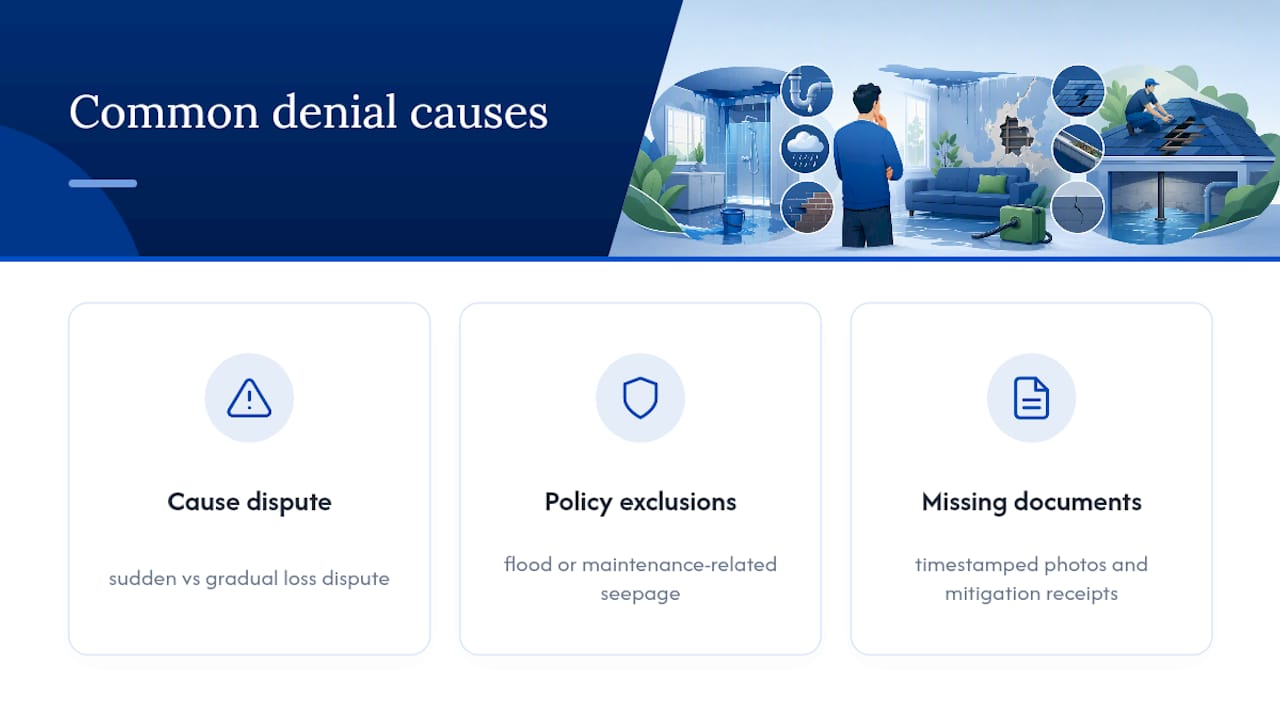
Most denials trace back to a cause-of-loss dispute (sudden versus gradual), a policy exclusion like flood or maintenance-related seepage, or missing documentation such as timestamped photos and mitigation receipts.
Which insurance issues deny the most water damage claims?
Cause-of-loss disagreements and unendorsed sewer or sump backup are the most frequently cited denial categories, according to claims industry guidance, followed closely by documentation gaps and late reporting.
Why would insurance not cover water damage?
Standard homeowners policies exclude gradual leaks, seepage, wear and tear, and flooding, since flood coverage is handled separately through the NFIP or private flood insurers rather than a standard HO-3 policy.
How long does a water damage claim stay on your record?
Insurers typically report claims to shared databases like CLUE for several years, and a claim history can affect premiums or underwriting decisions during that window even if the claim was ultimately paid or denied.
Do I need a public adjuster or an attorney to appeal a denial?
Not always. A public adjuster helps when you're disputing the dollar value of an accepted claim, while an attorney is the better call when the insurer denied coverage outright or the policy language is genuinely disputed.