
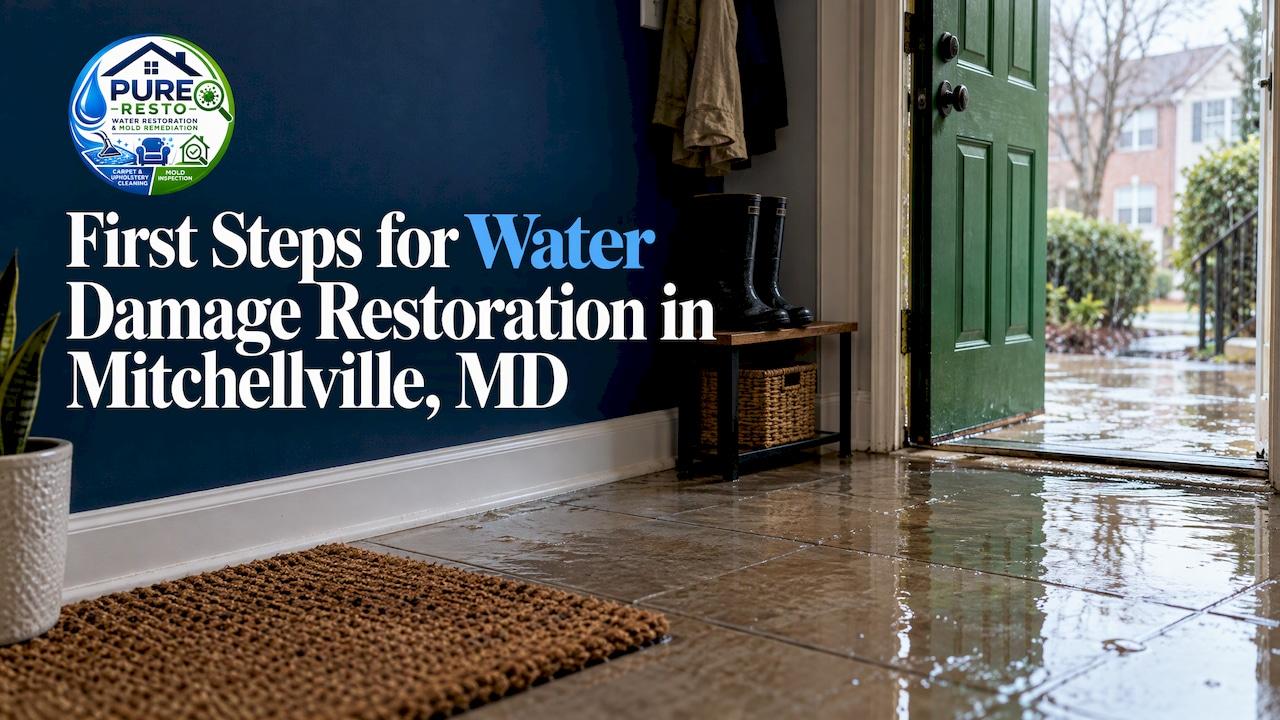
If water is coming into your Mitchellville home or business, the fastest good outcome is a certified crew on site within hours, not days, because wet materials start to break down and grow mold on a clock measured in 24 to 48 hours. Pure Resto is an IICRC-certified restoration company based in Bowie, MD, with 24/7 emergency response and a typical arrival time of 30 minutes. It extracts water, dries the structure with HEPA-filtered equipment and bills your insurer directly. This guide covers what to do first, how restoration works, what it costs and what to put on paper.
TL;DR
- Make the situation safe first: assume electrical hazards, shut off power and gas if you can do so safely, and stay out if you are unsure.
- Photograph everything before cleanup, then call your insurer before you sign any mitigation contract.
- Porous materials such as carpet, padding and drywall should be dried within roughly 24 to 48 hours to limit mold.
- National cost estimates run from $1,305 to $5,707 per job, and the type of water changes the price.
- Pure Resto responds around the clock, typically within 30 minutes, and works directly with insurers.
Table of Contents
- What to do in the first hour
- Why the first 48 hours matter
- What kind of water is it?
- How professional restoration works, step by step
- Carpet, mold and what comes after the water
- What water damage restoration costs
- Insurance and paperwork in Maryland
- How to choose a restoration company in Mitchellville
- Water damage restoration from Pure Resto
- Our perspective
- FAQ
- Sources
What to do in the first hour
Safety comes before saving anything. Maryland Historical Trust guidance on drying out a water-damaged building tells owners to treat live power lines, gas leaks and floodwater that may contain sewage or animal waste as hazards, and not to enter the building if personal safety is uncertain.
In practice, the order looks like this:
- Protect yourself. If water has reached outlets, appliances or the electrical panel, assume it is live. Turn off power and gas only if you can reach the shutoffs without standing in water.
- Stop the source. For an indoor leak, Nationwide's claims guidance says to shut the main water valve when it is safe to do so, and to call a plumber if the leak needs repair. Keep the failed part if you can, because your insurer may want to see it.
- Photograph and video the damage before anything is moved or thrown away. The same Maryland guidance says to document damage before cleanup.
- Limit further water entry. After a storm, temporary roof or window repairs keep more water out. Save the receipts.
- Call a restoration company. Every hour of standing water pushes moisture deeper into drywall, subfloors and framing.
For storm-related losses, our Maryland storm damage cleanup guide walks through what to do before and after the crew arrives.
Why the first 48 hours matter
Saturated building materials do not just dry out on their own. Maryland Historical Trust guidance notes that saturation can cause direct material damage, contamination, and mold, mildew, fungus and dry rot.
Massachusetts public guidance on water damage response in buildings says wet materials should be examined promptly, inaccessible areas controlled, and drying started with fans, dehumidifiers and heat. It cites EPA and ACGIH guidance recommending that porous materials be dried within 24 to 48 hours to limit mold growth.
That is a guideline, not a guarantee. The EPA's water damage table says mold can still occur when drying finishes inside that window. What the window tells you is how little time there is to get equipment running. A Mitchellville homeowner who finds a wet basement on Friday night should not wait for Monday.
Our first 48 hours guide for emergency water cleanup lays out what happens hour by hour.
What kind of water is it?
The type of water decides how the job is done, what protective gear is needed and what it costs. Public guidance, such as the Massachusetts reference above, sorts water into three categories:
| Category | What it is | Typical sources |
|---|---|---|
| Category 1 | Sanitary water | Supply line break, overflowing sink with clean water |
| Category 2 | Gray water that can cause illness | Dishwasher or washing machine discharge |
| Category 3 | Highly contaminated black water | Sewage, toilet backflow with waste, rising floodwater |
A clean supply-line leak caught early can often be handled by drying in place. Category 3 water means contaminated porous materials are usually removed rather than saved, and the crew works with protective equipment and containment. If sewage is involved, read our sewage backup cleanup process and keep everyone, pets included, out of the affected area.
How professional restoration works, step by step
Nationwide describes a typical cleanup as stopping the water source, moving contents, extracting standing water with pumps and vacuums, drying with fans and dehumidifiers, removing damaged materials, and cleaning, sanitizing and deodorizing. Here is what each stage takes and where a job goes wrong.

1. Emergency response and assessment
The crew finds where the water came from, where it traveled and which materials are wet. Water spreads under baseboards, into wall cavities and beneath flooring, so a floor that looks dry can still hold moisture. Pure Resto's crews typically arrive within 30 minutes, any hour of the day, which matters because this stage starts the clock on everything else.
2. Water extraction
Standing water comes out first, with pumps and extraction vacuums. Delays here mean longer drying later. Pure Resto uses advanced extraction equipment so that less water is left for the drying phase to handle.
3. Removal of materials that cannot be saved
EPA guidance says drywall can sometimes be dried in place when it is not swelling and its seams are intact. When those conditions are not met, damaged drywall should be removed and replaced. Carpet padding and contaminated materials often follow. Removal is a judgment call: take out too little and moisture stays trapped, take out too much and the repair bill climbs. If you are weighing what a wall repair costs afterward, this overview of drywall repair cost factors explains how severity and water type affect cleanup and repair pricing.
4. Structural drying and dehumidification
This is the stage most owners underestimate. Air movers and dehumidifiers pull moisture out of materials, and the work is checked with moisture readings rather than by touch. Pure Resto uses advanced drying and HEPA filtration techniques, designed to prevent further damage and health hazards while the structure dries. A fan from the hardware store cannot reach moisture inside a wall cavity or under a subfloor.
5. Cleaning, sanitizing and odor control
Once the structure is dry, surfaces are cleaned and sanitized and lingering odors are treated. Pure Resto also offers odor removal and contents cleaning, storage and packout for furniture and belongings that must leave the room while work is under way.
6. Insurance paperwork
Pure Resto is fully licensed and insured and works directly with insurance providers to streamline the claims process, so the documentation your adjuster needs is handled alongside the cleanup, not after it.
Carpet, mold and what comes after the water
Carpet is where water damage and mold most often meet. EPA guidance for water-damaged carpet and backing is to extract the water, reduce humidity with a dehumidifier and speed drying with fans, all within 24 to 48 hours. The subfloor under the carpet must be cleaned and dried too. If carpet has stayed wet longer than that, or mold is already present, the EPA's table on water damage and mold points to mold remediation guidance, and contaminated-water work calls for protective equipment and containment.
That is the point at which a mold inspection makes sense: musty smells, visible spotting or materials that were wet for more than two days. If the inspection finds growth, mold remediation removes it and addresses the moisture behind it. Carpet that survives the water event can then be professionally cleaned.
For families, the practical rule is simple: if anyone in the house has asthma or allergies, or if the water sat for more than two days, ask for the inspection rather than waiting to see whether something grows. Anyone with health symptoms should talk to their doctor.
What water damage restoration costs
There is no single price, because the job depends on how much water, how far it spread, how long it sat and what kind it was. The Maryland Insurance Administration notes that costs vary with water type and extent, with clean Category 1 water generally costing less than sewage-contaminated Category 3 water.
For a national benchmark, Bob Vila's 2023 cost guide, citing Angi and HomeAdvisor, puts typical restoration at $1,305 to $5,707, with an average of $3,455. Its per-square-foot figures are $3 to $4 for Category 1, $4 to $6.50 for Category 2 and $7 to $7.50 for Category 3. These are national averages from 2023, not Mitchellville quotes. Your written estimate is the number that counts.
Two things push costs up: waiting, because wetter materials mean more removal, and contamination. Acting in the first day is the one cost lever fully in your control.

Insurance and paperwork in Maryland
The Maryland Insurance Administration and the Maryland Attorney General agree on the sequence:
- Call your insurer before you sign a mitigation contract. The insurer can explain required steps, covered emergency work and whether an inspection must happen before work begins.
- Know who pays. If a claim is denied, the owner is responsible for the restoration company's charges. Covered claims generally pay only necessary and reasonable charges.
- Keep everything. Contracts, estimates, invoices, photographs, receipts and messages with the company and the insurer.
- Do not make permanent repairs first. Maryland's post-disaster claims guide warns that unauthorized permanent work may not be paid. Essential protective repairs are fine, with receipts.
- Be present for the adjuster's inspection and keep a detailed inventory of damaged property.
The Maryland Attorney General's consumer guide on restoration companies adds that you should read the contract to confirm it lists the agreed services, ask for documentation of drying progress and inspect the work afterward. A restoration company works for the property owner even when the insurer recommends it, so the contract and the records are yours to control.
This is where a company that bills insurers directly earns its keep: the drying logs, photos and invoices an adjuster expects are produced as part of the job.
How to choose a restoration company in Mitchellville
The Attorney General's guide points to three checks: the company holds IICRC certification, it is licensed for home-improvement work, and its contract spells out the services. Add these questions:
- How fast can you be here? Response time decides how much is salvageable. Pure Resto's typical arrival is 30 minutes, 24/7.
- Is the crew certified and the company insured? Pure Resto is IICRC-certified, licensed and insured.
- What will drying look like? Ask for written documentation of progress and completion.
- Will the company work with your insurer? Pure Resto handles insurance claims directly.
- What stands behind the work? Pure Resto backs its jobs with a satisfaction guarantee and written workmanship standards.
Water damage restoration from Pure Resto
Pure Resto is based in Bowie, MD and serves Mitchellville along with nearby communities such as Lanham, Glenn Dale, Woodmore, Greenbelt, Annapolis and Crofton. Our crews bring extraction, drying and HEPA filtration equipment, and we handle water damage restoration, mold inspection and remediation, odor removal, contents cleaning and carpet cleaning under one roof. Businesses and property managers get the same 24/7 response as homeowners.
Start with our Mitchellville water damage restoration page, or call any time day or night.
If you manage a rental or commercial property, the same page covers how we work with insurers and property owners. You can also see our wider water damage restoration service for the full process.
Our perspective
Most of the damage we see is not done by the water itself. It is done by the hours after. A burst line floods a floor in minutes, but the swollen subfloor, the stained drywall and the mold that follows come from moisture left sitting.
That is why we built our service around speed and around drying, not just cleanup. A 30-minute typical response, advanced extraction, monitored drying and HEPA filtration all aim at one thing: stopping the damage from spreading while it is still small.
We also think the paperwork should not be a second emergency. Working directly with insurers lets you focus on your family and your home, while we document the job and handle the claims process with your provider.
Restoration should mean the property is genuinely restored, with preventative measures in place, not just mopped up. That is the standard we put in writing and back with a satisfaction guarantee.
Pure
FAQ
How fast should water damage be dealt with in Mitchellville?
As fast as possible. Public guidance recommends drying porous materials such as carpet and drywall within 24 to 48 hours to limit mold. Pure Resto's crews typically arrive within 30 minutes, at any hour.
Does homeowners insurance cover water damage restoration?
It depends on your policy and the cause of the loss. The Maryland Insurance Administration says covered claims generally pay necessary and reasonable charges, while owners are responsible if a claim is denied. Call your insurer before signing a mitigation contract. Pure Resto works directly with insurance providers to streamline the claims process.
Should I get a mold inspection after a leak or flood?
Yes, if materials stayed wet for more than 48 hours, if you smell mustiness or see spotting, or if anyone in the home has breathing problems. An inspection confirms whether mold is present before you decide on remediation.
Can my carpet be saved after water damage?
Often, when it is extracted and dried quickly and the water was clean. Carpet exposed to contaminated water or left wet for days may need to be replaced. A technician can tell you after assessing it.
Do you serve businesses and rental properties in Mitchellville?
Yes. We respond to residential and commercial properties, including property managers, with the same 24/7 emergency service.
Sources
- Tips for Drying Out a Water-Damaged Building, Maryland Historical Trust
- Water Damage Insurance Claims, Nationwide
- Quick reference: water damage response in buildings, Mass.gov
- Mold Remediation in Schools and Commercial Buildings, EPA table
- Mold Remediation in Schools and Commercial Buildings, water damage table
- Mitigation companies, Maryland Insurance Administration
- Consumer Guide on Restoration Companies, Maryland Attorney General
- Post-Disaster Claims, Maryland Insurance Administration
- How Much Does Water Damage Restoration Cost?, Bob Vila
- Drywall Repair Cost: What Homeowners Pay and Why