
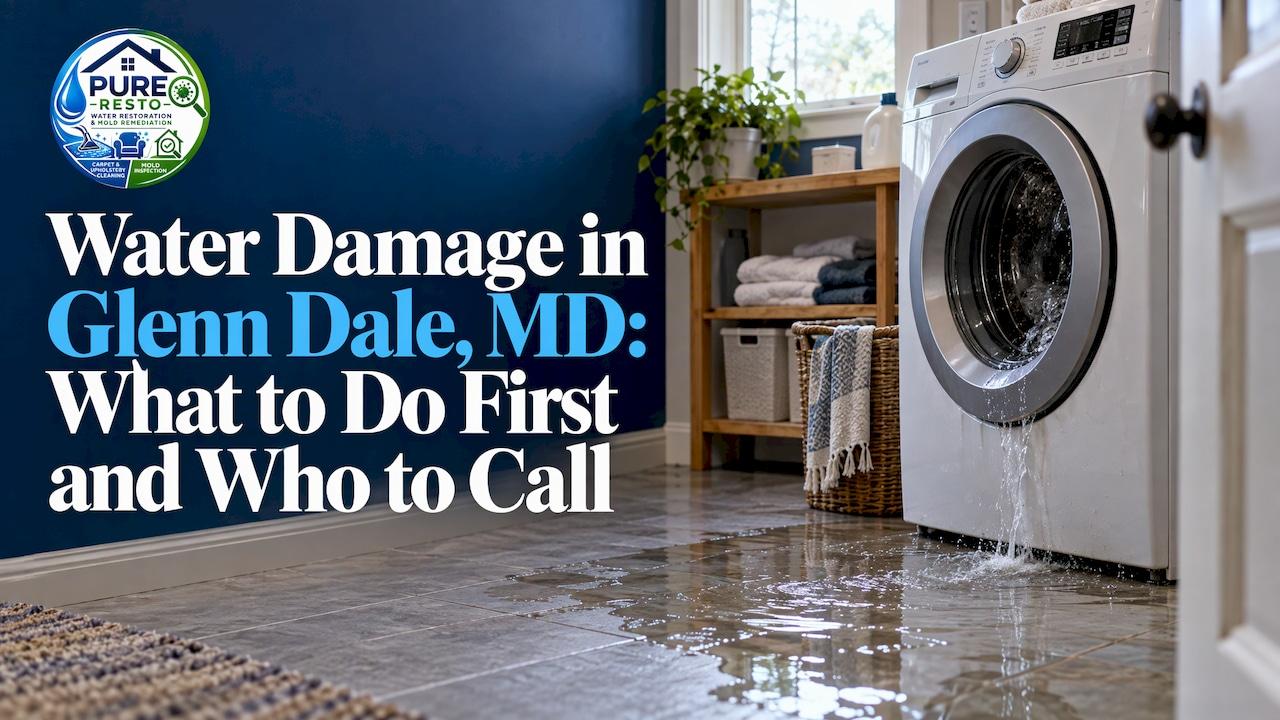
If water is spreading through your Glenn Dale home or business, make it safe, document it, and call a certified restoration crew right away, because wet materials start to turn into a bigger problem within 24 to 48 hours. Pure Resto is an IICRC-certified, licensed and insured restoration company based in nearby Bowie, with 24/7 emergency response and crews that typically arrive within 30 minutes. We extract, dry and filter the air with HEPA equipment, and we bill your insurer directly. You can see our water damage restoration in Glenn Dale page for local service details.
This guide covers what to do in the first hour, how to judge the type of water you are dealing with, how Maryland insurance treats water losses, how professional restoration works, and how to keep mold from following the water.
TL;DR
- Put safety first: stop the source if you can do so safely, stay out of areas the authorities have not cleared, and photograph everything before cleanup.
- Clean water can turn into a bigger problem in about 24 to 48 hours, so extraction and drying should start the same day.
- Standard Maryland homeowners policies generally do not cover flood, and sewer backup coverage is an add-on, so read your policy and call your insurer early.
- A signed restoration contract makes you responsible for payment even if a claim is denied, so read it before work begins.
- Pure Resto responds around the clock across Glenn Dale and nearby Bowie, Lanham, Woodmore and Mitchellville, and bills insurers directly.
Table of Contents
- What to do in the first hour
- Know your water: three categories
- Why the first 24 to 48 hours matter
- How professional water damage restoration works
- Insurance and water damage in Maryland
- When water turns into mold
- How to choose a restoration company near Glenn Dale
- Our perspective: restore, do not just clean up
- Get help now in Glenn Dale
- Reducing the risk of the next loss
- FAQ
- Sources
What to do in the first hour
The first hour is about safety, stopping the source and creating a record. The Maryland State Archives' disaster recovery guidance says not to reenter a damaged building without permission from the proper authorities, to document damaged items, to notify your insurance representative about significant losses, and to check for mold afterward.
In practice, work through this order:
- Protect people. Keep children and pets out of wet areas. If water has reached outlets, appliances or the electrical panel, stay away from them and have the power shut off by a qualified professional.
- Stop the source. For a burst pipe or failed supply line, shut off the water at the main. Our guide on what to do after a pipe bursts walks through it step by step. In winter, a frozen pipe burst needs the same fast response.
- Photograph and video everything. The Maryland Insurance Administration says to photograph or video damage before, during and after temporary repairs and to keep receipts.
- Call your insurer and a restoration company. Report the loss as soon as possible. The same agency's post-disaster claims guide says to keep emergency-repair receipts and to hold off on permanent repairs until you have spoken with the insurer, because unauthorized repairs may not be paid.
- Keep damaged items until the adjuster says otherwise. Nationwide's claims guidance advises inventorying damaged property and not discarding it before speaking with the claims representative, and keeping any part suspected of causing the leak.
For commercial properties the sequence is the same. The Hartford tells business owners to identify the source, shut off the water main when necessary, notify the insurer immediately, document the damage and arrange qualified extraction. Our overview of commercial restoration services covers what that looks like for offices, retail and multi-unit buildings.
Know your water: three categories
Not all water is equal, and the category decides what can be saved and how the work is done. According to Massachusetts' water damage quick reference, the categories break down like this:
| Category | What it is | Typical examples |
|---|---|---|
| 1 | Clean water from a sanitary source | Supply line break, overflowing sink with clean water |
| 2 | Gray water with chemical or biological contamination | Washing machine or dishwasher discharge |
| 3 | Highly contaminated black water that may contain pathogens | Sewer backup, rising flood water |
The same guidance lists plumbing, HVAC, roof or building leaks, appliances, sewer backups and flooding as common sources. The University of Florida's environmental health office adds roof leaks, pipe breaks, sewer backups, outside flooding and moisture entering through the building envelope to the list.
Treat any water you cannot identify as contaminated. Sewage in particular is a job for trained crews with protective equipment; see our sewage backup cleanup process for what that involves.
Not every loss starts with a visible puddle. Slow leaks inside walls and ceilings can go unnoticed for weeks, and our list of signs of water damage behind walls helps you catch them: staining, bubbling paint, warped baseboards and a persistent musty smell.
Why the first 24 to 48 hours matter
Time is the single biggest factor in what a loss costs. The University of Florida's guidance explains that clean water offers the best chance of salvaging materials at first, but Category 1 damage should be addressed within roughly 24 to 48 hours, because microbial growth can lower water quality toward Category 2 after that. The EPA's remediation guidance for commercial buildings gives the same window, stating that clean water damage should be dealt with within 24 to 48 hours to prevent mold growth, with specific actions for carpet, drywall and insulation.
That is why a 30-minute emergency response matters. Our crews typically arrive within 30 minutes of your call, any hour of the day, which starts the clock on extraction and drying while the materials are still salvageable. If you are searching for 24/7 water extraction near you, that is the standard we hold ourselves to across Glenn Dale and the surrounding area.

How professional water damage restoration works
A reputable restoration job follows a clear order. The Maryland Attorney General's consumer guide on restoration companies describes the start: the company walks through the property with you, evaluates the work and equipment needed, and gives you a service contract to review and sign before work begins. It also advises asking for documentation of drying progress and completion, and inspecting afterward for remaining moisture.
Here is how that fits together on a typical Glenn Dale job:
- Emergency response and walkthrough. A technician assesses the property with you and identifies where the water came from and how far it has traveled.
- Water extraction. Standing water comes out first, using professional extraction equipment. This is the step that most limits further damage to floors, walls and contents.
- Drying. Wet structure and materials are dried with professional drying equipment. Surfaces that feel dry can still hold moisture, which is why documented drying matters to you and to your insurer.
- Air filtration. We use HEPA filtration to help protect the air quality in your home during the work.
- Cleaning and contents. Affected belongings can be handled through our contents cleaning, storage and packout service, and odors can be addressed with odor removal. Wet carpet and upholstery are covered by our carpet cleaning and upholstery cleaning services.
- Claim paperwork. We work directly with your insurance provider to streamline the claims process, so you are not relaying numbers between a contractor and an adjuster.
How long all this takes depends on the water category, the size of the affected area, the materials involved, hidden moisture and how much rebuilding is needed. A small, clean-water leak and a basement sewer backup are very different projects, so beware of anyone promising a fixed number of days before seeing the property.
Insurance and water damage in Maryland
Insurance is where many Glenn Dale homeowners get surprised, so read your policy before you need it. The Maryland Insurance Administration explains that mold remediation may be covered when mold results from a covered peril such as sudden, accidental water damage from a burst pipe, but that the policy and the insurer determine coverage. The same document states that flood damage is almost never covered by a standard homeowners policy, and that sewer backup coverage requires a purchased endorsement.
A few points to know:
- Flood is separate. Maryland's homeowners policy notice says standard homeowners policies do not cover flood, and that insurers must offer sewer-and-drain backup coverage, though lower limits may be available.
- Backup coverage has limits. The Insurance Administration notes that water or sewer backup coverage pays subject to policy terms, conditions and limits, and that many policies do not pay to repair or replace the failed pipe or drain itself.
- Your contract is your responsibility. The Attorney General warns that you remain responsible for paying the restoration company under the signed contract if the insurance claim is denied, even if the insurer recommended the company. Read the contract and keep a copy.
We bill insurers directly and handle the claims process alongside you, which keeps the documentation consistent from the first photo to the final moisture reading. For a closer look at how coverage works near us, read our article on whether insurance covers water damage in Bowie, MD; the principles apply in Glenn Dale too.
When water turns into mold
Mold needs moisture, and wet drywall, insulation and carpet provide plenty. Massachusetts' homeowner mold guide says control means finding and fixing the moisture source, drying damaged areas, discarding items that cannot be dried and repairing or replacing damaged materials. That is why fast drying is the best mold prevention there is.

When should you bring in a specialist? The EPA says that when mold is visible, sampling is usually unnecessary, and that there are no federal limits for mold or mold spores against which a building can be tested. It adds that sampling can be useful for evaluating cleanup or remediation, but should be done by professionals experienced in sampling protocols and interpretation.
If you see or smell mold after a leak, or you want a professional to confirm that a dried-out area is clear, our mold inspection and mold remediation services are built for exactly that follow-up. Our mold FAQ answers common questions on testing, removal and prevention, and we also offer mold inspection in nearby Lanham.
How to choose a restoration company near Glenn Dale
The Maryland Attorney General's guide gives the questions worth asking any restoration company, and we are glad to answer every one:
- Is the company IICRC certified? The Attorney General recommends asking. Pure Resto is IICRC certified, licensed and insured.
- Will you walk the property with me and give a written contract? You should receive a contract to read, sign and keep before work starts.
- Will you document drying progress and completion? This protects you when you file with your insurer.
- How fast can you be here? Our crews typically arrive within 30 minutes, 24/7.
- Do you work with my insurer? We handle insurance claims directly to streamline the process.
- What stands behind the work? Our jobs carry a satisfaction guarantee and written workmanship standards.
Local reach matters too. We are based in Bowie and serve Glenn Dale along with Mitchellville, Lanham, Greenbelt, Woodmore, Laurel and the rest of the Prince George's and Anne Arundel County corridor. If you are just over the line, we have dedicated pages for water damage restoration in Woodmore and Washington, DC.
Our perspective: restore, do not just clean up
We see water damage as a race between drying and decay. Cleanup that only removes what you can see leaves moisture in the structure, and that moisture is what causes mold, odors and warped materials later.
That is why we put extraction, drying and HEPA filtration at the center of every job, and why we aim to be at your door within 30 minutes. Our approach is restoration and prevention, not a quick mop-up.
We also believe the paperwork should not be your second emergency. We work directly with your insurer so the claim follows the same record as the repair.
Pure
Get help now in Glenn Dale
When water is on the floor, you should not be comparing quotes for an hour. Pure Resto provides 24/7 water damage restoration for homes and businesses across Glenn Dale and nearby communities, with certified technicians, advanced extraction and drying equipment, HEPA filtration and direct insurance billing. Start from our Glenn Dale service page or contact us any hour.
If a fire or smoke event caused the water, as with firefighting runoff, we also handle fire and smoke damage restoration.
Reducing the risk of the next loss
Once your property is dry and repaired, it is worth lowering the odds of a repeat. FEMA's low-cost flood protection projects recommend:
- installing a sump pump with a battery-operated backup;
- sealing foundation and basement walls;
- cleaning gutters and downspouts to maintain proper drainage;
- improving lot grading so stormwater drains away from the building;
- installing sewer backflow valves on pipes entering the building.
The Center for Neighborhood Technology's RainReady guidance adds assessing your property's flood risk, having building sewers checked, managing water inside the home with smart technologies and getting insured, including through the National Flood Insurance Program. Since standard Maryland policies exclude flood, that last step deserves a conversation with your insurance agent.
FAQ
How fast can a restoration crew get to Glenn Dale?
Pure Resto crews typically arrive within 30 minutes of your call, and we answer 24/7, including nights, weekends and holidays. We are based in nearby Bowie, so Glenn Dale is within our core service area.
Does homeowners insurance pay for water damage in Glenn Dale?
It depends on the cause. The Maryland Insurance Administration says sudden, accidental damage such as a burst pipe may be covered, while flood is almost never covered by a standard policy and sewer backup needs an added endorsement. Your policy wording and insurer decide, so report the loss early. We bill insurers directly and work through the claim with you.
Do I need a mold test after water damage?
Not always. The EPA says sampling is usually unnecessary when mold is visible, and professional sampling can help evaluate whether cleanup was effective. If you smell mustiness or the water sat for more than a day or two, our mold inspection team can check the affected areas.
How long does water damage restoration take?
The timeline depends on the water category, the size of the area, the materials affected, hidden moisture and how much rebuilding is required. Extraction and drying come first, and the Maryland Attorney General advises getting documentation of drying progress and completion. We walk the property with you and explain the scope before work begins.
What should I do if the water came from a sewer backup?
Treat it as Category 3 water that may contain pathogens: keep people and pets out, do not try to clean it yourself, and call us right away. Check whether your policy includes a sewer-and-drain backup endorsement and notify your insurer promptly.
Sources
- Disaster Recovery at Home, Maryland State Archives
- Storm Related Damage FAQs, Maryland Insurance Administration
- Post-Disaster Claims guide, Maryland Insurance Administration
- Water Damage Insurance Claims, Nationwide
- Quick reference: water damage response in buildings, Mass.gov
- Water Intrusion Problems, University of Florida EHS
- Mold Remediation in Schools and Commercial Buildings, Table 1, US EPA
- Consumer Guide on Restoration Companies, Maryland Attorney General
- Things You Need to Know About Your Insurance Policy, Maryland Insurance Administration
- What Your Homeowners, Renters and Auto Will Cover for Water Damage, Maryland Insurance Administration
- Mold Cleanup, Repairs, and Excess Moisture Control, Mass.gov
- Frequent Questions About Flooded Homes, US EPA
- Protect Your Home from Flooding: Low-cost Projects, FEMA
- RainReady Homeowner Guidance, Center for Neighborhood Technology