
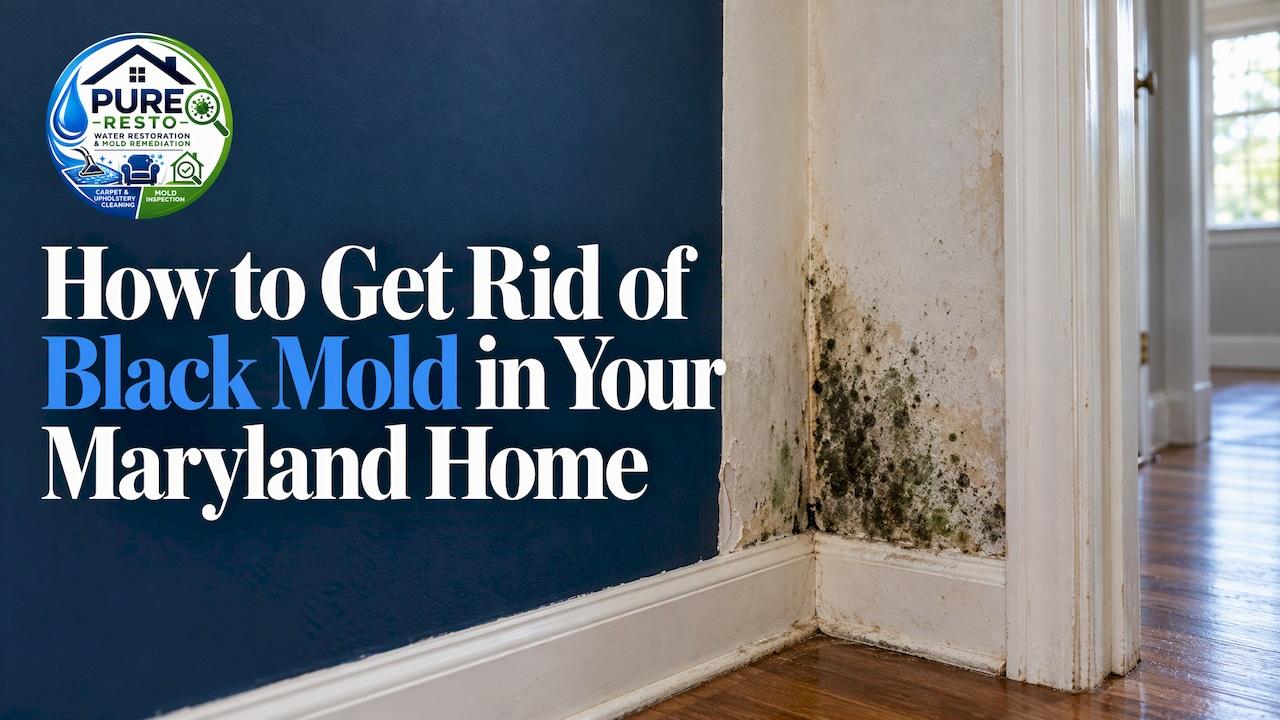
You get rid of black mold by fixing the water source and physically removing every bit of growth, not by spraying it. A patch smaller than a few square feet on a hard surface is a careful cleaning job. Anything larger, anything inside drywall, or anything that follows a leak or flood is a remediation job. Pure Resto is an IICRC-certified restoration company in Bowie, MD, that responds around the clock, typically within 30 minutes, and handles the drying, HEPA filtration and insurance paperwork that keep mold from coming back.
TL;DR
- "Black mold" is a nickname, not a species. Color does not tell you how dangerous a mold is, so treat any visible or smelly mold the same way: remove it.
- Killing mold is not enough. Dead mold can still trigger allergic reactions, so the growth has to be physically removed and the moisture fixed.
- Once affected areas pass roughly 10 square feet, or mold sits inside walls, ceilings or carpet padding, bring in a certified remediation crew.
- Dry water-damaged materials within 24 to 48 hours. That window decides whether you have a cleanup or a remediation.
- People with asthma, allergies or weakened immune systems should stay out of mold cleanup altogether.
Table of Contents
- What "black mold" actually is
- Step one is always the water
- Small patch or remediation job?
- How a professional removes black mold, step by step
- Cleaning a small patch safely
- Bleach, vinegar and store-bought sprays
- Carpet and upholstery after mold or water
- What changes in Maryland
- Our view
- When you are ready to act
- FAQ
- Sources
What "black mold" actually is
The EPA's Mold Course explains that "black mold" is not a species or a specific kind of mold. The term is media shorthand, sometimes for molds that may produce mycotoxins and sometimes for Stachybotrys chartarum. The same page says no one can tell whether a mold is producing mycotoxins just by looking at it.
The CDC says the same thing in practical terms: mold color does not indicate whether it is more or less dangerous, and toxigenic molds such as Stachybotrys should be handled like other household molds. Cleveland Clinic adds that black mold is not more dangerous than any other mold. Common reactions are itchy eyes or throat, nasal congestion, sneezing, coughing, chest tightness and wheezing.
That is useful for you. You do not need to figure out whether the dark patch on your basement wall is the "bad" kind. The CDC advises removing mold whenever you see or smell it, without identifying the type first.
How to recognize it
The CDC describes Stachybotrys as a greenish-black mold that grows on high-cellulose materials such as fiberboard, gypsum board (drywall) and paper, and needs constant moisture from leaks, condensation or flooding. WebMD notes that indoors it typically looks slimy and sticky on wallboard, wallpaper and insulation.
Smell is the other clue. The EPA says the musty odor comes from microbial volatile organic compounds, and that a moldy smell suggests mold is growing and should be investigated. Inhaling those compounds has been linked to headaches, nasal irritation, dizziness, fatigue and nausea. If you smell mold but see nothing, look behind furniture, under sinks, inside closets on exterior walls and around old leaks.
Step one is always the water
Mold needs moisture, so removal without a dry building is temporary. The CDC recommends keeping indoor humidity no higher than 50% all day, fixing roof, wall and plumbing leaks, and drying everything fully within 24 to 48 hours after a flood. The NEHA guide for responding to indoor mold concerns gives a 30% to 50% humidity range and the same 24 to 48 hour drying window.
The EPA's flood guidance explains why that window matters: mold can grow on wood, drywall, carpet and furniture that stay wet for more than 24 hours. Plenty of Maryland mold starts with a slow pipe leak, a failed sump pump, a clogged gutter or a basement that took on water after a storm. If your mold followed one of those events, our guide to stopping mold in the 24 to 48 hours after a leak shows how fast the clock runs.
This is where professional drying earns its place. Pure Resto uses advanced extraction, drying and HEPA filtration equipment, so water is pulled out of the structure and not just wiped off the surface. If the source of your mold is water you can still see or feel, our water damage restoration team is the first call, because every day wet materials stay wet adds to the mold you will have to remove later.
Small patch or remediation job?
The size and location of the growth decide who should do the work. The NEHA guide suggests bringing in a remediation contractor when the affected area exceeds 10 square feet. That is roughly a 3 by 3 foot section of wall.
Call a certified crew when any of these apply:
- The mold covers more than about 10 square feet, or keeps spreading after you clean it.
- It came back after a previous cleanup, which usually means moisture is still behind the surface.
- It is on or behind drywall, ceiling tiles, insulation or carpet padding. The California Department of Public Health notes that porous materials that stay wet for more than a day or two, such as drywall, ceiling tiles, drapes or upholstered furniture, may need removal even if they do not yet look or smell moldy.
- It followed a flood, sewage backup or long-term leak.
- Anyone in the home has asthma, allergies, a lung condition or a weakened immune system.
- You smell mold strongly but cannot find it.
That last group matters. The CDC says people with allergies, immune suppression, or chronic respiratory disease such as asthma or COPD should not take part in mold cleanup. The EPA adds children and pregnant people to the list of those who should stay out of flood cleanup. If that describes someone in your household, hand the job to a professional crew from the start.
How a professional removes black mold, step by step
Here is the order of work for a job that goes beyond a small patch, and where each step tends to go wrong.
- Find and stop the moisture. A leaking supply line, a failing roof flashing or a window with constant condensation will regrow mold within days. Cleaning before fixing is the most common reason mold returns. Our water damage restoration service covers extraction and drying when water is the cause.
- Confirm the extent. Mold often runs well past what you can see. Our mold inspection and testing service is there to establish where the problem is. Keep in mind the CDC does not recommend routine air sampling, since there are no health-based standards for mold in indoor air. The practical question is where the growth and the moisture are.
- Remove what cannot be saved. Porous materials with established growth, such as soaked drywall, insulation and carpet padding, are generally discarded instead of cleaned. This is the step most homeowners underestimate, and it is the reason surface scrubbing so often fails.
- Clean and remove the growth with HEPA filtration. Disturbing mold throws spores into the air. HEPA filtration captures fine particles so they do not settle in other rooms. Our mold remediation service uses HEPA filtration for this reason.
- Dry completely. Materials that remain have to reach a dry state, or the mold returns. Extraction and drying equipment does in hours what open windows do in days.
- Clean contents and deal with odor. Furniture, clothing and belongings near the mold can hold spores and smell. We offer contents cleaning, storage and packout, as well as odor removal.
- Rebuild. Only after the area is clean and dry should you repair walls, paint or caulk. The CDC states that painting or caulking over mold will not prevent it from growing back.
For a longer walk through what happens on site, see our guides to the mold remediation process and what professional mold cleanup involves.
Cleaning a small patch safely
For a small area on a hard, nonporous surface such as bathroom tile, with no one in the household in the groups above, the CDC gives clear safety terms. Wear at least a NIOSH-approved N95 respirator, non-latex gloves, and goggles that keep out dust and small particles. Open windows or doors for fresh air. Never mix bleach with ammonia or another cleanser. If you use bleach, the CDC's limit is no more than 1 cup per gallon of water, and dish detergent and water is also an accepted cleaner.
The EPA's flood guidance adds long sleeves, pants, boots and goggles without vent holes. The gear matters more than people think. A 2024 peer-reviewed study after Hurricane Ida found that although most residents knew respirators were recommended, actual use of NIOSH-approved respirators was low. A dust mask or a cloth face covering is not the same protection.
A bathroom is the most common place for a first patch. Our guide to black mold in the bathroom covers safe removal and prevention, and for anything beyond the grout line, a mold inspection tells you whether the growth is deeper than it looks.

Bleach, vinegar and store-bought sprays
People search "what kills black mold" expecting a product name. The better answer is that killing is not the goal. The NEHA guide, citing EPA, says routine use of bleach or other mold-killing chemicals is not recommended, because completely sterilizing an area is usually unnecessary and impossible, and dead mold can still cause allergic reactions. The mold has to be removed. Bleach works best on nonporous surfaces like tile or sealed countertops, and it does not help on drywall or wood.
The same logic applies to vinegar and sprays. On porous materials, the liquid soaks in while the growth stays. Spray-and-wipe on a wall that is wet behind the paint hides the stain for a few weeks and leaves the cause alone. If you want a broader overview of indoor remediation principles, this indoor mold remediation guide is a worthwhile companion read.
Carpet and upholstery after mold or water
Carpet is a frequent hiding place. A wet carpet and pad that is not dried within a day or two can grow mold underneath where you never see it. Our carpet cleaning and upholstery cleaning services are for textiles that have gone through water or years of use. If the material has been wet too long, removal is the safer decision, and the same rule applies to soaked furniture.

What changes in Maryland
Maryland is moving toward uniform mold rules. Senate Bill 856, effective July 1, 2025, requires the Maryland Department of the Environment to adopt uniform regulations by June 1, 2027 covering mold identification, sample analysis, visible mold inspections and remediation in line with EPA guidelines. It also sets landlord obligations for mold assessment and remediation in rental units. For property managers, that means documented assessments and remediation are becoming part of the standard of care.
We work throughout Maryland and the District of Columbia, including Bowie, Annapolis, Bethesda, Rockville, Silver Spring, Laurel, Greenbelt, Lanham, Odenton and Crofton.
Our view
Most black mold calls we hear about start the same way: the mold got cleaned, and the water never got fixed. Our approach follows from that. Restoration, not simple cleanup, means we treat the moisture, the materials and the air together.
We are IICRC-certified, licensed and insured, and our crews use advanced extraction, drying and HEPA filtration equipment to prevent further damage and health hazards. We respond 24/7, with crews typically arriving within 30 minutes, because the first 24 to 48 hours decide how much mold you will have to deal with.
We also work directly with insurance providers to streamline the claims process, and our work is backed by a satisfaction guarantee. If you suspect mold, or you have had water in your home, the best first move is to get a trained team to look at it before the problem grows.
Pure
When you are ready to act
If you found mold after a leak or flood, or you cannot find the source of a musty smell, Pure Resto's mold remediation service is built for exactly that. We handle inspection, removal and drying, and we bill your insurance provider directly when your claim applies. For an emergency, our crews are available around the clock across Maryland.
If you are not sure what you are dealing with, start with a mold inspection, or reach us through purerestomd.com.
FAQ
What actually kills black mold?
Killing it is not the goal. Dead mold can still cause allergic reactions, so the growth has to be physically removed and the moisture source fixed. On hard surfaces, detergent and water work, and bleach (no more than 1 cup per gallon of water) can be used with proper protection. On drywall, wood or carpet padding with established growth, removal is the reliable answer.
How harmful is black mold?
Cleveland Clinic says black mold is not more dangerous than other molds. Any indoor mold can cause itchy eyes, congestion, sneezing, coughing and wheezing, particularly for people with asthma or allergies. That is why we treat every visible mold the same way: find the moisture and remove the growth.
What does black mold smell like?
It smells musty and earthy. The EPA explains this odor comes from microbial volatile organic compounds released by growing mold, and a moldy smell is a sign to investigate. If you smell it but cannot see it, it may be behind a wall, under flooring or inside an old leak area.
Is bleach or vinegar better for mold?
Neither solves a mold problem on porous surfaces, because the growth sits below the surface. On nonporous surfaces like tile, bleach used within the CDC's limit works, but never mix it with ammonia or another cleanser. For drywall, carpet or anything that has been wet, professional removal is the dependable route.
Do I need mold testing before removal?
Not to decide whether to act. The California Department of Public Health says that if you can see or smell mold, that is enough reason to fix it, and spore counts do not show whether there is a health problem. An inspection is valuable for finding how far the mold has spread and where the moisture is coming from.
Sources
- EPA Mold Course, Chapter 1
- CDC NIOSH: Mold, Testing, and Remediation
- Cleveland Clinic: Black Mold Exposure
- CDC: Facts About Stachybotrys chartarum
- WebMD: What to Know About Black Mold
- EPA: What does mold smell like?
- CDC: Mold
- CDC: Mold Clean Up Guidelines and Recommendations
- CDC: Homeowner's and Renter's Guide to Mold Cleanup After Disasters
- EPA: Flood Cleanup to Protect Indoor Air and Your Health
- NEHA: Responding to Indoor Mold Concerns
- California Department of Public Health: Frequently Asked Questions about Mold
- Maryland Senate Bill 856 Fiscal and Policy Note
- Foreman et al. 2024: Knowledge, Attitudes, and Practices Related to Mold
- Indoor mold remediation guide