
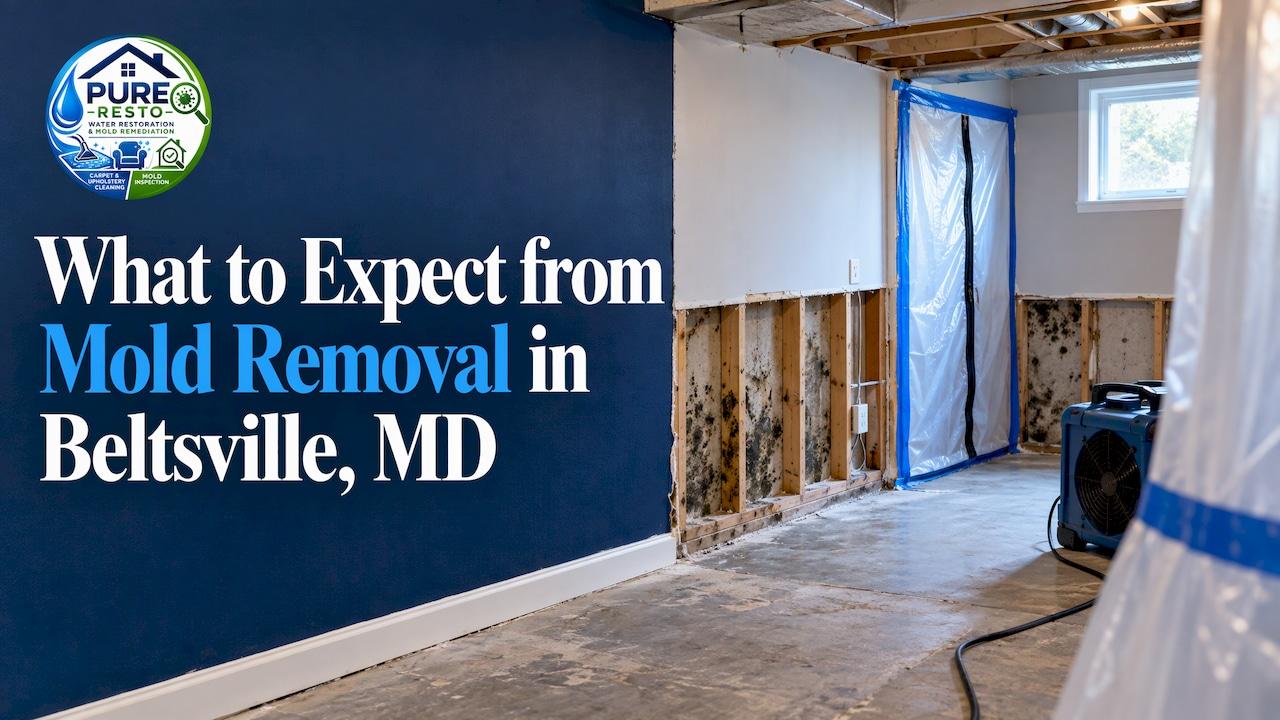
If mold covers more than a small patch in your Beltsville home, or it keeps coming back after you clean it, the right answer is professional remediation: finding and fixing the moisture, containing the area, removing what cannot be saved and drying everything properly. Wiping the stain away is not enough. Pure Resto is an IICRC-certified restoration company in Bowie, MD, and our crews typically arrive within 30 minutes of your call, 24/7. Here is how the work goes, what drives the price and how to judge a contractor before you sign.
TL;DR
- Mold can't be eliminated from a home, so the goal is moisture control. The EPA says if you clean up mold but don't fix the water problem, it will most likely return.
- Growth over about 10 square feet, or mold after a lot of water damage, is a job for a professional.
- Ask for a contractor certified through a body such as the IICRC, NEHA, AIHA or ACAC, as the CDC recommends.
- National averages put remediation near $2,300, with most quotes between $1,200 and $6,000, depending on size, location and mold type.
- Maryland is writing uniform mold standards due by June 1, 2027, so a contractor who already follows EPA guidance is the safer choice today.
Table of Contents
- Mold removal vs. mold remediation
- When to call a professional
- How professional mold remediation works, step by step
- What mold removal costs
- Maryland rules: what has changed
- How to choose a mold remediation contractor in Beltsville
- Preventing mold from returning
- Our perspective
- Get help with mold in Beltsville
- FAQ
- Sources
Mold removal vs. mold remediation
People use the two terms interchangeably, but they describe different outcomes. Removal sounds like making the mold disappear. Remediation is the full job: locate the moisture source, contain the work area, clean or discard affected materials, dry everything and confirm the problem has not returned.
The distinction matters because mold spores are always present in air and dust. The EPA's position is that the deciding factor is moisture. Remove the visible growth without fixing the leak, the humidity or the condensation, and the colony usually returns within weeks. That is why a company that only scrubs and sprays is not really solving a Beltsville basement problem.
When to call a professional
Small, surface-level mold on a hard, nonporous surface can often be wiped off with water and detergent, according to EPA guidance on mold in buildings. Call a professional when any of these apply:
- The area is larger than about 10 square feet. The EPA points homeowners to its more detailed remediation guidance at that size, or when there has been a lot of water damage (EPA).
- The water was contaminated. Sewage or other contaminated water calls for a professional with experience in that kind of cleanup.
- The mold is in drywall, insulation, carpet padding or ceiling tile. The EPA notes that porous materials that are wet and moldy may have to be discarded, because mold works into the crevices and is hard or impossible to remove completely.
- You smell mold but can't see it. Hidden growth behind walls, under flooring or in HVAC components needs a proper inspection.
- The problem keeps returning. A repeat colony usually means the moisture source has not been found.
Water damage and mold travel together. If you have had a burst pipe, a failed sump pump, a roof leak or a flooded basement, getting water damage restoration in Beltsville started quickly is the best way to prevent a mold job in the first place.
How professional mold remediation works, step by step
The EPA's Key Steps flowchart lays out the sequence that reputable remediators follow. Here is each stage, where it tends to go wrong, and what we do.

1. Assess the damage and find the moisture source
The first step is to look at the affected materials and trace the water: a leaking supply line, a failed window seal, a damp crawl space, a clogged condensate line, poor attic ventilation. Skipping this step is the single most common reason mold comes back. If hidden mold turns up once walls are opened, the plan is reevaluated.
For homeowners who want a clear picture before any work starts, our mold inspection in Beltsville identifies where the growth is and what is feeding it.
2. Plan the work and the protection
A good plan sets out the containment, the protective equipment and the personnel. The size of the job drives all three. The scale matters: contamination of more than 100 square feet is generally classed as extensive, and the work then calls for a sealed enclosure, a HEPA-filtered exhaust fan, and trained workers in full-face respirators and protective clothing. OSHA describes inhalation as the exposure route of most concern during mold cleanup, which is why engineering controls and protective gear are not optional on large jobs.
This is where hiring a professional pays off. Our technicians are IICRC-certified and work with HEPA filtration equipment, which is built to capture airborne particles so they are not spread through the rest of your home.
3. Contain, remediate and fix the moisture problem
Containment keeps spores from drifting into clean rooms while materials are cleaned or removed. Hard surfaces are cleaned. Porous materials that cannot be cleaned are removed in sealed bags. The moisture source is corrected at the same time, not afterward.
Where it goes wrong: crews that open a wall without containment, or that leave the leak for "the plumber later." Ask any contractor how they will keep dust out of the rest of the house.
4. Dry everything
The EPA flowchart calls for drying non-moldy items within 48 hours. Extraction and drying equipment does this faster and more thoroughly than fans and open windows. Our approach combines advanced extraction, drying and HEPA filtration so that moisture is dealt with as part of the job.
If a flood or leak soaked your floors too, carpet cleaning in Beltsville and contents cleaning can be handled by the same crew, so you are not coordinating several companies.
5. Check that moisture and mold have not returned
The last step is a check for returning moisture or mold. The CDC says cleanup is finished when no signs of water damage or mold growth remain and people can re-occupy the space without health complaints. Odors left behind after remediation are a separate problem, and our odor removal and sanitization service addresses them.
What mold removal costs
We don't publish fixed prices, because every job depends on the square footage, the materials and where the mold is. National figures from Redfin's 2025 mold guide give a realistic range to budget against:
| Job type | Typical national cost (Redfin, Aug. 2025) |
|---|---|
| Mold inspection | $300 to $1,000, national average around $680 |
| Small area, under 10 sq ft | $500 to $1,500 |
| Medium area, 50 to 300 sq ft | $1,000 to $7,500 |
| HVAC or critical systems | $2,000 to $10,000 |
| Whole-home or hard-to-reach work | $10,000 to $30,000 |
| Overall remediation | Averages around $2,300; most quotes $1,200 to $6,000 |
Redfin also reports a per-square-foot range of $10 to $25 for remediation, and says Stachybotrys (often called black mold) or Fusarium jobs run $800 to $8,000, against $600 to $6,000 for Aspergillus or Cladosporium.
What moves the number most:
- Size of the affected area. Cost rises quickly once containment and negative air are needed.
- Location. A basement wall is cheaper to reach than mold in an attic, a crawl space or ductwork.
- Materials affected. Drywall and insulation must be replaced; tile and framing can often be cleaned.
- The moisture repair. A leaking roof or plumbing line is a separate fix that must happen for the work to last.
If the mold followed a covered event, such as a burst pipe, insurance may pay part of the work. We work directly with insurance providers to streamline the claims process, so the paperwork does not fall entirely on you. Coverage depends on your policy and the cause of the damage, so read your policy or call your agent about what applies.
Maryland rules: what has changed
Maryland has historically had no working state licensing program for mold firms. A 2008 law created a licensing scheme through the Maryland Home Improvement Commission, but according to a 2024 state workgroup report it was never implemented because funding was not provided.
That is changing. Senate Bill 856, effective July 1, 2025, requires the Maryland Department of the Environment to adopt uniform regulations by June 1, 2027. They will cover mold evaluation, sample analysis, visible mold inspections, remediation under the EPA's 2008 guidelines as revised, and a risk reduction standard for mold hazards.
For property managers and landlords, the same law adds timelines. Per the state's fiscal and policy note, landlords must provide tenants the mold pamphlet at lease signing and on request, perform an assessment within 15 days after written notice of detected mold, and remediate within 45 days after an assessment detects mold, or within a reasonable time if that is not feasible. If you manage rental property in Beltsville, building a response plan around those deadlines is sensible.

How to choose a mold remediation contractor in Beltsville
Until the new state standards arrive, the best protection is to hire carefully. Use this checklist:
- Certification. The CDC recommends a professional affiliated with or certified by NEHA, AIHA, IICRC or ACAC. Pure Resto is IICRC-certified.
- License and insurance. Ask for proof. We are fully licensed and insured.
- Moisture plan. The contractor should explain how the water source will be found and fixed, not just how the mold will be removed.
- Containment and air filtration. Ask what keeps spores from spreading, and whether HEPA filtration is used.
- Written scope and workmanship standards. You should know what is being removed, what is being replaced and what is covered by the guarantee. Our jobs are backed by a satisfaction guarantee and written workmanship standards.
- Response time. Mold grows where water lingers. A crew that arrives in hours rather than days limits the spread. Our emergency crews typically arrive within 30 minutes.
- Insurance handling. If your claim is involved, a contractor who bills the insurer directly saves you time.
One point about the first step: the person who tests and the person who removes the mold can be the same company. Having one team handle inspection, remediation, drying and cleanup keeps a single party accountable for the result.
Preventing mold from returning
The EPA says the key to mold control is moisture control. In a typical Beltsville house that means:
- Fixing leaks in pipes, roofs and windows quickly.
- Watching for condensation and high humidity, especially in basements and bathrooms.
- Servicing HVAC systems and keeping condensate lines clear.
- Drying wet materials within 48 hours.
Exterior water management matters too. Overflowing gutters and poorly ventilated soffits send moisture into walls and attics, and fixing the moisture first and then cleaning mold on soffits follows the same principle as the interior work. After cleanup, a safe post-renovation cleaning plan helps clear construction dust from the rooms that were opened up.
Our perspective
Most mold calls we hear start the same way: a homeowner cleaned a stain, it came back, and now it is bigger. The stain was never the problem. The water behind it was.
That is why we treat mold as part of a restoration job, not a cleaning job. Our approach emphasizes preventive measures and restoration rather than simple cleanup: extraction and drying to remove the moisture, HEPA filtration to protect the air in your home, and certified technicians who follow industry practice.
When a Beltsville family finds mold, speed matters. That is why we staff 24/7 and aim to have a crew at your door within 30 minutes. And because water damage, mold, odors, carpets and contents often come as a package, one team can handle each part and bill your insurance provider directly.
Pure
Get help with mold in Beltsville
If you have found mold, a musty smell or water damage, our team handles inspection, removal, drying and odor control for Beltsville homes and businesses. Start with our mold remediation in Beltsville page, or visit the Pure Resto homepage to reach a crew at any hour.
We are licensed and insured, back our work with a satisfaction guarantee, and work directly with insurance providers on covered claims. Neighbors in Greenbelt and Silver Spring can reach us the same way.
FAQ
How much does mold removal cost in Beltsville?
Prices depend on the size and location of the growth and the materials involved. Redfin's 2025 national figures show most remediation quotes between $1,200 and $6,000, with an average near $2,300. A written estimate after an inspection is the reliable way to know your number.
What is Stage 4 mold contamination?
It is the most extensive level of contamination, generally more than 100 square feet in one area. It calls for a sealed enclosure, HEPA-filtered exhaust, sealed disposal of materials that can't be cleaned and trained workers in full protective gear. This is professional work, not a weekend project.
Is mold removal the same as mold remediation?
Not quite. Removal is taking mold out. Remediation includes finding and fixing the moisture source, containment, cleaning or discarding materials, drying and a final check, so the mold does not come back.
Does Maryland license mold contractors?
Not yet in a working program. A 2025 law directs the state to adopt uniform mold standards by June 1, 2027. In the meantime, look for certifications such as the IICRC, plus license and insurance.
Will insurance cover mold removal?
It depends on your policy and what caused the moisture. Mold that follows a sudden covered event, like a burst pipe, is more likely to be included than mold from long-term humidity. We work directly with insurance providers on the claims process.
Sources
- A Brief Guide to Mold, Moisture and Your Home, US EPA
- Mold Remediation in Schools and Commercial Buildings, Chapter 3, US EPA
- Mold Remediation Key Steps flowchart, US EPA
- Homeowner's and Renter's Guide to Mold Cleanup After Disasters, CDC
- Post-flood mold factsheet, NJ Work Environment Council
- Mold Hazards during Disaster Cleanup, OSHA
- When You Might Need a Home Mold Inspection, Redfin
- Maryland Senate Bill 856, Chapter 539
- Maryland Senate Bill 856 Fiscal and Policy Note
- Workgroup on Mold Standards and Remediation, Maryland, 2024