
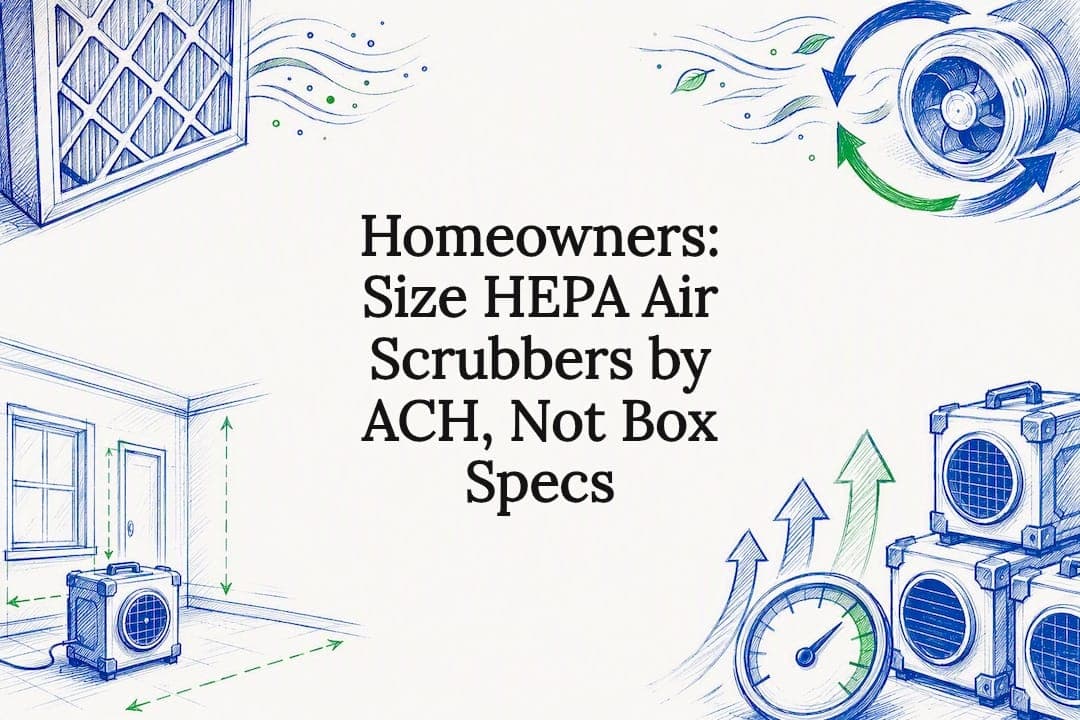
A true HEPA air scrubber captures airborne mold spores as they pass through its filter, but it does not kill mold or remove growth already colonizing drywall, wood, or carpet. It is a containment and air quality tool used during active remediation work, not a standalone fix. Skip the moisture repair and skip proper containment, and the scrubber becomes an expensive fan.
TL;DR:
- HEPA air scrubbers are designed for continuous, high airflow remediation work and are not suitable as standalone solutions without proper containment and moisture control.
- True HEPA filters capture 99.97% of particles at 0.3 microns, but only if they are correctly sealed and properly installed, preventing unfiltered air from bypassing the filter.
- Sizing a scrubber requires calculating room volume and target air changes per hour, with at least 6 ACH recommended for faster removal in contaminated spaces.
- Proper setup—including sealed containment, ducting exhaust outdoors, and confirming negative pressure—is critical to prevent spores from spreading during mold remediation.
- Air scrubbers do not kill mold or dry wet materials; they only filter airborne spores, so moisture control and physical removal are essential for effective mold treatment.
Table of Contents
- What Is a HEPA Air Scrubber, and How Is It Different From an Air Purifier?
- How Does HEPA Filtration Actually Capture Mold Spores?
- When Should You Actually Use an Air Scrubber for Mold?
- How Much Airflow Do You Actually Need? Sizing an Air Scrubber
- How Do You Set Up an Air Scrubber the Right Way?
- What Air Scrubbers Don't Do (and Where People Waste Money)
- What PPE, Cleanup, and Clearance Testing Look Like After the Work Is Done
- Pure Resto's Take: How Pros Use Scrubbers, and When to Call One
- When It's Time to Call in Pure Resto
- Sources
- FAQ
What Is a HEPA Air Scrubber, and How Is It Different From an Air Purifier?
A HEPA air scrubber and a consumer air purifier both push air through HEPA media, but they're built for different jobs. Scrubbers are industrial machines designed to run continuously for days at high airflow, often ducted into containment barriers during a remediation project. Consumer purifiers are built for quiet, occasional cycling in a living room, not for the sustained abuse of a construction-style job site.
The construction quality reflects that gap. Remediation-grade scrubbers use multi-stage filtration (a pre-filter, sometimes a carbon stage, then true HEPA), heavier housings, and ducting collars that let technicians connect flexible hose to move filtered air outside containment. A residential purifier has none of that. It's a sealed unit meant to sit in a corner, not to be hard-ducted into a sealed room.
The operational difference matters just as much:
- Scrubbers run around the clock during demolition, drying, and cleanup, often for several days straight.
- They integrate into physical containment, pulling air through the space and exhausting it through ducting, which is how negative pressure gets created.
- Purifiers cycle room air passively and were never engineered to anchor a containment system.
For everyday indoor air quality, a well-rated residential purifier is usually enough. Once you're cutting into moldy drywall or disturbing an attic full of contaminated insulation, you need the higher airflow and durability of a real scrubber. Mixing up the two is one of the most common and costly mistakes homeowners make when a mold problem escalates.
How Does HEPA Filtration Actually Capture Mold Spores?
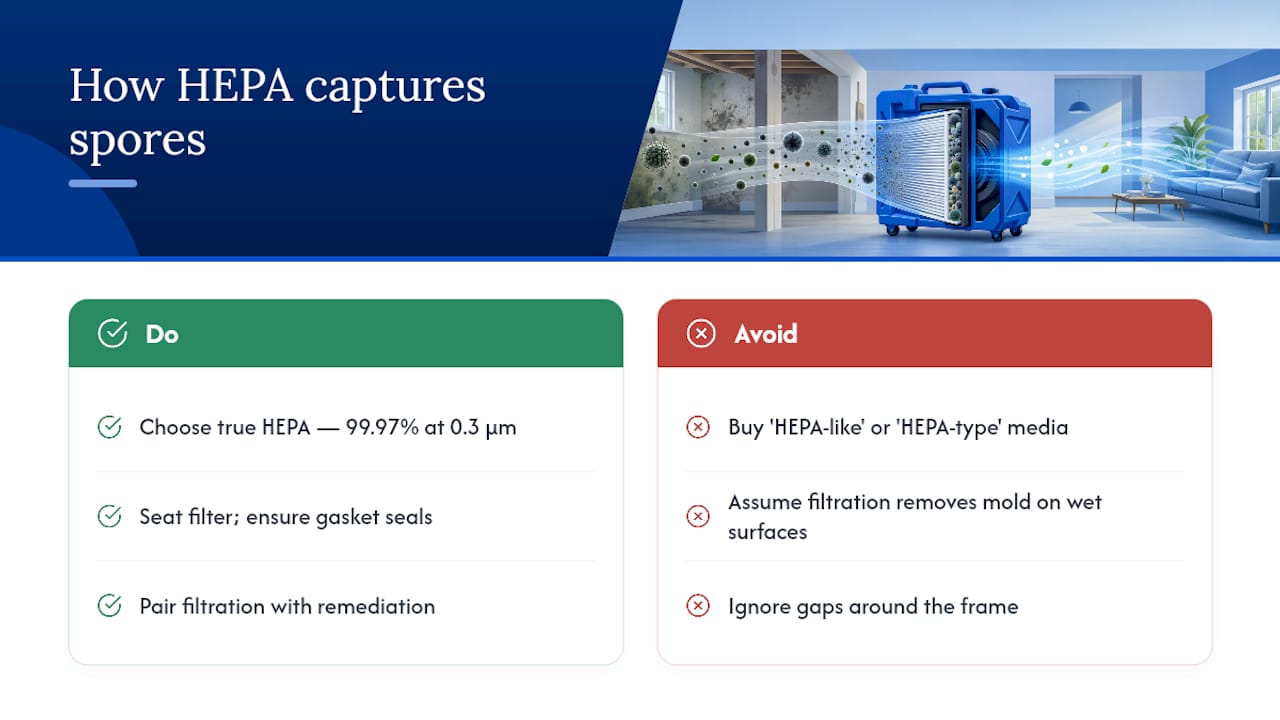
HEPA is a specific, regulated performance standard, not a marketing label. A true HEPA filter captures 99.97% of particles at 0.3 microns in diameter, which happens to be the hardest particle size to trap. Most indoor mold spores measure roughly 2 to 12 microns, comfortably larger than that benchmark size, so a properly seated true HEPA filter catches the overwhelming majority of spores that reach it.
But that number only describes what happens to particles that pass through the filter media. It says nothing about moisture, volatile organic compounds, or the mold already growing on a wet baseboard. Filtration and remediation are two separate jobs, and confusing them is where a lot of DIY mold projects go sideways.
Two technical details decide whether a scrubber performs as advertised. First, it has to be true HEPA, not a "HEPA-type" or "HEPA-like" filter, terms manufacturers use for cheaper media that doesn't meet the actual spec. Second, the filter has to seat correctly in its housing. A warped gasket or a gap around the frame lets unfiltered air bypass the media entirely, and you'd never know just by looking at the unit running.
When Should You Actually Use an Air Scrubber for Mold?
Air scrubbers earn their place during active disturbance, the phase of a job where mold-contaminated material gets cut, pulled, or otherwise agitated and spores go airborne in large numbers. That covers a specific set of situations:
- Demolition and drywall removal. Cutting out moldy drywall or subfloor releases a burst of spores that a scrubber pulls out of the air before they settle elsewhere.
- Attic and crawlspace work. Disturbing contaminated insulation or sheathing in a confined space benefits from continuous filtration, since these areas often have poor natural air exchange to begin with.
- Containment maintenance. Once a barrier is up, a scrubber ducted into that space keeps it under negative pressure for the duration of the job.
- Post-remediation drying. After materials are removed, running a scrubber alongside dehumidification helps clear residual dust and fine particulate before final cleaning.
Scale matters here. A single isolated spot of mold, say a small patch behind a leaking sink trap, usually doesn't justify full containment and a dedicated scrubber. Careful removal, HEPA vacuuming, and fixing the leak often suffice. Once contamination spreads beyond roughly ten square feet, involves multiple rooms, or keeps returning after cleanup, the math changes.
Certain red flags should push you toward calling a professional rather than renting equipment yourself:
- A musty odor that persists after visible cleanup
- Visible growth larger than a small, isolated patch
- Any sign mold has entered HVAC ductwork
- Recurring moisture from a source you haven't been able to stop
If any of those apply, the job has likely outgrown a DIY approach, and a professional assessment beats guessing at containment on your own.
How Much Airflow Do You Actually Need? Sizing an Air Scrubber
Sizing starts with room volume, not floor area. Multiply length by width by ceiling height to get cubic feet. A 20 by 15 foot room with 8 foot ceilings comes out to 2,400 cubic feet.
From there, you calculate required airflow using air changes per hour, or ACH, the number of times the total air volume gets filtered in sixty minutes. EPA-referenced remediation guidance for schools and commercial buildings sets a minimum of 4 ACH for containment areas, though many remediation professionals target 6 ACH to move contaminated air out faster during active work.
The formula: Required CFM = (Room volume × Target ACH) ÷ 60.
For that 2,400 cubic foot room at 6 ACH: (2,400 × 6) ÷ 60 = 240 CFM minimum. That's a modest room. Larger basements, open floor plans, or multi-room containment setups push required CFM well past what a residential unit can deliver, which is exactly why remediation crews reach for dedicated scrubbers rather than the air purifier already sitting in the living room. Portable remediation scrubbers are built to move air at a scale residential purifiers were never designed to hit.
A few practical notes on running the numbers:
- Round up, not down. Undersizing airflow is the single most common sizing mistake on DIY jobs.
- Account for containment leaks. Real-world negative pressure loss means your effective ACH runs lower than the math predicts, so build in a margin.
- Recalculate per room. A scrubber sized for a 2,400 cubic foot bedroom won't cut it in an open basement three times that volume.
Pro Tip: Don't just eyeball airflow off the box. Multiply room volume by your target ACH, divide by 60, and you'll know within minutes whether the unit you're looking at can actually do the job or whether you need to size up.
Filter change frequency depends on load. On a heavy demolition job with visible dust, pre-filters may need daily changes, while the HEPA stage itself typically lasts through a single project before requiring replacement. Lighter drying-only phases stretch that interval considerably.
How Do You Set Up an Air Scrubber the Right Way?
Setup mistakes are where good equipment stops working the way it's supposed to. Containment and placement matter as much as the CFM rating on the box.
- Build the containment barrier first. Seal the work area with polyethylene sheeting, taping seams at walls, floor, and ceiling. Install a zippered airlock or flap door so people can enter and exit without breaking the seal repeatedly.
- Position the scrubber to pull air, not just push it. Place the intake inside the contaminated zone and duct the exhaust outdoors or into a secondary chamber if outdoor venting isn't possible.
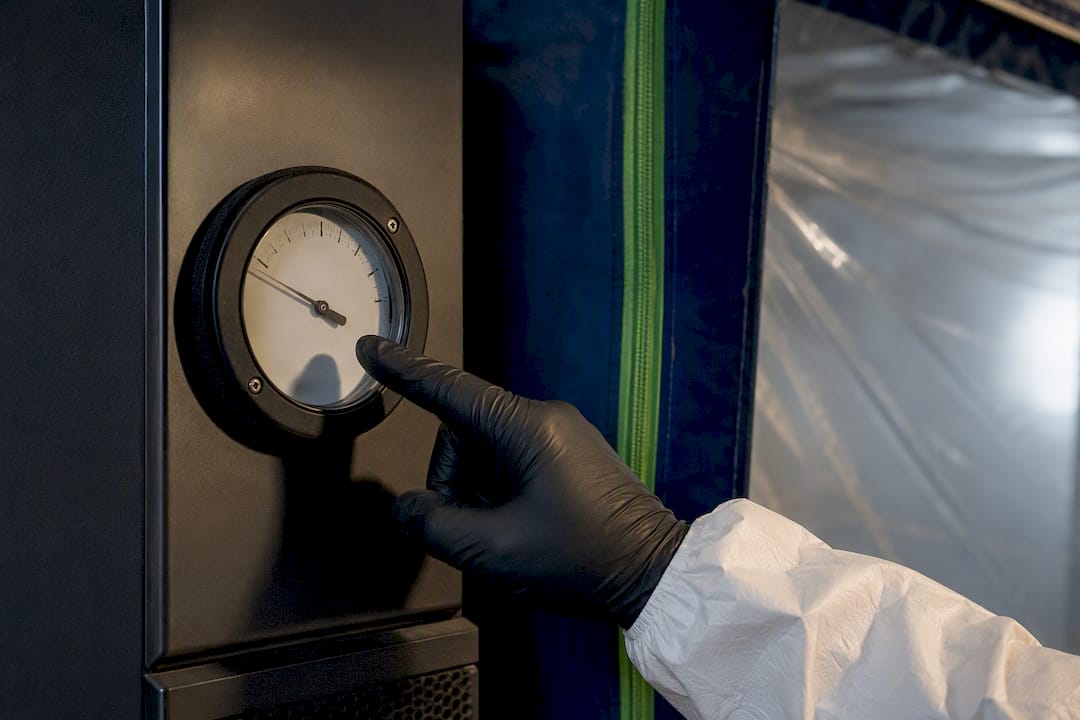
- Confirm negative pressure. A manometer or pressure gauge tells you whether the containment is actually holding negative pressure relative to the surrounding space. Skipping this step is the most common reason DIY containment fails silently.
- Watch discharge direction. Never aim the exhaust across a contaminated surface. That redistributes settled spores instead of clearing them, undoing the point of running the scrubber at all.
- Start before disturbance begins. Turn the scrubber on and let it establish negative pressure before any cutting, removal, or demolition starts, then keep it running through the work and for a period afterward to clear residual particulate.
- Log runtime. Note start and stop times for each phase of the job. That runtime log matters later during clearance testing and, often, for insurance documentation.
Pro Tip: If you can't feel a slight pull of air through the airlock flap when it opens, your containment isn't holding negative pressure, no matter how good the scrubber's spec sheet looks.
Skipping the pressure check is the single biggest gap between a scrubber that contains contamination and one that just moves it around the room.
What Air Scrubbers Don't Do (and Where People Waste Money)
An air scrubber doesn't kill mold, and it doesn't dry out wet materials. Its job is airborne particulate, full stop. Mold growing on a windowsill or inside a wall cavity stays right where it is until someone physically removes the contaminated material or a licensed remediator treats it. The EPA is direct about this: air cleaners capture particles, they don't fix the moisture source causing the growth in the first place.
That distinction trips up a lot of homeowners who buy a purifier hoping it will resolve a musty smell. Long-term prevention comes down entirely to moisture control, whether that's fixing a roof leak, running a dehumidifier after water intrusion, or repairing a failed vapor barrier in a crawlspace.
A few common misuse patterns worth flagging:
- Running a scrubber in an open room with no containment, which just dilutes contamination across a larger volume of air instead of controlling it.
- Leaving a scrubber running indefinitely while an active leak goes unaddressed.
- Expecting a scrubber to eliminate musty odors permanently when the odor source, active growth, is still present.
Air cleaning genuinely helps with lingering odors from a resolved problem. It does nothing for odors sourced from ongoing, active growth.
What PPE, Cleanup, and Clearance Testing Look Like After the Work Is Done
Personal protection scales with the size of the job. For a small, isolated patch you're handling yourself, an N95 respirator, gloves, and eye protection are the baseline minimum. Larger remediation projects call for half-face or full-face respirators, and heavy-exposure commercial work often steps up to powered air-purifying respirators, or PAPRs.
Final cleanup follows a specific sequence, and skipping steps undermines everything done before it:
- HEPA vacuum every surface in the work area, including framing members and subfloor, not just visible dust.
- Damp-wipe surfaces with an appropriate cleaning solution after vacuuming.
- Bag and seal all contaminated debris before it leaves the containment zone.
Clearance testing is the final checkpoint, and the goal is straightforward: indoor spore counts should reach parity with outdoor background levels, not zero. Outdoor air always carries some mold spores, so that's the realistic benchmark professionals test against. Clearance testing typically happens after final cleaning and before containment comes down, giving you documented proof the job actually worked rather than a guess based on smell alone.
Pure Resto's Take: How Pros Use Scrubbers, and When to Call One
Here's what separates a professional setup from a DIY attempt: pressure gauges. Any contractor running containment should have a manometer confirming negative pressure holds throughout the job, not just when the scrubber first switches on. Without that instrument, you're trusting a fan to do a job it can't verify on its own.
We'd call a contractor once contamination crosses a few clear lines: growth beyond a small, isolated patch, odor that persists after visible cleanup, water damage that keeps recurring from the same source, or any sign mold has reached HVAC ductwork. Past that threshold, staged filtration and properly ducted negative pressure aren't optional extras, they're what keeps spores from spreading to parts of the home that were never contaminated in the first place.
Pure Resto's rapid response protocol and IICRC-certified crews are built around exactly that standard.
— Pure
When It's Time to Call in Pure Resto
If you've read this far and you're staring at a contamination problem bigger than an N95 and a spray bottle can handle, that's the point where equipment specs stop mattering and process starts to matter more. Pure Resto handles mold remediation across Maryland with a straightforward sequence: inspection, containment plan, estimate, then insurance coordination if a claim applies.
What sets the process apart is the equipment and the speed behind it. Pure Resto's IICRC-certified technicians bring remediation-grade scrubbers, negative-air containment, and pressure monitoring to every job, not consumer-grade purifiers borrowed from a big-box store. Combined with a 30-minute emergency response window, that means contamination gets contained before it spreads to untouched rooms rather than after. For homeowners juggling an active leak, a spreading odor, or an insurance clock already ticking, that speed differential is the whole ballgame.
Direct insurance billing means you're not fronting remediation costs and fighting for reimbursement later. If any of the red flags covered above sound familiar, the next step is a phone call and an inspection, not another trip to the hardware store for a bigger fan.
Sources
- What is a HEPA filter? | US EPA
- PMC article on indoor mold and health (example peer-reviewed source)
FAQ
Can an Air Scrubber Kill Mold?
No. An air scrubber filters airborne spores as they pass through its HEPA media, but it has no effect on mold already growing on drywall, wood, or other materials, which requires physical removal or targeted treatment.
Can a HEPA Air Purifier Remove Mold From a Room?
A HEPA purifier removes airborne mold spores circulating through the air, but it cannot remove mold growth attached to surfaces, and it won't resolve the underlying moisture problem causing that growth.
Will a HEPA Air Purifier Help With a Mold Problem?
It helps reduce airborne spore counts and can support recovery during active remediation work, but it's not a substitute for fixing moisture issues or removing contaminated material.
Does a HEPA Filter Actually Work Against Mold Spores?
Yes, for airborne spores specifically.
How Do I Know if I Need a Professional Instead of a DIY Scrubber Setup?
Call a professional once contamination covers more than a small isolated patch, odor persists after cleanup, moisture keeps recurring, or mold has reached HVAC ductwork, since those situations typically require containment and airflow beyond DIY equipment.