
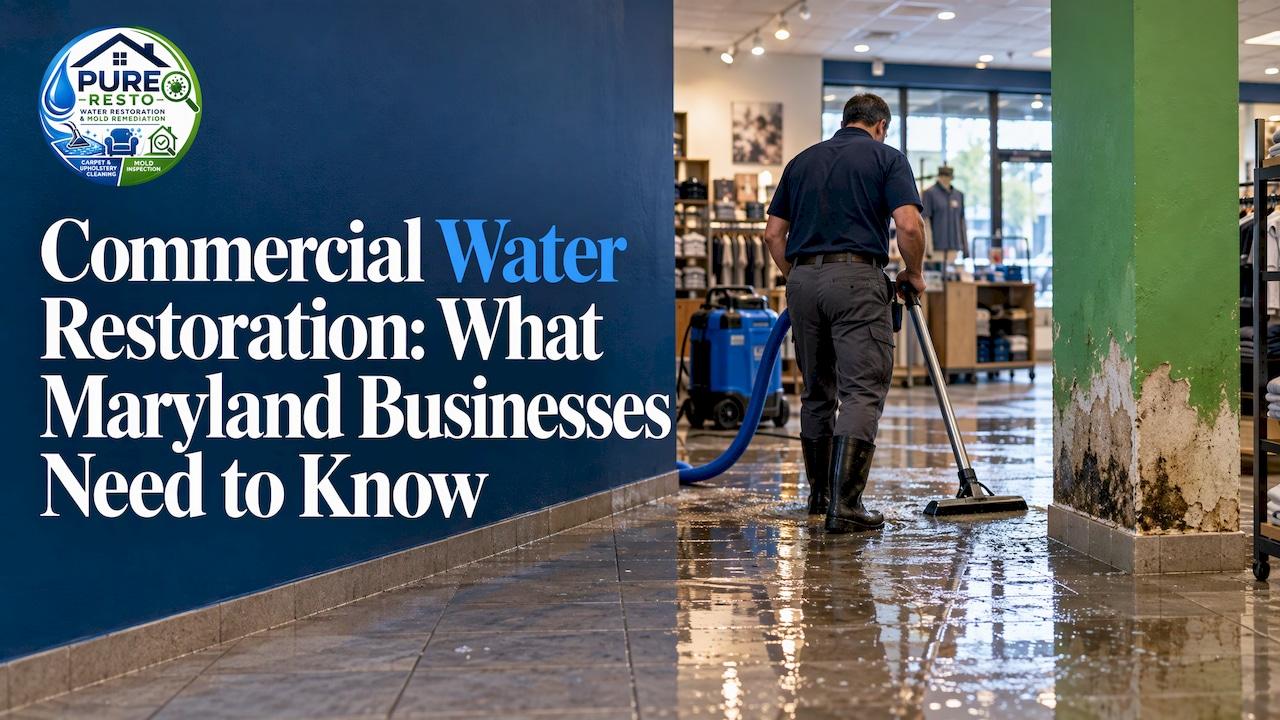
Commercial water restoration is the work of stopping water, removing it, drying the building to verified levels, cleaning and sanitizing, and repairing what was damaged so your business can reopen safely. The faster a qualified crew starts, the smaller the loss. If you manage a property in Bowie, Rockville, Silver Spring, Bethesda, College Park or anywhere else in our service area, this guide covers what to do in the first hour, what the process looks like, how long it takes, what drives cost, and how insurance fits in.
TL;DR
- Stop the water at the source if it is safe, protect people first, then call a restoration contractor right away. Mold can begin within 24 to 48 hours.
- Real restoration means extraction, structural drying, moisture monitoring and sanitizing, not just removing visible water.
- Most mitigation takes several days, and rebuilding is a separate phase. Reopening depends on verified drying, systems checks and insurer sign-off.
- Cost depends mostly on water category, square footage and how long water sat. Published per-square-foot ranges vary by city.
- Document everything from the first minute. It protects your insurance claim and your business interruption recovery.
Table of Contents
- What commercial water damage restoration covers
- The first hour: what to do right now
- How the restoration process works
- How long it takes and when you can reopen
- What it costs and what moves the price
- Insurance and documentation
- Our perspective
- Commercial restoration from Pure Resto
- FAQ
- Sources
What commercial water damage restoration covers
Commercial water damage restoration is the drying, cleaning and repair of a business property after water gets in, with the goal of returning it to a safe, usable condition through inspection, water removal, drying, cleaning and repairs. It applies to offices, retail spaces, warehouses and multi-unit residential buildings, and it goes beyond floors and walls. Inventory, equipment and documents are often in the water's path too.
The difference from a home loss is scale and consequence. A burst sprinkler line over a retail floor in Rockville or a failed supply line above a medical office in Bethesda can shut a whole operation, not just a room. Hidden moisture inside walls, ceilings, shafts and under flooring is the usual reason a "dry-looking" building gets sick later with odor, delamination or mold.
Common causes in our region include:
- Burst or leaking supply lines and failed fixtures
- Sprinkler and fire suppression discharge
- HVAC condensate backups
- Roof and envelope leaks during heavy rain
- Sewage backups and storm intrusion
If the source is the roof, fix the cause as well as the symptoms. Resources on commercial roof leak repair explain how leaks are located and corrected, and a dry building that keeps taking in water is only dry until the next storm.
The first hour: what to do right now
Act in this order, and only as far as it is safe. CNA's incident response guide says to stop the water quickly, put your response plan into action, contact remediation contractors as soon as possible, begin removing water, and notify your risk manager and insurer.
- Protect people. If water has reached outlets or equipment, have a qualified electrician isolate power before anyone walks through standing water. Keep staff and customers out of affected areas.
- Stop the source. Close the valve, shut the main, or stop the discharge.
- Identify the water. Clean supply-line water is a different problem from sewage or other biologically contaminated water. Contaminated water changes the safety rules and the scope.
- Photograph everything. Capture the source, the water line and affected contents before anything is moved.
- Call your contractor and your carrier. Early mitigation limits damage, and your insurer needs prompt notice.
- Protect critical operations. Decide what must keep running, and move records, electronics and inventory out of harm's way where it is safe to do so.
Employers also carry a duty to keep the workplace free of recognized hazards, so water, slip risks and electrical exposure have to be addressed before employees return.
How the restoration process works
The industry's technical framework is the ANSI/IICRC S500 standard. It covers residential, commercial and institutional buildings, including building systems and contents. Current professional practice classifies water by contamination category and drying difficulty class, and verifies drying against moisture readings from unaffected areas.
Inspection and moisture mapping
A technician finds where water traveled, not only where it landed. Moisture meters and thermal tools map walls, floors, ceilings and lower levels. That map becomes the baseline for the drying plan. We wrote more on why moisture mapping beats a single meter reading.
Water extraction
Standing water comes out first. In large spaces, truck-mounted and portable pumps remove volume quickly, followed by extraction from carpet, padding and porous materials that can be saved.

Structural drying and dehumidification
Commercial-grade air movers and dehumidifiers pull moisture out of the building. Technicians then track moisture with meters to confirm the structure is dry through and through, not just dry on the surface. Fans and open windows are not a substitute: trapped moisture under carpet and in subfloors can cause delamination, odor and mold. Our guide to a dehumidifier after water damage explains why equipment sizing and placement matter.
Cleaning, sanitizing and odor control
Affected surfaces are cleaned and, where the water was contaminated, treated with antimicrobials. Lingering smells are handled through odor removal and sanitization.
Contents, then repairs
Furniture, equipment, files and stock are evaluated for cleaning, drying or replacement. When space has to be cleared for work, contents cleaning, storage and packout keeps your inventory safe off-site. Once the structure is dry, reconstruction replaces drywall, flooring or ceilings that could not be saved.
Mold checks
If drying is delayed or moisture was hidden, mold becomes a risk. Mold can start growing within 24 to 48 hours of water exposure. If you suspect it, mold inspection and testing comes before any remediation plan, and mold remediation follows if it is confirmed. Our article on stopping mold after a water leak covers the timeline in detail.
How long it takes and when you can reopen
Plan in phases. Mitigation (extraction and structural drying) commonly runs 3 to 7 days, depending on square footage, water category and materials, and reconstruction is a separate timeline after that. One restoration firm notes larger events and contaminated water can need 7 to 14 days of mitigation before rebuilding starts. Overall, a full project can run from a few days to several weeks depending on severity, drying time and repairs.

What decides when you can reopen is a checklist more than a calendar. One guide describes the conditions as verified drying through moisture mapping, completed sanitizing, HVAC and electrical passing inspection, no detected mold, and insurer clearance. Partial reopening of unaffected sections is sometimes possible while repairs continue.
For larger losses, continuity is a coordination problem. Scope can include temporary power, temporary HVAC, server room drying with humidity control, and elevator coordination when shafts flood. Ask early which areas can be released first so staff can return in stages.
What it costs and what moves the price
We do not publish a flat price, because every loss is different. For context, one Houston contractor's guide puts commercial restoration at roughly $3 to $25 per square foot, with clean-water losses at the low end, gray water in the middle and sewage or water sitting more than 72 hours at the top. A Los Angeles contractor lists $4.50 to $8.00 per square foot for clean-water mitigation. Those are other markets and other years, so treat them as a sense of scale, not a Maryland quote.
The factors that move any commercial estimate:
| Factor | Why it matters |
|---|---|
| Water category | Clean, gray and black water need different safety steps and treatments |
| Time before mitigation | Longer exposure means more wet materials and more mold risk |
| Square footage and layout | More area and more floors mean more equipment and monitoring |
| Materials affected | Carpet, drywall, insulation and flooring dry or fail differently |
| Contents | Inventory, equipment and records may need cleaning or packout |
| Continuity needs | Temporary power, HVAC or phased reopening add scope |
The most controllable factor is speed. Hours matter, and so does a clear scope in writing before work begins.
Insurance and documentation
Coverage depends on your policy and on the cause. Commercial property insurance may cover sudden and accidental plumbing losses, subject to terms. Standard commercial coverage generally excludes flood, long-term leaks, corrosion and deterioration, and flood protection requires a separate flood policy. Read your declarations page and endorsements, and call your agent about your specific policy.
Two details worth knowing before a loss. Commercial policies can carry a co-insurance clause requiring coverage to 80% or 90% of replacement value, and under-insurance triggers a proportional penalty. In that source's example, a building insured to 70% against an 80% requirement is paid 87.5% of the covered loss. Also, business interruption clocks run from the moment damage makes normal operations impossible, so delay in starting mitigation can lengthen the interruption.
Keep a claim file:
- Photos and video of the source, damage and contents, with timestamps
- Your policy documents and your adjuster's contact details
- Moisture readings, equipment logs and drying records
- Invoices, and receipts for temporary expenses
- Sales, payroll and financial records that support business interruption
Ask your contractor for a close-out report showing water category and class, moisture readings over time, equipment used and photos. We work directly with insurance providers to streamline the claims process.
Our perspective
Most commercial losses get worse in the first day, not on the day of the flood. A building that looks fine on Monday can be growing mold by Wednesday if moisture is trapped behind a wall or under a floor.
That is why we built our service around speed and verification. We aim to respond within 30 minutes, 24 hours a day, because the first hours decide how much of your property can be saved instead of replaced. Our IICRC-certified team uses advanced extraction, drying and HEPA filtration to protect both the structure and the air your people breathe.
We treat restoration as more than cleanup. The goal is to dry the building properly, prevent the secondary problems, and document the work so your claim moves smoothly. As a licensed and insured company standing behind a satisfaction guarantee, we want your business back to normal on a plan you can follow.
Pure
Commercial restoration from Pure Resto
If water has hit your business in Bowie, Crofton, Rockville, Silver Spring, College Park, Greenbelt, Lanham, Laurel, Beltsville, Potomac, Glenn Dale, North Bethesda, North Potomac, Bethesda or Washington, DC, we can help. We provide 24/7 emergency water damage restoration, mold inspection and remediation, odor removal, and contents cleaning and storage for commercial and residential properties.
See our commercial restoration page or our water damage restoration service, or contact us from purerestomd.com to get a crew moving. Local pages are also available for Lanham and Washington, DC.
FAQ
Is commercial water damage restoration different from residential?
Yes, mainly in scale and consequences. Commercial jobs involve larger areas, building systems, inventory and equipment, and the business has to weigh downtime and continuity alongside drying. The drying science is the same, but the planning, staging and documentation are heavier.
Should I call my insurance company or a restoration contractor first?
Do both quickly. Notify your insurer and risk manager promptly, and start mitigation right away, because waiting for mold prevention is not a safe plan. We work directly with insurers, so we can coordinate documentation while the crew is on site.
Can my business stay open during restoration?
Sometimes. Unaffected sections can often stay in use while affected areas are dried and repaired, provided they are safe and your insurer agrees. Your contractor should tell you which zones can be released first.
Will mold be a problem after a commercial water loss?
It can be if materials stay wet. Mold can begin in 24 to 48 hours, so fast extraction and verified drying are the best prevention. If you smell mustiness or see staining after a loss, schedule a mold inspection.
Sources
- What Is Commercial Water Damage Restoration?
- Commercial Water Damage Restoration: A Business Guide
- CNA Water Damage Incident Response Guide
- What to do in the first 24 hours after a commercial flood
- Commercial Water Damage Guide, Fast Restoration
- ANSI/IICRC S500 Standard
- Water Damage Restoration Guide
- Commercial Water Damage Restoration, Tpro Group
- Commercial Water Damage Restoration for Business Recovery
- Commercial Water Damage Restoration: How Businesses Limit Loss
- Commercial Water Damage Restoration in Houston
- Commercial Water Restoration Cost Houston
- Commercial Water Damage Cleanup Los Angeles
- How Long Does Commercial Water Damage Restoration Take?
- Large Loss Protocol, Restoration Intel
- Water Damage and Your Business: Understanding Coverage