
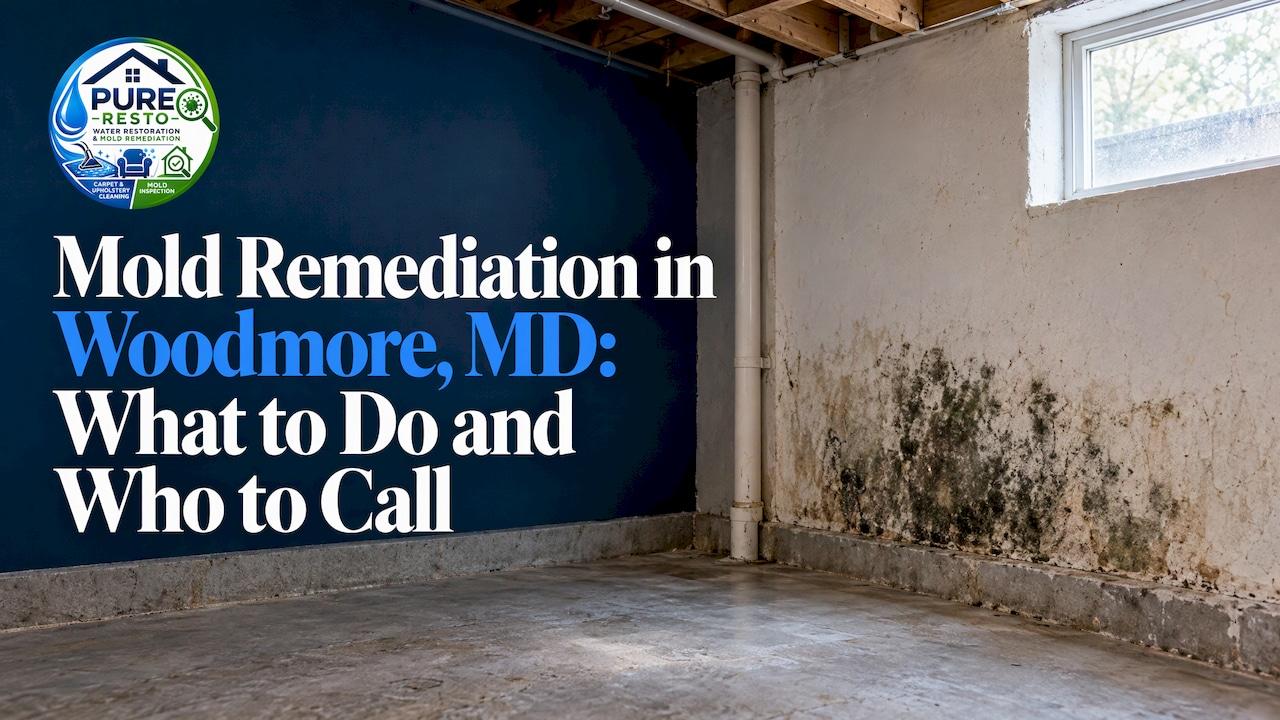
If mold covers more than about 10 square feet of your Woodmore home, came from a plumbing leak or sewage, or keeps coming back, it needs professional remediation, and the sooner the moisture is dealt with, the less there is to remove. Pure Resto is an IICRC-certified restoration company based in Bowie, MD, and our crews typically arrive within 30 minutes of your call. We find the moisture source, contain and remove the mold, dry the structure and work directly with your insurance provider. Our Woodmore mold remediation page lays out the service.
This guide is for homeowners and property managers in Woodmore and nearby Bowie, Mitchellville, Glenn Dale and Lanham. It covers how to tell what you are dealing with, what to do in the first 48 hours, what a proper remediation looks like step by step, what affects the price and what Maryland law says.
TL;DR
- Mold on more than roughly 10 square feet, mold after sewage or a chronic leak, or mold in the HVAC system calls for a professional, according to EPA-based guidance.
- Mold follows moisture. Wet materials should be dried within 24 to 48 hours or removed, and the leak must be fixed or the mold returns.
- Keep indoor humidity at or below 50% in Maryland's humid months, and never paint over mold.
- Maryland does not currently require a separate mold remediation license beyond a home improvement license, so ask any contractor about certification and insurance.
- Call us at the first sign of a leak or musty smell. We respond around the clock and bill your insurer directly.
Table of Contents
- How to tell if your Woodmore home has a mold problem
- What to do in the first 48 hours
- What professional mold remediation involves
- What affects the cost of mold remediation
- Maryland rules on mold: what you need to know
- Keeping mold from coming back in Woodmore
- Why Woodmore homeowners call us
- Our view: moisture first, then mold
- Get a Woodmore mold problem handled
- FAQ
- Sources
How to tell if your Woodmore home has a mold problem
Mold announces itself in a few ways. Federal disaster-recovery guidance from the NIEHS lists a musty or earthy odor, staining or discoloration, and fuzzy growth as signs of a possible problem. The same guidance notes that mold starts to accumulate on surfaces at around 20% moisture content, and that drying targets are generally 17% or less.
In Woodmore, the usual culprits are familiar to anyone who owns a house in Prince George's County:
- Basements and lower levels, where groundwater, window wells and foundation seepage keep walls and carpet damp.
- Bathrooms and laundry rooms, where a slow supply-line or drain leak hides behind drywall.
- Attics and ceilings, where roof leaks or poor ventilation leave stains that spread.
- HVAC systems, where clogged condensate drain pans and humid summer air create moisture inside the ductwork.
- Anywhere a past water event was not dried completely, including carpet and pad that stayed wet for days.
Visual inspection is how mold is mostly assessed. The EPA says there are no established safe levels or regulatory standards for mold, and that assessment is mainly done by looking at areas where water damage has occurred. That is why a trained inspector who understands how water moves through a house is useful: the job is to find where the moisture came from, including areas you cannot see. Our mold inspection service covers Woodmore homes.
The 10 square foot rule
The most practical line for homeowners comes from EPA-based guidance: call a professional when contiguous moldy material exceeds roughly 10 square feet, HVAC contamination is documented, or the moisture source is sewage or a chronic plumbing leak. The National Environmental Health Association's 2026 guide says the same about contacting a remediation contractor above 10 square feet. Ten square feet is about a 3 by 3 foot patch, roughly the size of a small closet door.

Below that size, hard surfaces such as tile can be cleaned with detergent and water. Porous materials like drywall and carpet pad that have stayed wet usually need to be replaced rather than cleaned.
What to do in the first 48 hours
Speed matters because mold grows on wet materials quickly. CDC and NIOSH guidance says appropriate response includes drying wetted materials within 48 hours or removing them, repairing the source to stop further water entry, and using proper containment when mold is found on materials.
Here is a practical order of operations after a leak or flood:
- Stop the water. Shut off the supply to the broken fixture or the main valve. If the leak is from a pipe, a plumber's guide on stopping water and preventing mold walks through the shutoff and power safety steps.
- Stay away from wet electrical areas. If water has reached outlets, panels or appliances, turn off power to that area from the breaker only if you can do so without standing in water, and call an electrician.
- Remove standing water and open the space to air. Move furniture and lift soaked rugs off floors.
- Call a restoration company early. Extraction and drying equipment pulls moisture out of walls and subfloors faster than fans and open windows can. Our water damage restoration team is available 24/7 for exactly this stage, and a quick start is the best way to avoid needing mold remediation at all. Our guide to stopping mold in the 24 to 48 hours after a leak goes deeper.
- Do not paint over stains. CDC and NIOSH guidance says painting over water-damaged or moldy surfaces is inappropriate.
- Protect yourself. If you do any small cleanup, NEHA advises an N95 respirator, long gloves and goggles, and discarding porous materials that have been wet more than 24 to 48 hours.
Who should be extra careful
The Maryland Department of Health notes that molds can produce irritants that worsen asthma or cause allergic reactions such as sneezing, a runny nose, red eyes and skin rash. NEHA advises extra precautions for children, older adults and people with respiratory conditions. If someone in your household has asthma or a weakened immune system, keep them out of the affected area and talk with their doctor about symptoms.
What professional mold remediation involves
The EPA's remediation guide, written for schools and commercial buildings but widely used as the model sequence, lays out the stages in order. Here is that sequence with what it means in a Woodmore house.
| Stage | What happens | Why it matters |
|---|---|---|
| Assess | Measure the size of the problem and which materials are damaged | Sets the scope and tells you whether the job is small or structural |
| Find the moisture source | Trace the leak, condensation, humidity or HVAC issue | The key to mold control is moisture control; otherwise mold can reappear |
| Plan and protect | Select protective equipment and containment | Keeps spores from spreading to clean rooms |
| Remediate | Clean and dry moldy materials; discard what cannot be cleaned | Removes the contamination itself |
| Fix the moisture problem | Repair the leak and dry the structure | Stops regrowth |
| Dry and verify | Dry non-moldy items within 48 hours and check for returning moisture or mold | Confirms the job held |
The EPA also makes occupant health and safety the manager's highest priority, calls for communicating with occupants throughout, and says large cases may involve temporarily relocating occupants. OSHA's workplace guide adds that after remediation, a revisit should show no moldy or musty odors, water damage or mold growth, and that any sampling should show indoor mold levels and types similar to outdoors.
Where our crews fit
At Pure Resto, remediation is paired with the water work that causes it. Our technicians are IICRC-certified and use advanced extraction, drying and HEPA filtration equipment to prevent further damage and health hazards. HEPA filtration captures very fine airborne particles, which is what you want in a house where mold is being disturbed. Because water damage restoration and mold remediation are handled by the same company, the leak, the wet materials and the mold are treated as one problem. If lingering smells remain after the mold is gone, our odor removal service addresses them.
Wet carpet and upholstery are part of this too. The Howard County Health Department recommends replacing previously soaked carpets and upholstery. When items can be saved, our contents cleaning and storage service moves them out of the work area so they are not exposed while walls and floors are being treated, and our carpet cleaning and upholstery cleaning services handle fabrics that come through water events.
What affects the cost of mold remediation
We do not publish a flat price, because mold jobs vary too much for one number to be honest. A quote depends on factors you can understand before anyone arrives:
- Area affected. A few square feet in a bathroom corner is a different job from a finished basement.
- Materials involved. Drywall, insulation and carpet pad that have to be removed and replaced add labor and materials. Hard surfaces that can be cleaned cost less.
- Location. Attics, crawl spaces and ductwork take more containment and access work.
- The moisture source. A one-time spill is simple. A chronic leak, sewage or a humidity problem means more drying and repair.
- Containment needs. Larger or more disturbed areas need more protection for the rest of the house.
- Rebuild. Removing drywall or flooring means it must be replaced afterward.
If the mold followed a covered water event, such as a sudden pipe burst, your homeowner's policy may respond. We work directly with insurance providers to streamline the claims process, so you are not trading calls between adjusters and contractors while a house is drying. Read your policy or call your agent about what is covered, since coverage differs between policies and between causes of loss.
Maryland rules on mold: what you need to know
Maryland's mold rules are narrower than many homeowners assume.
Contractor licensing. The Maryland Home Improvement Commission states that a 2008 law once required licensing for residential mold remediation contractors, but that subtitle was terminated on July 1, 2019, so no separate state mold-remediation license is currently required beyond an MHIC license. A 2024 state workgroup report adds that the 2008 law was never implemented because funding was not provided. In practice, that makes industry certification and insurance the things to look for. We are IICRC-certified, fully licensed and insured.
Rental housing. If you are a landlord or property manager, a newer law applies. Maryland's Tenant Mold Protection Act, effective July 1, 2025, requires landlords to give tenants a state mold pamphlet at lease signing, begin assessment and remediation within 15 days after written notice of mold, and complete remediation within 45 days after a positive assessment, or within a reasonable time if that is infeasible. It also requires communication with occupants and proper ventilation and low humidity. The Maryland Department of the Environment must adopt uniform standards by June 1, 2027. Those deadlines are tight, which is why property managers benefit from a contractor that responds in minutes rather than days.
Standards for mold levels. Howard County's health department points out there are no standards for acceptable or unacceptable mold levels. That is why the focus is on removing visible growth, fixing moisture and confirming that the space is dry and clean.

Keeping mold from coming back in Woodmore
Maryland summers are humid, and a house that stays damp will grow mold again however well it was cleaned. Howard County's guidance, which fits neighboring Prince George's County homes, recommends:
- Keeping indoor humidity no higher than 50% all day.
- Running air conditioners or dehumidifiers in humid months and using exhaust fans in bathrooms and kitchens.
- Cleaning bathrooms with mold-killing products and using mold inhibitors in paint.
- Avoiding carpet in bathrooms and basements.
The EPA's recommended range is 30 to 60% humidity, with damp materials cleaned and dried within 24 to 48 hours. A cheap hygrometer from a hardware store tells you where you stand. The Maryland Department of Health adds that the best control is addressing building moisture and leaks and maintaining HVAC systems properly. If your air conditioning is struggling to keep humidity down, a basic overview of how an HVAC system works helps you ask the right questions when you call your HVAC service company.
Why Woodmore homeowners call us
A mold problem usually starts as a water problem. The advantage of a single company is that the same crew that dries your house can remove the mold and document the work for your insurer. Here is what we offer Woodmore homeowners:
- Fast response. Our emergency crews typically arrive within 30 minutes, day or night.
- Certified technicians. Our team holds IICRC certification, the industry standard for restoration.
- Complete drying and filtration. Advanced extraction, drying and HEPA filtration equipment.
- Insurance handled directly. We work with your provider to streamline the claims process.
- A satisfaction guarantee backed by written workmanship standards.
If you want the whole picture, see our statewide mold remediation page and our mold inspection and testing service.
Our view: moisture first, then mold
We treat every mold call as a water call first. Mold is the symptom. The leak, the wet insulation or the damp basement wall is the cause, and a job that removes only the visible growth leaves the cause in place.
That is why our approach combines extraction, drying and HEPA filtration with certified technicians who understand how water moves through a house. It is also why we respond within 30 minutes when we can. The first hours decide whether you face a drying job or a remediation job, and a drying job is always smaller.
Homeowners in Woodmore often ask whether they should wait and see. Our answer is that a musty smell, a stain that spreads or a wet area that has not dried in two days is reason enough to call. We would rather arrive early and find a small problem than arrive late and find a large one.
We also take the paperwork off your plate by working directly with your insurance provider, and we stand behind our work with a satisfaction guarantee.
Pure
Get a Woodmore mold problem handled
If you have found mold, a musty smell or a leak that has not dried, our team is on call 24/7 across Woodmore, Bowie, Mitchellville, Glenn Dale and surrounding Maryland communities. We will assess the damage, stop the spread and manage the insurance side with you.
Start with mold remediation in Woodmore, or see everything we do at Pure Resto.
FAQ
When does mold in my house need a professional?
Call a professional when moldy material covers more than about 10 square feet, when the mold came from sewage or a chronic plumbing leak, or when the HVAC system is contaminated. Smaller patches on hard surfaces can be cleaned with detergent and water. If mold keeps returning after cleaning, there is a moisture source still active.
How much does mold remediation cost in Maryland?
It depends on how much area is affected, which materials must be removed, where the mold is and what caused the moisture. Small, surface-level jobs and whole-basement jobs are very different projects. We provide a quote after assessing your home, and where a covered water event caused the mold we work directly with your insurer.
Does Maryland require mold remediation contractors to have a special license?
Not currently. The Maryland Home Improvement Commission says the separate mold remediation licensing law was terminated in 2019, so an MHIC license is the state requirement. Look for industry certification such as IICRC and proof of insurance. Pure Resto is IICRC-certified, licensed and insured.
Can I just bleach or paint over mold?
No. CDC and NIOSH guidance says painting over moldy or water-damaged surfaces is inappropriate, and porous materials such as drywall and carpet pad that stayed wet usually need to be replaced rather than treated. The lasting fix is removing the contaminated material and correcting the moisture source.
What rights do tenants and landlords have under Maryland mold law?
Since July 1, 2025, landlords must give tenants a state mold pamphlet and start assessment and remediation within 15 days of written notice of mold. Remediation must be completed within 45 days after a positive assessment, or within a reasonable time if that is infeasible. Property managers should keep written records of every notice and step.
Sources
- EPA: Who can test my home or clean, fix and remediate my home for mold?
- EPA: Mold Remediation in Schools and Commercial Buildings, Chapter 3
- NIEHS Disaster Recovery Mold Remediation Guidance (elcosh)
- Mold Inspection MD: A Maryland Homeowner Guide
- NEHA: Responding to Indoor Mold Concerns
- CDC/NIOSH: Mold, Testing, and Remediation
- OSHA: A Brief Guide to Mold in the Workplace
- Howard County Health Department: Mold
- EPA Ten Things You Should Know About Mold (Carroll County excerpt)
- Maryland Department of Health: Healthy Homes
- Maryland Senate Bill 856, Chapter 539 (2025)
- Maryland Home Improvement Commission: Licensing FAQs
- Maryland Workgroup on Mold Standards and Remediation