
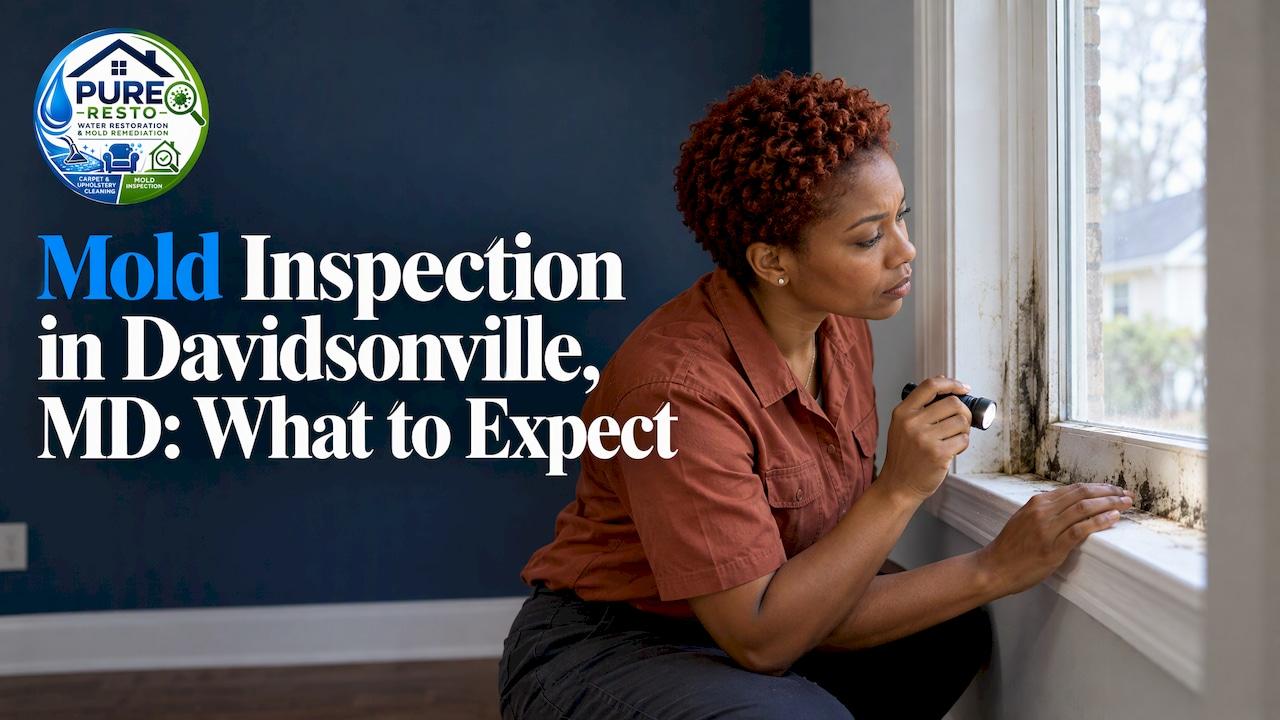
If you see mold, smell a musty odor, or had a leak or flood that stayed wet for more than a day or two, a professional mold inspection in Davidsonville starts with a trained person tracing the moisture and checking the areas where mold hides. Lab sampling is added only when its results would change your plan. Pure Resto is an IICRC-certified restoration company based in Bowie, and we offer mold inspection in Davidsonville with crews that typically arrive within 30 minutes in an emergency. This guide explains when to call, what the inspector does, what the results mean and what comes next.
TL;DR
- Anything that stayed wet for more than 24 to 48 hours should be treated as a mold risk, and that is the clearest signal to call.
- A good inspection is mostly visual and moisture-based: the inspector finds where water got in, where it is still hiding and what is growing.
- Air or surface samples are useful when the results would change your decisions, for example when the source is unclear or health concerns are involved.
- Finding mold is the start of the fix: the moisture source has to be repaired and the mold cleaned up by a qualified remediation team.
- Pick a company with recognized training, such as IICRC certification, because no federal agency certifies mold inspectors.
Table of Contents
- When to schedule a mold inspection
- What a professional mold inspection includes
- What the results can and cannot tell you
- How to choose an inspector in Davidsonville
- What mold inspection costs in Davidsonville
- After the inspection: moisture first, then remediation
- Maryland rules to know
- Our perspective
- Book your Davidsonville inspection
- FAQ
- Sources
When to schedule a mold inspection
Mold needs moisture, and the time that moisture sits is what matters most. The CDC's homeowner guide says that if a flooded home and its furnishings could not be dried within 24 to 48 hours, you should assume mold growth exists, dry everything, clean up the mold and fix the moisture problem. The EPA adds that items dried within 24 to 48 hours after a leak will in most cases not become moldy.
For a Davidsonville homeowner, the common triggers look like this:
- A burst or slow-leaking supply line, dishwasher hose or water heater that ran longer than a day.
- A wet basement or crawl space after a heavy storm, which is common in homes on lower ground or with older foundations.
- A roof or window leak that left a stain on the ceiling or wall.
- A persistent musty smell with no visible source.
- Condensation, peeling paint or bubbling drywall in a bathroom, laundry room or utility room.
- Health symptoms that seem to ease when you leave the house and return when you come back.
The EPA lists bathrooms, laundry and utility rooms and basements among the most common places for mold to show up, so start your own look there before the inspector arrives.
If the water event just happened
When the water is still present, drying comes before inspection. Extraction and drying equipment can bring a structure back under the 24 to 48 hour window, and that is the best way to avoid mold in the first place. Our water damage restoration crews handle extraction and drying, and an inspection afterward confirms that the moisture is gone from walls, floors and hidden cavities.
If you already see mold
Visible mold does not always need lab work to confirm it. The EPA says that when mold is visible, sampling is usually unnecessary unless the results would change plans. In that case the useful inspection is one that finds how far the growth extends and why it is there, so the remediation covers the entire problem and not just the visible patch.
What a professional mold inspection includes
The International Association of Certified Indoor Air Consultants (IAC2) publishes standards of practice for mold inspections. Under them, the inspector performs a non-invasive visual examination of the readily accessible, visible parts of the home, measures moisture, temperature and humidity, and takes mold samples where appropriate. The written report covers moisture intrusion, water damage, musty odors, apparent mold growth, conditions that favor mold and any lab results.
In practice, a Davidsonville inspection usually follows this order.

1. The conversation
The inspector asks about the history of the house: past leaks, floods, repairs, when the smell started and who in the household has symptoms. This tells them where to look first.
2. Visual survey
They walk the property, checking ceilings, walls, window frames, under sinks, around the water heater and HVAC equipment, and the basement or crawl space. Non-invasive means they do not open walls without your permission, so the survey covers what can be reached and seen.
3. Moisture mapping
Moisture meters read the water content of materials. The EPA notes investigators use meters on carpet, wallboard, wood, brick and concrete and sometimes borescopes, small cameras that look inside wall cavities, to find hidden mold. A wall that looks dry can still read wet, and that reading often points to the real source.

4. Sampling, when it helps
IAC2 standards call for at least one surface sample in each area of concern. A surface sample (a swab or tape lift) identifies what is growing on a specific spot. Air sampling collects spores from the room. The NACHI course material, based on the same standard, describes at least three air samples, one indoor and two outdoor, taken with the same flow rate, duration, height and device so the comparison is fair.
That last point matters because spore counts swing with the weather. The IAC2 standards note that airborne spores vary with the mold's life cycle, atmospheric conditions, ventilation and season, so indoor and outdoor samples must be collected as close in time and conditions as possible for the comparison to mean anything.
5. The report
You should leave with a written summary of what was found, where, and what conditions let it develop. That document guides the repair plan and, if you have a claim, supports the conversation with your insurer.
What the results can and cannot tell you
This is where homeowners are most often confused. There are no health-based standards for mold in indoor air, and CDC/NIOSH does not recommend routine air sampling. Short-term spore counts cannot be tied to a health risk. NIOSH found thorough visual inspection and noticing musty odors to be more reliable than air sampling alone.
The Howard County Health Department makes the same point for Maryland homes: its guidance says there are no standards for acceptable or unacceptable mold levels in buildings, and that any testing should be done by a trained specialist.
So read results as information about your house, not a pass/fail score:
- What type of mold is on this surface? A surface sample answers that.
- Is there a hidden problem I cannot see? Moisture readings and, where warranted, air samples compared with an outdoor reference help.
- Did the cleanup work? A careful inspection after remediation confirms no mold or odor remains.
The EPA says sampling is worth doing when the results would change what you do: when the source is unclear, when health is a concern or when litigation is involved. A skilled inspector decides with you whether that applies, and designs the sampling plan carefully, because the EPA warns that a poorly designed plan can produce misleading, confusing results.
How to choose an inspector in Davidsonville
No federal agency certifies mold professionals. The EPA states it has no certification program for mold inspectors or remediation firms and keeps no list of them, though some states may. It advises asking about qualifications, training and experience and checking references.
The CDC guide suggests hiring a professional affiliated with or certified by one of NEHA, AIHA, IICRC or ACAC. Use this short checklist:
- Recognized certification. Ask which body certified the technicians. Pure Resto is IICRC-certified.
- Licensing and insurance. Confirm the company is licensed and insured. We are fully licensed and insured.
- A written report. You should get documented findings, not a verbal summary.
- A plan that addresses the water source. The inspection should name the moisture cause, not only the mold.
- Response speed. If water is still present, hours matter. Our emergency crews typically arrive within 30 minutes.
- Insurance handling. If the cause was a covered water loss, ask whether the company works directly with your insurer. We do, which keeps the paperwork from falling on you.
An inspector and a remediation team can be separate companies, but when one team does both, the inspection findings flow straight into the cleanup plan without anything lost in translation.
What mold inspection costs in Davidsonville
Price depends on the size of the home, the number of areas of concern, how much sampling is needed and the lab work involved. Because each house is different, we quote after learning about the property rather than publishing a flat figure. Our mold inspection cost guide explains what drives the number so you can compare any quote on equal terms. If the problem began with a covered water loss, ask your insurer what is included in your policy before you book.
After the inspection: moisture first, then remediation
The EPA frames the goal of remediation simply: find the source of the water problem, fix it and clean up the mold. Skip the first step and the mold returns. That order is why inspection findings turn directly into a repair list:
- Stop the water. Repair the pipe, roof, window, grading or drainage problem. A homeowner dealing with a ceiling stain can use this walkthrough on water stains on a ceiling to trace the cause before repairs begin.
- Dry the structure. Extraction and drying bring materials back to normal moisture levels.
- Remove and clean. Contaminated materials are cleaned or removed under containment, with HEPA filtration to capture airborne particles. Our mold remediation service uses HEPA filtration, and we offer mold remediation in Davidsonville as well.
- Clean contents. Furniture, clothing and belongings exposed to water or mold may need cleaning. We offer contents cleaning, storage and packout when rooms must be cleared for work.
- Address odor. Lingering musty smells are handled with odor removal.
- Confirm completion. The CDC guide says a careful inspection for absence of mold and odors is usually the right way to confirm the job is done.
The CDC also gives a plain test for yourself: if you still see or smell mold after remediation, there is more work to do, and if health problems worsen when you return home, some mold may remain.
If the damage is so extensive that you are weighing a sale, this overview of selling a home with mold lays out the as-is and remediate options. Most Davidsonville homeowners find that a documented inspection and remediation plan keeps every option open.
Maryland rules to know
Maryland has not had state regulations that set mold limits in housing. A Carroll County document from 2018 reports that there were no U.S. Government or Maryland State regulations concerning mold in rental housing and that county housing inspectors did not inspect for mold or require testing, though they may help identify water sources. Rules and local practice can change, so check your county or the state for current requirements, and if you are a landlord or tenant with a mold dispute, speak with a Maryland attorney.
Our perspective
Most mold calls we hear about start the same way: a leak, a few days of waiting, then a smell. The mistake is rarely the leak itself. It is the gap between the water and the drying.
That is why we built our service around speed and follow-through. Our crews typically arrive within 30 minutes, we use extraction, drying and HEPA filtration equipment, and our technicians are IICRC-certified. An inspection is most valuable when the same team that finds the moisture can also dry the structure and clean up the mold, with our satisfaction guarantee and written workmanship standards behind the work.
We also work directly with insurance providers, so a Davidsonville family dealing with a water loss is not left sorting out claim paperwork while trying to dry out a house. Restoration, not simple cleanup, is how we approach every job.
Pure
Book your Davidsonville inspection
If you have a suspected leak, a musty room or visible growth, we can inspect, document and plan the repair in one visit. Pure Resto serves Davidsonville and nearby Bowie, Crofton, Gambrills, Annapolis and Millersville with 24/7 emergency response, and we bill insurers directly where a claim applies.
Start with our Davidsonville mold inspection page, or see all our mold inspection and testing services across Maryland. If you are close to Millersville, our Millersville mold inspection page has the local details.
FAQ
Do I need a mold test if I can already see mold?
Not always. The EPA says that when mold is visible, sampling is usually unnecessary unless the results would change your plans, such as an unclear source, health concerns or litigation. What you do need is an inspection that finds the moisture source and the full extent of the growth.
How soon should I call after a leak or flood?
As soon as you find it. Materials dried within 24 to 48 hours usually do not become moldy, so fast extraction and drying matter more than anything else. If the area stayed wet longer than that, the CDC advises assuming mold is present and calling a qualified professional.
What is the difference between a mold inspection and mold remediation?
An inspection finds and documents moisture and mold: where it is, how far it goes and what caused it. Remediation fixes the problem by drying the structure, cleaning or removing affected materials and confirming that mold and odors are gone. When one company does both, the findings carry straight into the cleanup plan.
Does Maryland require a license for mold inspectors?
The EPA has no certification program for mold inspectors, and it advises homeowners to ask about qualifications, training and references. Because requirements can change, confirm current rules with the state. We recommend choosing a company with recognized certification such as IICRC and the proper license and insurance, which we hold.
Will my insurance cover mold inspection?
Coverage depends on your policy and on what caused the water. Many policies respond to sudden water losses, so document the damage and contact your insurer early. We work directly with insurance providers to streamline the claims process.
Sources
- CDC: Homeowner's and Renter's Guide to Mold Cleanup After Disasters
- US EPA: Mold Course Chapter 3
- IAC2: Mold Inspection Standards of Practice
- NACHI: How to Perform Mold Inspections
- CDC/NIOSH: Mold, Testing, and Remediation
- Howard County Health Department: Mold
- US EPA: Who can test my home or clean, fix and remediate my home for mold
- Carroll County, MD: Mold inspections excerpt from the EPA