
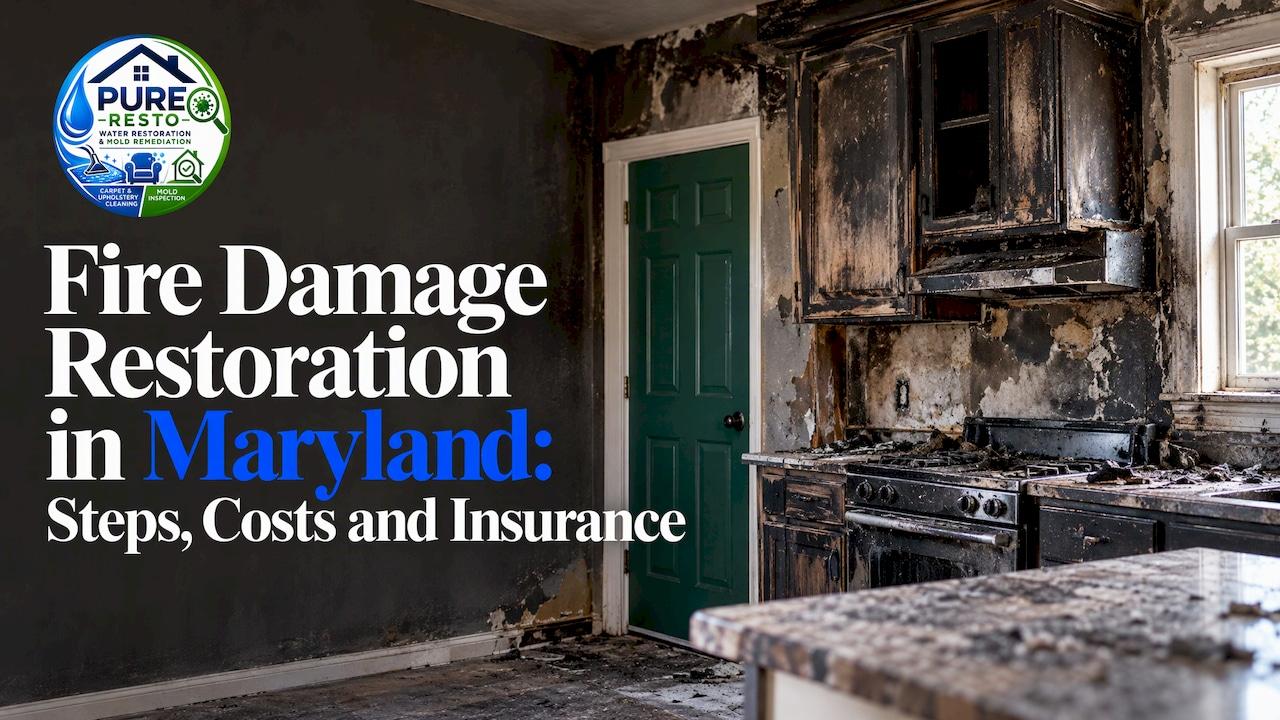
Fire damage restoration is the work of making a home safe and livable again after a fire: securing the building, drying out firefighting water, removing soot and smoke residue, cleaning or replacing belongings, deodorizing, and rebuilding what burned. The first days decide how much of the home and its contents you keep. At Pure Resto, our IICRC-certified crews respond around the clock across Maryland, typically arriving within 30 minutes, and we bill your insurance provider directly so you can focus on your family. Our fire and smoke damage restoration service covers the whole sequence below.
TL;DR
- Stay out until the fire department says the home is safe, then call your insurer before any cleanup begins.
- Fire restoration is more than cleaning: it includes water extraction and drying, HEPA soot removal, contents cleaning, deodorizing, HVAC cleaning and repairs.
- Typical post-fire cleanup in the U.S. runs from about $3,000 to $26,000 according to one insurer's estimate, and large fires cost far more.
- Photograph and inventory everything before discarding it, and keep adjuster communication in writing.
- Call a certified restoration company early. Smoke damage is easy to underestimate.
Table of Contents
- The first hours: safety before restoration
- What fire damage restoration includes
- Why smoke damage is easy to underestimate
- What fire damage restoration costs
- Working with your insurance company
- Health risks during fire cleanup
- Choosing a restoration company in Maryland
- Fire restoration with Pure Resto
- Our perspective
- FAQ
- Sources
The first hours: safety before restoration
The American Red Cross says to stay out of a fire-damaged home until local fire authorities say it is safe to re-enter. It also says to call 9-1-1 for injuries, cool and cover burns, and let family and friends know you are safe.
A fire that is out can still be dangerous. The Washington State Department of Health warns that burned sites may contain asbestos, ash, unstable structures, live power lines and damaged propane tanks. It advises contacting your insurer before cleanup starts, because the insurer may need to inspect first. If no agency is helping, it suggests having a professional remediation company evaluate hazards before you go in. That is exactly the call we take.
A few rules for those first hours:
- Do not reconnect utilities yourself. Ready.gov says never to attempt this.
- Ask a relief organization such as the Red Cross about temporary housing, food and medicine, and tell your mortgage company about the loss, as Ready.gov advises.
- Do not run the HVAC system. If ducts hold soot, the system spreads it through the house.
- Do not throw anything away yet. You need it for the claim.
If your home is in Bowie, Crofton, Annapolis or anywhere else we serve, call us once the fire department clears you. Early mitigation, such as boarding openings and starting drying, limits secondary damage.
What fire damage restoration includes
Procedures vary a little by job, but professional restoration follows a consistent order. One industry guide outlines eight stages: emergency dispatch, inspection and assessment, site security, water removal and drying, debris removal, smoke and soot cleaning, sanitizing and deodorizing, and final restoration. Here is what each means for you.
1. Emergency response and assessment
A technician walks the property, documents the damage with photos and notes, and sets priorities. Our crews typically arrive within 30 minutes of your call. The sooner someone is on site, the less time soot has to etch surfaces and corrode metal.
2. Securing the property
Board-up of broken windows and doors and tarping of damaged roofs keep out weather, animals and trespassers. This protects the structure and also helps with your insurance obligation to prevent further loss.

3. Water removal and drying
Firefighting leaves a lot of water. Extraction and drying with air movers and dehumidifiers come early, because wet drywall, subfloors and carpet start growing mold if they stay damp. This is where our water damage and mold teams overlap with fire work. See our water damage restoration and mold remediation services if moisture has lingered.
4. Soot and smoke removal
The established method starts with dry removal using HEPA vacuums, because regular vacuums blow particles back into the house. Surfaces are then wiped from the top down, attic to floor, and smoke-saturated attic insulation is removed. HEPA filtration is part of how we work, which keeps fine particles out of the air your family will breathe.

5. Contents cleaning and storage
Furniture, clothing, electronics and keepsakes are inventoried, packed out, cleaned and stored while the structure is repaired, then returned. The IICRC S700 standard covers fire- and smoke-damaged personal items and includes documentation and a chain of custody for belongings. We offer contents cleaning, storage and packout, plus upholstery cleaning and carpet cleaning for soft goods that can be saved.
6. Odor removal
Smoke odor lives in porous materials, so wiping is rarely enough. Whole-home deodorizing uses ozone, hydroxyl or thermal fogging, and the HVAC system is cleaned and tested before it is turned back on. Our odor removal service handles sanitizing and deodorization.
7. Repairs and reconstruction
Typical repairs include replacing drywall, flooring, fixtures, cabinets and damaged electrical systems, and rebuilding roofs. Items damaged by flames usually need replacement rather than cleaning.
Why smoke damage is easy to underestimate
Soot travels. It settles in wall cavities, attics, closets and ductwork far from the burn. American Family Insurance notes that many homeowners do not grasp the extent of smoke damage, which can mean missing parts of the home that need work, and recommends hiring a contractor.
For a Maryland family, that matters most in a townhouse or condo, where a fire next door can send smoke through shared walls and ducts. Fire in one unit is rarely a one-unit problem. A trained crew maps where residue actually went, using visual inspection and diagrams, rather than guessing from what you can see.
Smoke testing is sometimes used on larger losses. UPHELP, a policyholder advocacy group, says proper indoor smoke testing generally costs $2,000 to $4,000 for sampling, lab work and a written report.
What fire damage restoration costs
No two fires cost the same, which is why we do not publish a flat price. Published ranges give a sense of scale. American Family Insurance puts typical post-fire cleanup between $3,000 and $26,000 in the U.S., with small-fire recovery averaging $3,000 to $5,000 and larger fires reaching $50,000 and up. The same article lists $200 to $1,000 for smoke remediation of furniture, clothing and carpet, and $150 to $500 for an HVAC evaluation, with repairs upward of $1,000.
| Cost factor | Why it moves the price |
|---|---|
| Size of the fire | More rooms burned means more demolition and rebuilding |
| Smoke spread | Soot in attics, walls and ducts adds cleaning labor |
| Water from firefighting | Extraction, drying and possible mold work |
| Contents | Number of items to clean, store or replace |
| Structure type | Materials, finishes and shared walls in condos and townhomes |
Most fire losses are paid through insurance, so the practical question is less "what will it cost" than "what will my policy cover and how do I document it."
Working with your insurance company
UPHELP explains that smoke damage to the structure is paid from dwelling coverage and damage to rugs, clothing and furniture from contents coverage, with no special cap beyond overall policy limits.
A sound claims routine, following American Family Insurance's guidance:
- Make sure everyone is safe first.
- Check whether your policy includes loss-of-use coverage for living elsewhere.
- Request the fire report from the responding fire department.
- Photograph affected areas, including appliances and structural elements.
- Estimate the value of lost belongings using receipts where you have them.
- Keep all adjuster communication in writing.
Before throwing anything out, take an inventory with photos, and save receipts for insurance and tax purposes. UPHELP also advises that food packaged in paper, cardboard or plastic and exposed to smoke is generally unsafe to eat and should be discarded.
This is where working with a restoration company that deals with insurers every day pays off. We work directly with insurance providers and bill them directly, so the documentation, scope and paperwork move together rather than landing on you while you are displaced. If an adjuster tells you the home seems fine, you can ask your insurer to pay for testing; UPHELP argues that only a credentialed professional is qualified to judge a home's condition.
Health risks during fire cleanup
This is the strongest reason to leave cleanup to trained crews. OSHA states that inhaled asbestos fibers cause disabling respiratory disease and cancers, with symptoms often appearing 20 or more years after exposure. Older Maryland homes may contain asbestos materials that fire disturbs. Cal/OSHA's checklist for fire cleanup workers calls for HEPA respirators with organic vapor and formaldehyde cartridges, coveralls, chemical-resistant gloves and boots, and lists hazards such as downed power lines, unstable structures, toxic ash and carbon monoxide from gasoline-powered equipment.
If you must go in for essentials after clearance, wear a well-fitted respirator and gloves, avoid disturbing ash, and keep children and pets out. Anyone with asthma, heart or lung conditions, pregnancy, or young children in the home should check with their doctor before spending time in a smoke-affected house. Our technicians work with the protective equipment and HEPA filtration this kind of site calls for.
If a fireplace or chimney was involved, have it evaluated before using it again, and keep the flue closed until then.
Choosing a restoration company in Maryland
Look for these markers:
- Certification. Health agencies point readers to the IICRC locator to verify technicians. Pure Resto is IICRC-certified.
- Licensed and insured. We are fully licensed and insured.
- Speed. Soot and moisture damage compound with time. Our crews typically arrive within 30 minutes, 24/7.
- Insurance handling. We bill insurers directly.
- Written standards. Our work is backed by a satisfaction guarantee and written workmanship standards.
- One team. Fire jobs often involve water and mold, so a company that handles all three avoids handoffs.
We serve Bowie, Crofton, Annapolis, Odenton, Fort Meade, Laurel, Lanham, Greenbelt, College Park, Hyattsville, Silver Spring, Rockville, Potomac, Bethesda, North Bethesda and Washington, DC, among other communities. For your area, see our pages for Silver Spring, College Park, Laurel, Lanham, Bethesda and Washington, DC.
Fire restoration with Pure Resto
When the fire is out and the fire department has cleared the home, we start with a rapid response, extraction and drying, HEPA soot removal, contents cleaning and odor removal, and we work with your insurer throughout.
Reach us through Pure Resto any hour. Our fire and smoke damage FAQ answers common questions about the process.
Our perspective
Most people meet restoration on the worst day of their year. What we have learned to explain first is that the visible damage is the smaller part of the story. Smoke and water keep working after the flames stop, which is why we start drying and containing residue right away rather than waiting for the claim to move.
We believe in restoring rather than simply cleaning up. Saving a sofa, a carpet or a box of family photographs is often possible when cleaning starts early, and that is why we pair emergency response with contents cleaning, storage and odor removal under one team.
Our crews are IICRC-certified, we are licensed and insured, and we deal with insurers directly so you are not translating between adjusters and contractors while your family is displaced.
Pure
FAQ
How long does fire damage restoration take?
It depends on the size of the loss. Cleaning and deodorizing a lightly affected home can move quickly, while a fire that needs rebuilding takes much longer. Mitigation starts within hours, and your technician can give a schedule after assessing the property.
Can the smoke smell be removed completely?
Yes, in most cases when the source residue is removed first. Odor lives in soot on surfaces and in porous materials, so cleaning comes before deodorizing with methods such as ozone, hydroxyl or thermal fogging, followed by HVAC cleaning.
Does homeowners insurance cover fire damage restoration?
Typically yes. Structural smoke damage falls under dwelling coverage and belongings under contents coverage, subject to your policy limits and deductible. Report the loss promptly, document everything, and we can bill your insurance provider directly.
Can I clean up fire damage myself?
The hazards, including asbestos, ash and unstable structures, are why health agencies suggest a professional evaluation first. Hidden soot in ducts and wall cavities is also easy to miss. Call us before you start.
Sources
- American Red Cross: What To Do After A Home Fire
- Washington State Department of Health: Post-Fire Cleanup Guidance
- Ready.gov: Home Fires
- UPHELP: Smoke Restoration Guide
- American Family Insurance: Smoke damage clean-up and restoration costs
- AlliedPA: What Is Fire Damage Restoration?
- The Home Depot: The Full Guide to Fire Damage Restoration
- OSHA: Asbestos Substance Technical Information
- Cal/OSHA: Worker Safety Checklist for Fire Cleanup Sites