

Upholstery cleaning codes are single-letter labels assigned by the fabric mill that tell you exactly which cleaning agents are safe for your furniture. The four standard codes, defined by the IICRC S300 Standard for Professional Upholstery Cleaning, are: W (water-based cleaners only), S (solvent-based cleaners only, no water), WS or W-S (either water or solvent), and X (vacuum and brush only, no liquid). Some labels also show DC or D, meaning dry-clean only. The one safe action you can take right now, before reaching for any cleaner: find the tag, spot-test in a hidden area, and vacuum if you are unsure.
- W: Use water-based foam or mild detergent solutions.
- S: Use water-free dry solvents only. Water causes permanent damage.
- WS / W-S: Either method works; start with water, escalate to solvent if needed.
- X: No liquids at all. Vacuum and light brushing only.
- DC / D: Professional dry-cleaning required.
Pro Tip: Photograph the tag before you clean anything. If the tag tears off or fades, you still have a record to share with a professional or the manufacturer.
Key Takeaways
Upholstery cleaning codes are mill-assigned labels that determine which cleaning agents are safe; matching the method to the code prevents permanent fabric damage.
| Point | Details |
|---|---|
| Four standard codes | W, S, WS, and X define which cleaners are safe; DC/D means dry-clean only. |
| Spot test first | Always test in a hidden area and let it dry fully before cleaning the visible surface. |
| Over-saturation is the top risk | Excess moisture soaks into padding, causing mold, odors, and water rings. |
| Missing tag means most restrictive | Treat unlabeled fabric as X or S and vacuum only until you verify the fabric type. |
| Call a pro for S, X, or large jobs | IICRC-certified cleaners with low-moisture equipment handle what DIY cannot safely do. |
Table of Contents
- What do the upholstery cleaning codes mean for each fabric?
- Where can you find the cleaning code on your furniture?
- How to clean upholstery safely for each code
- What to do when there's no cleaning code on your furniture
- Common DIY mistakes and a quick decision checklist
- When should you hire a professional upholstery cleaner?
- The case for slowing down before you clean
- Sources
- FAQ
What do the upholstery cleaning codes mean for each fabric?
The codes are a shorthand guide from the mill, not a blanket guarantee. Fabric construction, backing material, and surface finishes all affect how a piece responds to cleaning, which is why the DLI's cleanability code guidance explicitly recommends professional service for overall soiling even when you know the code.
| Code | Meaning | Approved agents | What to avoid |
|---|---|---|---|
| W | Water-based cleaning | Mild dish soap solution, water-based upholstery foam, steam (if low-moisture) | Dry solvents, harsh detergents |
| S | Solvent only | Water-free dry-cleaning solvents (e.g., Carbona, Guardsman) | Water, steam, water-based sprays |
| WS / W-S | Water or solvent | Mild soap solution OR dry solvent | Excessive moisture, harsh chemicals |
| X | Vacuum/brush only | Dry vacuuming, soft-bristle brush | Any liquid, solvent, or steam |
| DC / D | Dry-clean only | Professional dry-cleaning process | Any home cleaning method |
A few things worth knowing about how mills assign these codes:
- The code reflects testing of the face cloth, the backing, and any applied finish together. A fabric that looks like a W candidate can carry an S code because its backing shrinks when wet.
- Many fabric mills and retailers publish cleaning code tables on their product pages, so the spec sheet that came with your furniture is often the most reliable reference.
- Never remove cushion covers to machine-wash them unless the manufacturer explicitly states they are launderable. Many cushion casings have backings that warp or shrink in a washing machine, a point the DLI flags directly.
- S-coded fabrics are particularly unforgiving. Water can cause permanent rings, shrinkage, or distortion on contact.
Where can you find the cleaning code on your furniture?
Most manufacturers attach the care label in one of these spots:
- Under the seat cushions: Flip each cushion. The tag is usually sewn to the underside of the cushion itself or to the platform beneath it.
- On the underside of the frame: Check the bottom of the sofa or chair, near a corner or along the back rail.
- Sewn into a seam: Some labels are stitched into a side seam or the back panel, especially on older pieces.
- Product spec sheet or receipt: Retailers often include a care card with delivery paperwork. Check any documentation that came with the furniture.
- Manufacturer website or retailer product page: Search the model name or SKU. Many brands list upholstery care instructions in the product description.
Pro Tip: If the tag is faded or missing, contact the manufacturer with the model number before attempting any cleaning. If you cannot reach them, treat the fabric as the most restrictive code (X or S) until you know more.
How to clean upholstery safely for each code
Start here for any fresh spill
Blot immediately with a clean white cloth. Work from the outer edge of the spill toward the center to avoid spreading it. Never rub. Avoid colored cloths, which can transfer dye to the fabric. These first steps apply regardless of the code, and Living Spaces' how-to guide reinforces the blot-don't-rub rule as the single most important first-aid move.
W code: water-based method
- Vacuum the surface to remove loose debris.
- Mix a small amount of mild dish soap with cool water and whip it into a foam.
- Apply only the foam (not the liquid) to the stain with a clean white cloth.
- Blot gently; do not scrub.
- Rinse by blotting with a cloth dampened with plain water.
- Blot dry with a fresh cloth, then let the area air-dry fully with a fan or open window.
Steam cleaning is an option for W-coded fabrics, but only with a low-moisture technique. Per Rowenta USA's steam-cleaning guidance, always run a colorfastness test first and keep the steamer moving to avoid saturating any one spot.
S code: solvent-only method
- Ventilate the room well before opening any solvent product.
- Apply a small amount of a water-free dry-cleaning solvent to a clean white cloth.
- Blot the stain gently; never pour solvent directly onto the fabric.
- Work from the outside edge inward.
- Allow the area to air-dry completely. Do not use heat or steam.
Water is the enemy of S-coded fabric. Even a damp cloth can leave a permanent ring.
WS code: water or solvent
Try the W method first for water-soluble stains (coffee, juice, food). If the stain persists or is oil-based, switch to a dry solvent. The Keck Furniture stain guide recommends this step-up approach and maps common spills to the appropriate method. Be cautious about the backing: even WS fabrics can delaminate if you over-saturate them.
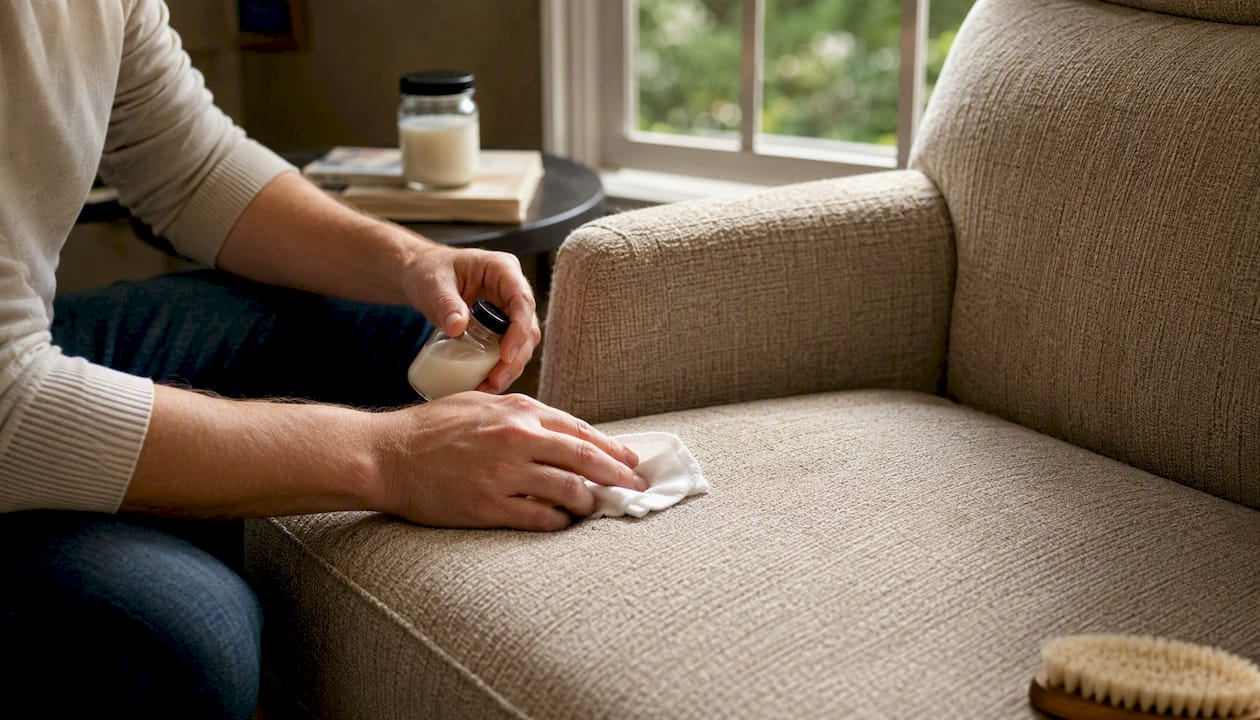
X code: vacuum and brush only
No liquids, no solvents, no steam. A soft-bristle upholstery brush and a vacuum with an upholstery attachment are your only tools. Dry extraction methods may be used with written mill approval, but that is a professional call, not a DIY one.
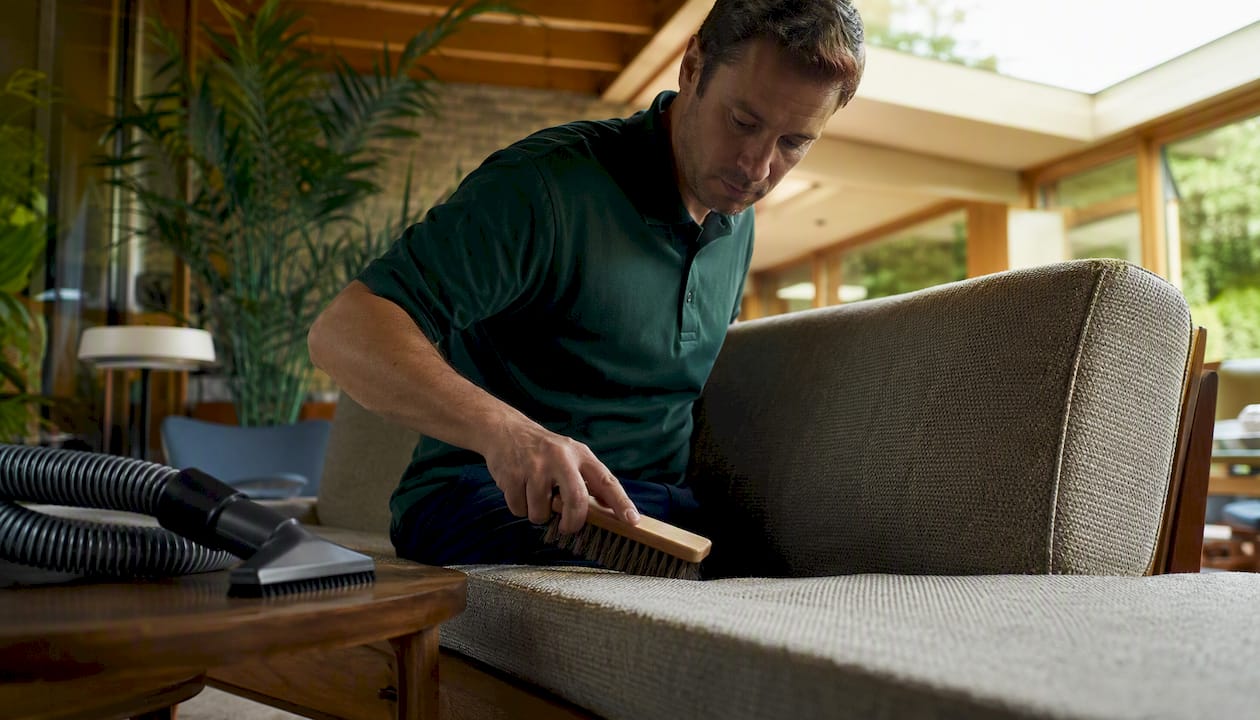
The spot test: non-negotiable before any cleaning
Apply your chosen cleaner to a hidden area (inside a back cushion seam, under the skirt). Wait for it to dry fully, then check for color change, bleeding, or texture distortion. Good Housekeeping calls this patch test non-negotiable, and it takes less than 30 minutes to complete.
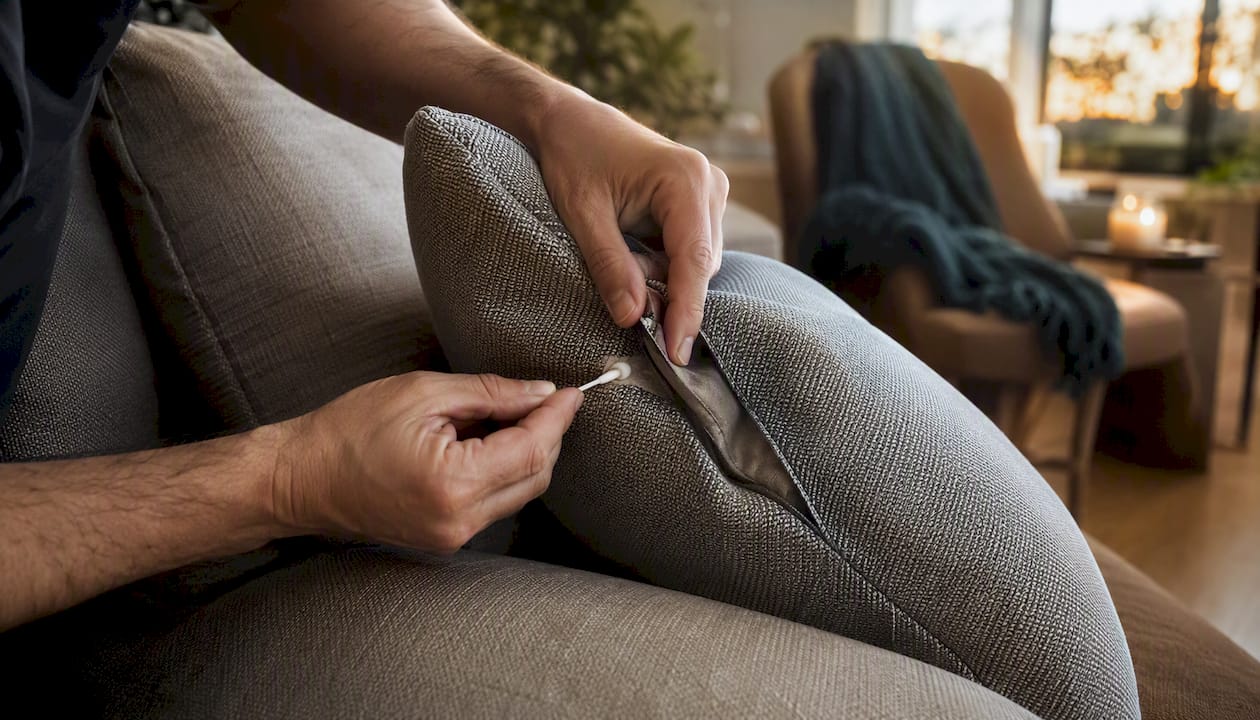
Pro Tip: Over-saturation is the most common and most costly DIY mistake. Moisture that soaks into padding creates mold, odors, and permanent water rings. Use the minimum amount of cleaner needed and dry the area quickly with a fan.
What to do when there's no cleaning code on your furniture
A missing tag is more common than you might think, especially on older pieces or furniture bought secondhand. Here is the safe path forward:
- Vacuum the surface. It is the only universally safe maintenance step until you know the fabric type.
- Treat the piece as X or S (the most restrictive codes) until you can verify the fabric.
- Check the manufacturer's website using the model number or collection name.
- Call the retailer where you bought it; many keep spec sheets on file.
- If none of those options work, a professional cleaner can often identify the fabric type and run a test before committing to a method.
When it is acceptable to try a DIY spot test: only if the fabric looks and feels like a standard woven or microfiber upholstery and you are testing a tiny, hidden area with plain water first. If the water beads up or the fabric changes color immediately, stop and call a pro.
Michael Jon Designs' cleaning code guide puts it plainly: if an item lacks a cleaning code, treat it as delicate or professional-only.
Pro Tip: Before attempting anything, photograph the tag area (even if blank) and the stain. This documentation protects you if a warranty or insurance claim comes up later.
Common DIY mistakes and a quick decision checklist
Mistakes that cause real damage
- Over-saturation: Soaking the fabric pushes moisture into the padding, where it breeds mold and creates odors. Speed drying with a fan is not optional.
- Using the wrong solvent on S fabric: Even a water-based upholstery spray marketed as "safe for all fabrics" will damage S-coded material.
- Rubbing instead of blotting: Rubbing spreads the stain and can distort the fabric pile.
- Skipping the spot test: Color bleed and texture damage show up after the fact, not during cleaning.
- Machine-washing cushion covers: Backing materials shrink or warp, and the covers rarely fit correctly afterward.
- Using colored cloths: Dye transfer from the cloth to the fabric is a common and avoidable problem.
Your cleaning decision checklist
- Find the tag and read the code.
- Vacuum the surface.
- Spot-test your chosen cleaner in a hidden area; let it dry fully.
- Apply the correct method for the code (W, S, WS, or X).
- Use minimal moisture and dry quickly with airflow.
- If the stain does not lift after one attempt, stop and call a professional.
If over-wetting happens: blot up as much moisture as possible immediately, place fans directly on the area, and avoid sitting on the piece until it is bone dry. If the padding feels wet to the touch after 24 hours, a mold inspection may be warranted.
When should you hire a professional upholstery cleaner?
Some jobs are beyond what a careful homeowner should attempt. Call a professional when:
- The fabric carries an S or X code and the soiling is more than a small spot.
- The piece has overall soiling rather than a single stain. The DLI recommends professional service for this scenario regardless of code.
- The stain is set-in, oil-based, or involves pet urine or biological matter.
- You detect odors from inside the padding, which can signal mold or bacterial growth.
- The furniture is antique, delicate, or has a specialty finish (velvet, silk blend, hand-embroidered).
- A previous DIY attempt left a water ring or color change.
What credentials and questions to ask
A qualified upholstery cleaner should be able to show you:
- IICRC certification in upholstery and fabric cleaning. The IICRC S300 standard is the industry benchmark professionals train to.
- Low-moisture extraction equipment, which reduces the over-saturation risk that causes mold.
- Written mill approval if they plan to use dry extraction on an X-coded fabric.
Ask these questions before booking:
- Will you inspect and test the fabric before cleaning?
- What drying time should I expect?
- Do you carry liability insurance for fabric damage?
- Can you bill my homeowner's insurance directly?
For Maryland homeowners, Purerestomd's professional carpet and upholstery cleaning team holds IICRC certification and uses low-moisture equipment suited to delicate fabrics. Readers in the Silver Spring area can also reach the Silver Spring cleaning team directly.
The case for slowing down before you clean
Most upholstery damage happens in the first five minutes after a spill, not because of the spill itself but because of the reaction to it. Someone grabs whatever cleaner is under the sink, scrubs hard, and saturates the fabric before ever checking the tag. The code system exists precisely to prevent that.
What gets underestimated is how much the backing matters. Two sofas can look identical and carry different codes because one has a water-sensitive latex backing and the other does not. The face fabric is only half the story. Professionals run tests because they know this; most homeowners do not find out until the damage is done.
The other thing worth saying plainly: a professional clean costs far less than reupholstering a sofa. If you are uncertain about the code, the fabric type, or the extent of soiling, the math strongly favors a phone call over a DIY attempt. Purerestomd offers 24/7 restoration and cleaning services across Maryland, with a 30-minute emergency response time for situations where waiting is not an option.
Sources
These references are worth bookmarking if you want to go deeper on any part of this topic:
- IICRC S300 Standard for Professional Upholstery Cleaning
- Cleanability Codes for Household Fabrics | DLI
- Upholstery Cleaning Codes Explained: W, S, W/S, X
- How to steam clean a couch or sofa | Rowenta USA
FAQ
How do you clean upholstery with an S code?
Use only a water-free dry-cleaning solvent applied to a clean white cloth, then blot gently from the outer edge inward. Never use water, steam, or water-based sprays on S-coded fabric, as even small amounts can cause permanent rings or shrinkage.
Where can you find the cleaning code on a couch?
Check under the seat cushions, on the underside of the frame, or in a sewn-in seam along the back or side panel. If the physical tag is missing, the manufacturer's website or the retailer's product page often lists the upholstery care instructions by model name or SKU.
What if my couch doesn't have a cleaning code?
Vacuum only and treat the fabric as the most restrictive code (X or S) until you can verify the material. Contact the manufacturer with the model number, or have a professional cleaner identify the fabric type before attempting any liquid cleaning.
Can you steam clean upholstery?
Steam cleaning is safe only when the fabric carries a W or WS code that permits water-based methods. Always run a colorfastness test in a hidden spot first, and use a low-moisture technique to avoid saturating the padding.