
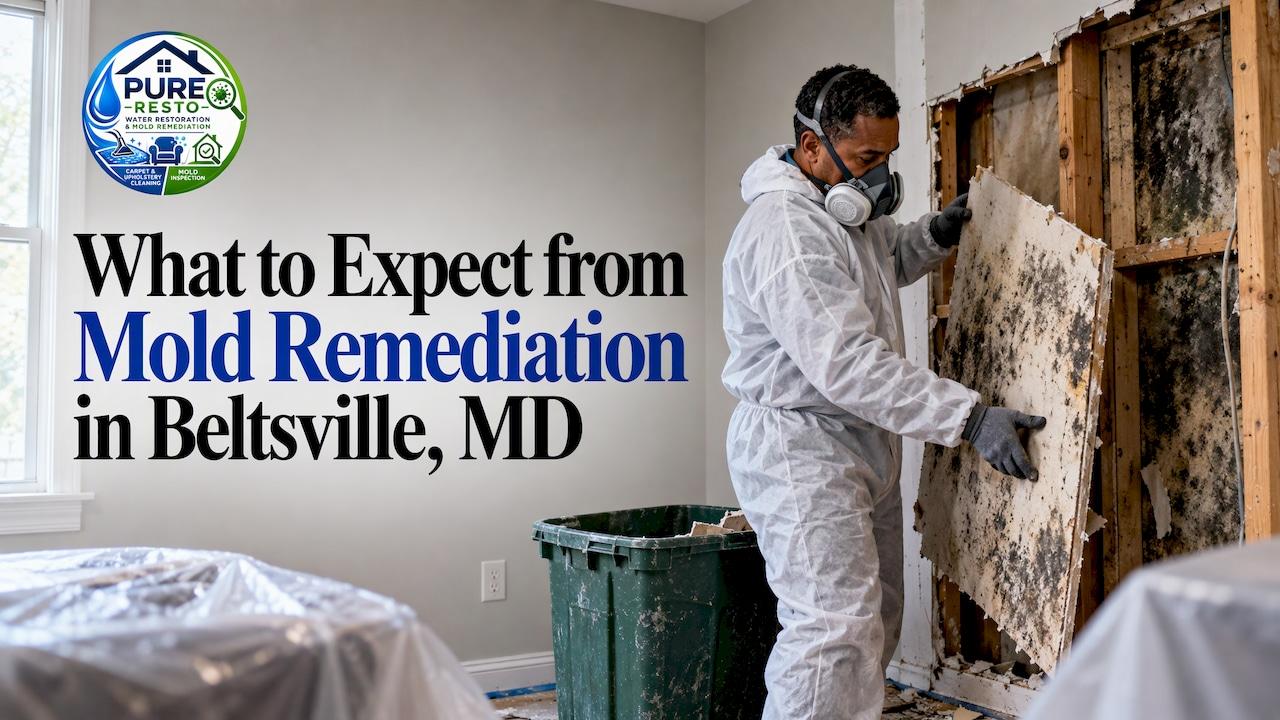
If you have found mold in your Beltsville home, the safest route is a certified crew that contains the area, removes the mold and fixes the moisture problem behind it. Pure Resto is an IICRC-certified restoration company in Bowie that serves Beltsville around the clock, and our crews typically arrive within 30 minutes of your call. This guide explains what professional remediation involves, what drives the price, how insurance fits in and what to check before you sign anything.
TL;DR
- Mold remediation is a sequence: inspection, containment, removal, cleaning, treatment and restoration. Skipping containment or the moisture fix is how mold comes back.
- Wet materials need to be dried within 24 to 48 hours. After a leak or flood, calling early is the cheapest decision you can make.
- Large jobs are commonly quoted at $10 to $25 per square foot, and many homeowners policies cap mold coverage well below a big job's cost.
- Before hiring, ask about IICRC certification, read the contract, and ask for drying and completion documentation.
- We bill insurers directly and back our work with a satisfaction guarantee.
Table of Contents
- What counts as mold remediation?
- Why moisture shows up in Beltsville homes
- The remediation process, step by step
- What you can handle yourself, and what you cannot
- How long it takes
- What mold remediation costs
- Insurance and mold
- How to choose a mold remediation company in Beltsville
- Perspective: why we treat mold and water as one job
- For landlords and property managers
- When to call Pure Resto
- FAQ
- Sources
What counts as mold remediation
Remediation is not wiping a wall with bleach. The ANSI/IICRC S520 standard is the American national standard for professional mold work. It describes a process of inspection, containment, removal, cleaning, treatment and restoration for residential, commercial and institutional buildings.
The goal is a space where the mold is gone and the conditions that fed it are corrected. Two details matter most to a homeowner:
- Containment means sealing off the work area so spores disturbed during removal do not travel into the rest of the house. This is what separates a professional job from scrubbing, which tends to spread the problem.
- Moisture control is the part that lasts. The EPA says the key to mold control is moisture control. If the source of the water is not fixed, the mold may simply reappear.
The S520 standard also notes that determining and correcting the underlying cause of contamination is the responsibility of the property owner or their agents. In practice that means a plumber, roofer or HVAC technician fixes the leak, and the remediation crew cleans up what the leak caused. Plan for both from day one.
Why moisture shows up in Beltsville homes
Mold needs a damp surface, and most Beltsville cases trace back to a few familiar sources: a slow plumbing leak behind a wall, a failed water heater, a basement that takes on water in heavy rain, condensation around ductwork, or a roof leak that soaks insulation unseen. The EPA lists high humidity, condensation, water leaks and HVAC problems among the moisture issues that must be fixed for a cleanup to hold.
Roof leaks are especially easy to miss because the water collects in the attic or inside walls. This guide to roof leak mold explains why the first 24 to 48 hours matter. A musty basement is the other common warning sign, and fixing moisture before treating the odor is the right order for any smell that keeps returning.
The remediation process, step by step
Here is what a professional job looks like, where each step goes wrong when rushed, and what we do at each stage.

1. Assess the size and source
The crew finds where the moisture came from, how far the mold has spread and which materials are affected. The EPA's guidance starts with assessing the size of the problem and the damaged materials. Mold on a visible patch of drywall often continues behind it, so a surface look is not enough.
If you want a documented starting point, our mold inspection service covers Beltsville homes. Inspection is mostly visual: areas with water damage or moisture problems are where the mold is. The EPA notes there are no established federal limits for mold, so lab results alone cannot tell you whether a home "passes."
2. Stop the water and dry what is wet
Wet materials need to be dried within 24 to 48 hours or removed. The CDC and NIOSH say appropriate remediation includes drying wet materials within that window and repairing whatever lets water in. If the water was standing, we begin with extraction and structural drying before any mold work. We use advanced extraction and drying equipment, which is why water and mold response are handled by the same team.
3. Contain the work area
The crew uses personal protective equipment and seals the area. HEPA filtration captures fine airborne particles, which protects the family during removal. Our crews use HEPA filtration as part of the process.
4. Remove and clean
Moldy materials that can be cleaned are cleaned and dried. Porous materials that cannot be restored, such as soaked drywall, insulation or ceiling tile, are removed and discarded, per the same EPA remediation steps. Painting over moldy or water-damaged surfaces is a mistake the CDC specifically warns can cause further problems.
5. Treat, deodorize and restore
Once the mold is out, surfaces are treated and odor is addressed. Our odor removal and sanitization service handles lingering smells. Carpet and upholstery that were in the affected room can be cleaned too, through our carpet cleaning in Beltsville.
6. Verify and monitor
The EPA's last step is checking that moisture and mold have not returned. The Maryland Attorney General's consumer guide also advises homeowners to inspect restored areas frequently in the weeks afterward to make sure no moisture or dampness remains. Photograph the area, keep your completion paperwork and note the date.
What you can handle yourself, and what you cannot
A small spot of mold from a known clean-water source can be a homeowner job. Bob Vila's cost guide, citing EPA guidance, puts that line at under 10 square feet, with no sewage involved and no respiratory sensitivities in the household.
Call a professional right away if any of these apply:
- The mold covers more than about 10 square feet, or you can smell it but not see it.
- The water came from sewage, deep standing water or an unknown source. State Farm's flood guidance says not to handle these yourself.
- Anyone at home has asthma, allergies, a weakened immune system or other respiratory issues.
- The mold is in or near your HVAC system.
- The materials stayed wet for more than two days.
If you are cleaning up a small clean-water spill in the meantime, confirm the electrical system is safe before using towels or equipment. Run any fuel-powered pump or generator outdoors, at least 20 feet from the building, with exhaust directed away from doors, windows and vents to avoid carbon monoxide buildup, per the same State Farm guidance.
For contaminated water, the EPA advises calling a professional experienced with contaminated-water damage. That is the situation our water damage restoration team is set up for.
How long it takes
There is no single number. Timing depends on how much area is affected, how wet the structure is, whether materials have to be removed and whether rebuilding follows. Small contained jobs are generally measured in days, while drying and rebuilding set the schedule on bigger ones. Your written scope should state the expected stages so you can see what is driving the timeline.
The fastest way to shorten any project is to call before the 48-hour window closes. The Maryland Attorney General's guide stresses that response time is crucial and that delay can lead to a much more costly recovery.
What mold remediation costs
We do not publish flat prices, because the scope of the work sets the number. What drives it:
- Size of the affected area. Bob Vila's guide reports larger jobs running $10 to $25 per square foot and costing more the longer they go unfixed.
- Materials involved. Drywall, insulation and flooring that must be removed add labor and rebuild work.
- Accessibility. Attics, crawl spaces and wall cavities take longer than an open room.
- Water category. Contaminated water requires different handling than a clean-water leak.
- Rebuild. Replacing removed materials is often a separate line from the remediation itself.
A worked example shows why early action matters. A slow leak under a bathroom sink that is caught in a day or two may mean drying and a small cleanup. The same leak found after weeks can mean removing a section of subfloor and cabinet backing, plus rebuild. The leak is identical, and the bill is not.
Get the estimate in writing, with the area, the method and what is and is not included. Our team walks you through the scope on site so you can compare it against your policy.
Insurance and mold
Coverage is where many homeowners are surprised. Reporting suggests most standard homeowners policies cap mold coverage at roughly $1,000 to $10,000 per occurrence, and coverage typically requires the mold to result from a covered water loss. Mold from gradual moisture buildup is often excluded. Read your own policy, or ask your agent, about the mold limit and what counts as a covered cause.
Two points from the Maryland Attorney General's guide are worth knowing before you sign anything. You should read the contract carefully and keep a copy, and once you sign, you are responsible for paying the restoration company if your insurance claim is denied. That is why the paperwork is worth getting right at the start. We work directly with insurance providers to streamline the claims process, so you are not assembling it alone.

How to choose a mold remediation company in Beltsville
Use these checks on any company, including us:
- Certification. The Maryland Attorney General advises asking whether the company is IICRC certified. The US Department of the Interior's guide also recommends professionals affiliated with or certified by groups such as the IICRC. Pure Resto is IICRC-certified, licensed and insured.
- Standards. The EPA tells homeowners to ask the contractor to follow recognized guidelines such as the EPA's remediation guide or IICRC guidelines, and to check references.
- Documentation. Ask for records showing drying progress and completion.
- A written scope. It should say what is removed, how the area is contained and what happens after.
- Response time. Mold grows while you wait. Ours is a 30-minute typical arrival, 24 hours a day.
- Guarantee. Our work is backed by a satisfaction guarantee and written workmanship standards.
Perspective: why we treat mold and water as one job
Most mold calls we take start as a water problem someone hoped would dry on its own. That is why we do not separate the two. A crew that can extract water, dry the structure and then contain and remove mold with HEPA filtration keeps the whole job under one plan, one point of contact and one set of records.
Our approach is restoration, not simple cleanup. Wiping visible growth makes a wall look better. Containing the area, removing what cannot be saved, drying the rest and checking that moisture has not returned is what makes the repair last. For Beltsville homeowners and property managers, we also handle the insurance side directly, so you can focus on your family or your tenants.
If there is a smell, a stain or a recent leak, call early. A short visit now costs far less than the work that follows weeks of hidden damage.
Pure
For landlords and property managers
If you manage rental housing in Maryland, the rules changed recently. Senate Bill 856, effective July 1, 2025, requires a landlord to perform a mold assessment within 15 days of written notice of mold from a tenant, an occupant or the local housing or livability code agency. If mold is found, the landlord must remediate within 45 days of the assessment, or within a reasonable time if that is not feasible. The same law directs the Maryland Department of the Environment to adopt uniform standards for mold assessment and remediation by June 1, 2027. Keep written notices, assessment reports and completion records for every unit. Commercial owners and managers can use the same containment and documentation process described above.
When to call Pure Resto
Call us the day you see mold, smell a persistent musty odor, or have a leak that has been wet for more than a day. Our mold remediation team serves Beltsville with certified technicians, advanced extraction and drying equipment, and HEPA filtration. We bill insurers directly, so your claim moves forward while the work does.
If you are not sure how far the problem goes, start with a mold inspection in Beltsville. For the full range of services, from water damage to contents cleaning, see Pure Resto.
FAQ
What counts as mold remediation?
It is a professional process of inspecting, containing, removing, cleaning, treating and restoring a mold-affected area, as described in the ANSI/IICRC S520 standard. It also includes correcting the moisture that caused the growth. Surface wiping alone does not qualify.
How much does mold remediation cost in Maryland?
It depends on the area, the materials and the water source. Larger jobs are commonly quoted at $10 to $25 per square foot. We scope each job on site and provide a written estimate, and we work with your insurer where coverage applies.
Can I do mold remediation myself?
Only for very small areas. The EPA's threshold, as cited by Bob Vila, is under 10 square feet, with no sewage and no respiratory sensitivities in the home. Anything larger, or anything involving contaminated water or your HVAC system, calls for a certified crew.
Does homeowners insurance cover mold?
Sometimes. Policies often cap mold coverage and typically require the mold to come from a covered water loss. Check your policy's mold limit, and we can help you document the damage for your claim.
Sources
- ANSI/IICRC S520-2024: Professional Mold Remediation
- EPA: Mold Remediation in Schools and Commercial Buildings, Chapter 3
- EPA: Mold Cleanup in Your Home
- CDC/NIOSH: Mold, Testing, and Remediation
- Maryland Attorney General: Consumer Guide on Restoration Companies
- US Department of the Interior: Homeowner's and Renter's Guide to Mold Cleanup After Disasters
- Maryland Senate Bill 856, Chapter 539 of 2025
- Bob Vila: Mold Remediation Cost Guide
- State Farm: What To Do When Your Basement Floods
- Live Insurance News: Mold Remediation Costs and Insurance
- Roof Leak Mold for Homeowners
- Musty Basement Smell: Fix Moisture Before Treating the Odor