
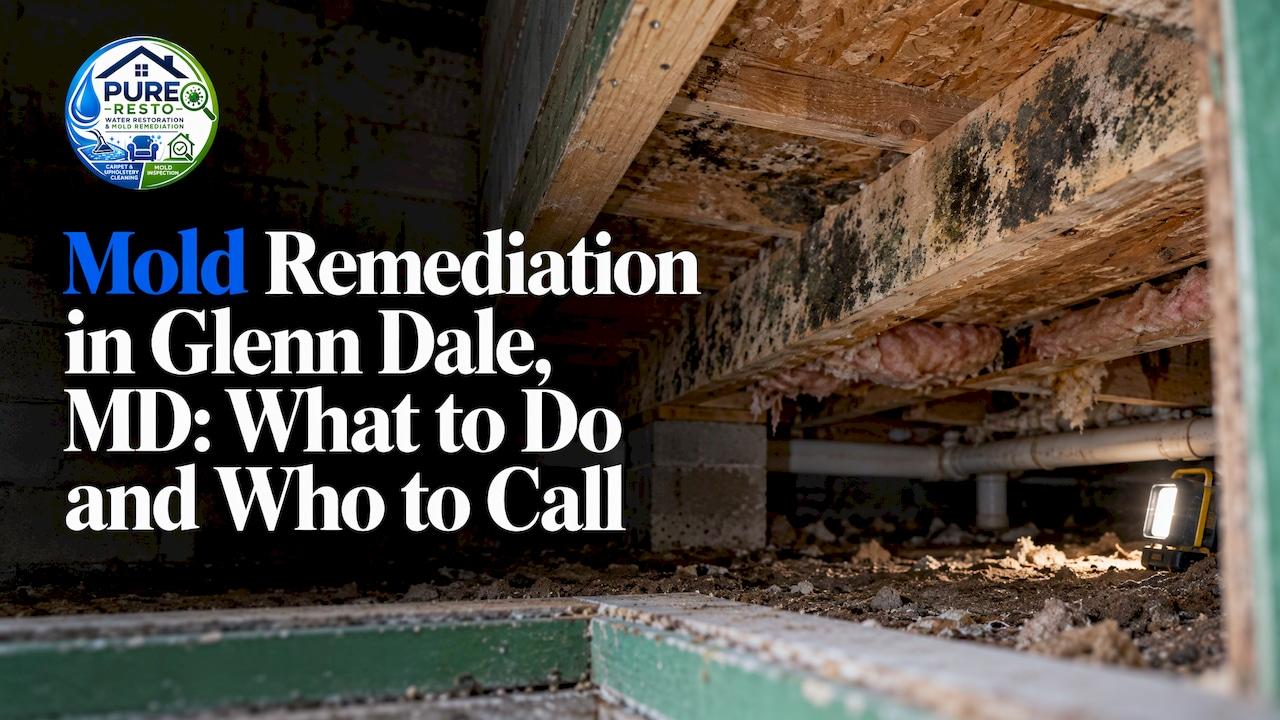
If you find mold in your Glenn Dale home after a leak or flood, the safest move is to stop the moisture, dry everything within 24 to 48 hours, and call a certified remediation company when the growth is large or tied to water damage. Pure Resto is an IICRC-certified restoration company based in Bowie, MD, and our crews typically arrive within 30 minutes of an emergency call. Below is what to do in the first day, when professionals are needed, what the work involves, what drives the price, and how to keep mold from returning.
TL;DR
- Dry the area and remove soaked items within 24 to 48 hours. That is the most important step in preventing mold damage.
- The EPA says most homeowners can handle mold under about 10 square feet. Larger areas, extensive water damage or sewage-contaminated water call for a professional.
- Hire a company certified by or affiliated with NEHA, AIHA, IICRC or ACAC. Pure Resto is IICRC-certified.
- Real remediation removes the mold, dries the structure and fixes the moisture source. Cleaning the surface alone does not.
- Cost depends on size, location and the damage behind the walls. Get a written estimate before work starts.
Table of Contents
- What to do in the first hour after you find mold
- When you can handle mold yourself and when you need a professional
- How professional mold remediation works
- Who is qualified to remove mold in Maryland
- What mold remediation costs in Maryland
- Mold after water damage: why speed matters
- Preventing mold from coming back
- For landlords and property managers: Maryland's 2025 mold law
- Why Glenn Dale homeowners call us
- Get a Glenn Dale mold assessment or emergency crew
- FAQ
- Sources
What to do in the first hour after you find mold
Mold needs moisture. Whatever fed it, whether a burst supply line, a failed sump pump, a roof leak or a flooded basement, has to be stopped first. Everything else depends on that.
Work through this order:
- Stop the water. Shut off the main valve if a pipe is leaking. If the source is a roof or window, contain it as best you can.
- Stay out if the home is unsafe. After a flood, federal guidance says to wait to re-enter until professionals say it is safe, with no structural, electrical or other hazards.
- Start drying. Open windows where weather allows, run fans and remove standing water. Pull out wet items that cannot be dried quickly, such as soaked padding, drywall pieces and cardboard.
- Photograph everything. Take pictures of the water source, damaged materials and visible growth before you move or discard anything. Your insurer will ask for them.
- Do not disturb it. Scrubbing or sanding moldy material can spread spores through the house.
- Call for help if the damage is more than a small patch. Our crews work 24/7, and an early call is cheaper than a late one.
The 24 to 48 hour window comes from the Department of the Interior and CDC homeowner's guide. If a wall cavity or subfloor stays wet past that, hidden growth becomes likely, even when the surface looks fine.
When you can handle mold yourself and when you need a professional
Small, surface-level spots on hard materials are a different job from mold that has followed water into drywall, insulation or flooring. The EPA's guidance says homeowners can usually manage areas under about 10 square feet. It advises consulting a professional for extensive water damage, larger areas, or sewage or other contaminated water. It also says people with health concerns should talk to a health professional.
Call a restoration company when any of these apply:
- The affected area is bigger than a patch roughly 3 feet by 3 feet.
- A leak, appliance failure or flood soaked carpet, padding, drywall or framing.
- The water was a sewage backup or other contaminated water.
- You smell mustiness but cannot find the source. That often means moisture inside a wall, ceiling or floor.
- Someone in the home has asthma, a weakened immune system or another breathing condition. Health guidance says people with breathing problems or weakened immune systems should stay away from moldy cleanup sites. If that is your household, a professional crew is the safe route, and a doctor can advise on symptoms.
- The mold came back after you cleaned it.
If you do clean a small spot, never mix bleach and ammonia or other cleaning products. Federal guidance warns they can create toxic vapors. Open doors and windows while you work.
How professional mold remediation works
The federal homeowner's guide describes the goal simply: remove the mold, dry the home and fix the moisture problem. A proper job follows that logic from start to finish.
1. Inspection and moisture source
The crew looks for visible growth and, just as important, the water that caused it. In a house like many in Glenn Dale, that could be a basement wall, a crawl space, an attic under a leaking roof or a bathroom with a slow supply leak. Our mold inspection service covers this step across Maryland. For homes nearby, we also have a page for mold inspection in Lanham.
2. Containment
Work areas are separated from the rest of the home so spores do not travel to clean rooms while materials are being removed.
3. Removal and cleaning
Materials that cannot be cleaned, such as soaked drywall or padding, are removed and bagged. Salvageable surfaces are cleaned. We use HEPA filtration to capture airborne particles during the work.

4. Drying
Extraction and drying equipment pulls moisture out of the structure. This step is what keeps the problem from returning. Mold that is removed from a wall that stays damp will grow back.
5. Odor control and restoration
Musty odors linger in fabric, carpet and framing. Our odor removal and sanitization service handles that for Glenn Dale homes. Contents such as furniture, clothing and keepsakes can be cleaned and stored while the work is done through our contents cleaning and storage service.
6. Repairs and final walkthrough
Once the area is dry and clean, damaged areas are rebuilt. The federal guide recommends qualified professionals to inspect, repair and restore damaged areas.
Who is qualified to remove mold in Maryland
Mold work is not a one-size-fits-all trade, and the title on the truck does not tell you much. The federal homeowner's guide advises hiring an inspection or remediation professional affiliated with or certified by NEHA, AIHA, IICRC or ACAC. Those are the National Environmental Health Association, the American Industrial Hygiene Association, the Institute of Inspection, Cleaning and Restoration Certification and the American Council for Accredited Certification.
Pure Resto is IICRC-certified, fully licensed and insured. Ask any company for its certification, its license and its insurance before work begins. Get the scope in writing.
You may see the phrase "Stage 4 mold contamination" online. Treat it as a marketing label rather than something to plan around. What matters for your home is the size of the affected area, the materials involved and whether water is still getting in. A written scope based on your actual house is more useful than any stage number.
What mold remediation costs in Maryland
Price depends on the house, so no honest number applies to every job. For a local reference, Angi's 2026 data for Baltimore puts the average mold remediation cost at $2,402, with most projects between $1,236 and $3,622. The same page says most professionals charge $10 to $25 per square foot. Treat those as a rough Maryland-area guide, not a quote for Glenn Dale. We do not publish prices, because the scope has to be seen first.
What moves the estimate:
- Size of the affected area. More square footage means more containment, labor and disposal.
- Location. Attics, crawl spaces and basements each bring different access and ventilation needs.
- Materials. Mold on hard surfaces is cleaned. Mold in drywall, insulation or carpet padding usually means removal and replacement.
- Water source. A repaired leak is simpler than ongoing moisture or contaminated water.
- Drying needs. A structure that is still wet needs equipment and time before rebuilding.
- Repairs afterward. Remediation clears the mold. Rebuilding walls, flooring or ceilings is a separate scope, so ask what the estimate includes.
If the mold came from a covered loss such as a sudden pipe burst, your insurance may cover part of the work. Policies differ, so read yours or call your agent. We work directly with insurance providers to streamline the claims process, and we can bill them directly.
Mold after water damage: why speed matters
Most mold jobs in homes start as a water job. The faster the water is handled, the smaller the mold problem. That is why we pair mold work with water damage restoration in Glenn Dale. Extraction and drying begin right away, and the mold remediation scope shrinks or disappears.
If water has been sitting for more than a day or two, treat the situation as a likely mold job and have it checked. Wet carpet and padding are common culprits. Wall cavities behind baseboards hold moisture for days after the surface feels dry.
Preventing mold from coming back
Removal without moisture control is temporary. After the work, focus on the conditions that let mold grow:
- Fix the source. Repair the roof, pipe, window seal or grading problem that let water in.
- Keep humidity in check. Measure indoor humidity before guessing. This guide on high indoor humidity and drying wet materials explains how to measure first and dry wet materials within 24 to 48 hours.
- Dry anything that gets wet, fast. Spills, plumbing leaks and storm intrusion should be dried the same day.
- Run bathroom and kitchen exhaust fans. Moisture from showers and cooking should leave the house.
- Watch the basement and crawl space. These are the first places Maryland homes show moisture trouble after heavy rain.
- Check after storms. Look at ceilings, window corners and the base of walls.
If a smell returns or a stain reappears, call early. A small return is much easier to deal with than a large one.
For landlords and property managers: Maryland's 2025 mold law
If you manage rental units, a new state law applies. The Maryland Tenant Mold Protection Act took effect July 1, 2025. According to Maryland's Real Property code, it sets specific landlord duties and requires the Maryland Department of the Environment to set uniform standards by 2027. A summary from a Maryland law firm describes the main timelines: a mold assessment within 15 days of notice and remediation within 45 days. The same summary says the law addresses health concerns affecting nearly 38,000 rental units in the state.
For property managers, the practical takeaway is to act on a mold report quickly and keep records of the assessment and the work. Talk to your attorney about how the act applies to your properties. Our crews work in residential and commercial buildings, and we can document the work for your files.

Why Glenn Dale homeowners call us
Glenn Dale sits in Prince George's County, minutes from Bowie, Lanham, Greenbelt and Mitchellville, all areas we serve. Our office is in Bowie, which is why we can promise a fast arrival and not a next-day window.
Our view: mold is a water problem first
When a family calls about mold, they usually ask how to get rid of it. We start with a different question: where did the water come from, and is it still there? Mold is the symptom. If the structure stays damp, it returns, no matter how well the surface was cleaned.
That is why we handle water damage, drying, mold and odor under one roof. Extraction and drying equipment pulls moisture out of the building, HEPA filtration helps capture what is released during removal, and our approach favors restoring what can be saved over tearing everything out. Our technicians are IICRC-certified, and our jobs are backed by a satisfaction guarantee and written workmanship standards.
Speed matters most. Our crews typically arrive within 30 minutes, because the first hours decide whether you have a drying job or a mold job. We also work directly with your insurance provider, so you are not left to run the claim alone while your home is torn up.
Pure
Get a Glenn Dale mold assessment or emergency crew
If you have mold, a musty smell or a wet area that has sat for more than a day, we can help. Our mold remediation service covers inspection, removal, drying and odor control, with certified technicians and direct insurance billing. Call us at any hour. We are open 24/7 and typically arrive within 30 minutes.
If you are not sure how bad it is, start with a mold inspection. For active water, our water damage restoration team can begin extraction and drying right away. You can reach us through purerestomd.com.
FAQ
Can I remove mold myself?
In most cases homeowners can handle small areas, under about 10 square feet, according to the EPA. For larger areas, extensive water damage or sewage-contaminated water, hire a professional. If anyone in your home has breathing problems or a weakened immune system, let a crew handle it and ask your doctor about symptoms.
How much does mold remediation cost in Maryland?
Angi's 2026 Baltimore data lists an average of $2,402, with most jobs between $1,236 and $3,622. Your cost depends on the size, location, materials and water source. A written estimate after an on-site look is the only reliable number.
Who is certified to remove mold?
Federal homeowner guidance suggests choosing a professional affiliated with or certified by NEHA, AIHA, IICRC or ACAC. Pure Resto is IICRC-certified, licensed and insured.
How fast does mold start after water damage?
The key window is 24 to 48 hours. Drying the home and removing water-damaged items in that time is the most important step in preventing mold damage. Call right away if water has sat longer.
Does insurance cover mold remediation?
It depends on your policy and on what caused the water. Sudden events like a burst pipe are often treated differently from long-term leaks. We work directly with insurance providers to streamline claims, and your agent can tell you what your policy covers.
Sources
- Homeowner's and Renter's Guide to Mold Cleanup After Disasters (DOI)
- Homeowner's and Renter's Guide to Mold Cleanup After Disasters (CDC)
- Mold Cleanup in Your Home (US EPA)
- Mouldy Homes and Buildings: Managing Indoor Mould (MyHealth.Alberta)
- How Much Does Mold Remediation Cost in Baltimore, MD? (Angi)
- Maryland Code, Real Property (Westlaw)
- Maryland Landlord & Tenant Laws: Summer 2025 (Holland Law Firm)
- High Humidity at Home: Measure First, Dry Wet Materials in 24–48 Hours