
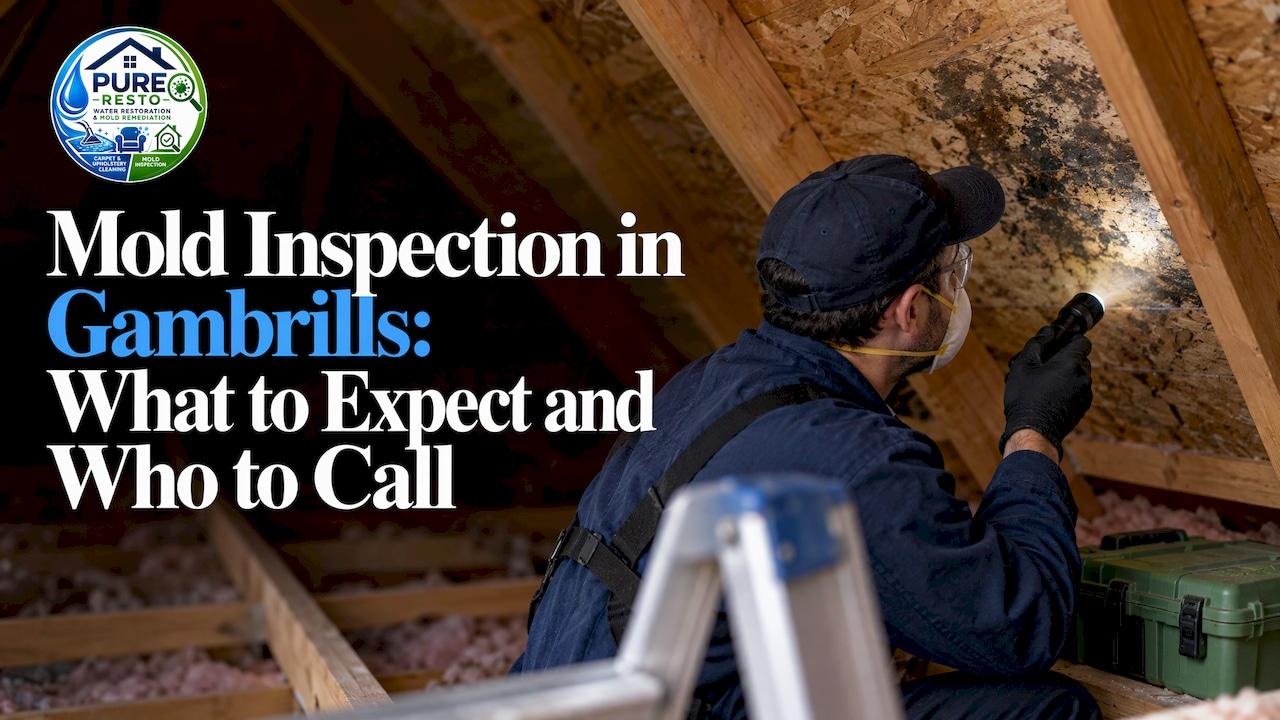
If you see or smell mold in a Gambrills home, or you had a leak or flood and want to know whether mold is growing, the best first step is a professional inspection that finds the moisture source and the extent of the growth. Pure Resto is an IICRC-certified restoration company in Maryland. Our crews typically arrive within 30 minutes on emergency calls, and our mold inspection and testing service covers Gambrills, Crofton, Odenton, Millersville, Davidsonville and Crownsville. The same company can then handle drying and cleanup if mold turns up, so you are not coordinating several contractors.
TL;DR
- A mold inspection looks for visible growth, but its real job is to find the moisture behind it. Without fixing the water source, mold returns.
- Schedule one when you see or smell mold, after any leak or flood that was not dried within 24 to 48 hours, or when musty odors keep coming back.
- Maryland has no separate state mold remediation license. Contractors are expected to follow industry standards such as IICRC S520, so check credentials before you hire.
- Mold areas larger than about 10 square feet generally call for professionals, and people with asthma, allergies or weak immune systems should stay out of the cleanup.
- Keep the written report. It is your baseline for repairs, insurance conversations and any future sale.
Table of Contents
- When a Gambrills homeowner should book an inspection
- What a mold inspection actually checks
- How long it takes
- What mold inspection costs in Gambrills
- What Maryland rules say about mold work
- What the standards mean by mold levels
- What happens after the inspection
- Choosing who inspects your home
- Why one company for inspection and cleanup
- Get a Gambrills inspection from Pure Resto
- FAQ
- Sources
When a Gambrills homeowner should book an inspection
Mold needs moisture, and the Chesapeake region supplies plenty: humid summers, basements and crawl spaces that stay damp, bathroom fans that vent into attics, and roofs and plumbing that leak quietly for months. The EPA states that moisture is the key to mold growth, so assessing a mold problem means looking for existing or potential moisture problems.
Book an inspection in any of these situations:
- You can see mold. Dark, fuzzy or speckled growth on drywall, ceilings, window frames, or around pipes.
- A musty smell will not go away. Odor with no visible source often means moisture behind a wall, under flooring or in a cavity.
- You had water damage. A burst pipe, appliance leak, sewage backup, roof leak or basement flood. The EPA advises drying a home and belongings as quickly as possible, within 24 to 48 hours if you can, according to its guide to mold cleanup after disasters.
- Someone in the home has symptoms that seem tied to one room. Persistent stuffiness or irritation that eases when you leave the house is worth investigating, and a doctor should be your first call for any health concern.
- You are buying, selling or renting out a property. A written report documents the condition of the home at a point in time.
If the water event just happened, do not wait for mold to show up. Fast extraction and drying is what prevents the growth in the first place, which is why we pair inspection with water damage restoration in Gambrills.
What a mold inspection actually checks
A residential inspection is mainly a careful look at how water moves through your house. According to the EPA, mold assessment is mainly done through visual inspection of areas with moisture problems or water damage. A thorough visit usually follows a sequence:
- Interview. The inspector asks about leaks, past floods, odors, health complaints and renovations.
- Visual assessment. Ceilings, walls, baseboards, window sills, under sinks, around water heaters, attics, basements and crawl spaces.
- Moisture readings. Meters show whether drywall, wood or subfloor is wet even when it looks dry. Thermal imaging and borescope cameras can point to hidden dampness, according to one published description of the process.
- Ventilation and HVAC review. Ducts, returns, bath fans and dryer vents can spread or feed a moisture problem.
- Sampling, when it is part of the scope. Air samples and surface swabs or tape lifts are sealed and sent to a laboratory, typically alongside an outdoor control sample so indoor spore counts have something to be compared with.
- A written report. It identifies moisture sources, affected areas and recommended next steps.
The report matters as much as the visit. It tells a remediation crew where to contain, what to remove and what to dry, and it gives you something to hand to your insurer.
Why moisture sources get so much attention
Cleaning visible mold without finding the water is the most common reason it returns. A slow roof leak, a failed window seal, condensation on cold ducts, a dripping supply line, a grading problem that sends rain toward the foundation: each feeds the same patch of drywall. Even small entry points count. For example, water seeping under a garage door can reach an adjoining wall or slab, and there are some low-cost fixes for water under a garage door worth knowing about when the garage shares a wall with living space.
How long it takes
Plan on a few hours for the visit, then a short wait if samples go to a lab.
| Stage | Typical time |
|---|---|
| On-site inspection of a standard home | About 1 to 3 hours, depending on the source consulted |
| Larger homes, big basements or crawl spaces, suspected hidden mold | Can run 4 to 6 hours |
| Laboratory results, when samples are taken | A few business days, commonly 1 to 5 |
Those ranges come from published industry descriptions, including one on inspection duration and one on lab turnaround. Your actual timing depends on house size, access, and how many samples are taken. When you call us, we will tell you what to expect for your specific property.
What mold inspection costs in Gambrills
We do not publish a fixed price for mold inspection because the cost depends on the home, not a template. These are the factors that move a quote:
- Square footage and layout. A split-level in Crofton and a large colonial in Davidsonville with a finished basement are different jobs.
- Access. Crawl spaces, attics and finished basements take longer to assess.
- Scope. A visual and moisture assessment is smaller than an assessment that includes laboratory sampling.
- Number of samples. Each lab sample adds analysis cost.
- Whether there was recent water damage. A known leak narrows the search; an unexplained odor widens it.
To get a number for your home, request a mold inspection quote for Gambrills. If the loss came from a covered event such as a sudden pipe burst, we work directly with insurance providers to streamline the claims process.
What Maryland rules say about mold work
Maryland has changed its approach to mold in recent years, mostly on the rental side. Here is what matters to a homeowner or property manager.
No separate state mold license. Maryland's former state mold remediation licensing program ended in 2019, according to a legal summary of Maryland mold law. Contractors may still need a general home improvement license, and work is expected to follow recognized industry guidelines. In practice, that means standards like IICRC S520. Because nobody hands you a state mold credential to check, the credentials a company holds, its insurance and its written workmanship standards carry more weight. Pure Resto is IICRC-certified, fully licensed and insured.
Landlord duties. Under Maryland Real Property § 8-220, effective July 1, 2025, a landlord must perform a mold assessment within 15 days after receiving written notice of mold from a tenant, occupant or local code agency. If mold is detected, remediation must follow within 45 days of the completed assessment, or within a reasonable time if 45 days is not feasible. Property managers handling rentals in Gambrills, Odenton or Annapolis should build that timeline into their response process.
Statewide standards are coming. The same legislation directs the Maryland Department of the Environment to develop uniform statewide standards for mold assessment and remediation, with a deadline of June 1, 2027. Watch the department's site for the final rules.
What the standards mean by mold levels
Readers often ask about stages or levels of mold contamination. There is no single federal numeric limit. The CDC notes there are no health-based standards for mold in indoor air. In the restoration trade, the reference is the IICRC S520 standard, which classifies conditions as Condition 1, 2 or 3 rather than relying on the size of visible growth alone. In plain terms: normal background mold, mold that has spread from its source, and areas with actual growth. Some guides use numbered levels based on square footage, but the S520 conditions are the professional benchmark.
The practical rule for homeowners is simpler. The EPA-referenced guidance, as presented in a Massachusetts state guide for homeowners, is that areas larger than 10 square feet call for professional remediation, and anyone who is immunocompromised or has asthma or known mold allergies should not do repairs or mold cleanup themselves.
What happens after the inspection
The report usually leads to one of three outcomes: no mold, limited mold with an identified moisture source, or extensive contamination. In each case, keep the report.
Limited mold with a known source
The water problem gets repaired, wet materials are dried or removed, and the affected area is cleaned and verified. Speed matters, because wet drywall and insulation can support growth within days.
Extensive or hidden contamination
This is where professional remediation earns its cost. Remediation to the IICRC S520 standard involves containing the work area, controlling air movement with negative air pressure, filtering the air with HEPA equipment and verifying the result afterward. Our approach to mold remediation in Gambrills uses HEPA filtration along with advanced extraction and drying to prevent further damage and health hazards.

Safe handling while you wait
Follow the EPA's disaster-cleanup advice as written: do not use fans if mold has already started to grow, never mix bleach and ammonia, and do not paint or caulk over mold, since that will not stop it from growing. Keep children, older adults and anyone with respiratory conditions away from the affected area.
If the home is being sold
Some owners facing a large mold finding want to understand their options before listing, including remediating first or selling the property as is. One resource laying out those choices is selling a home with mold. Whichever route you take, a written inspection report and documentation of any remediation make the conversation with buyers and lenders easier.
Choosing who inspects your home
Because Maryland has no state mold inspector license, check these things yourself before you book anyone:
- Industry certification. The EPA suggests looking for professionals affiliated with or certified by organizations such as NEHA, AIHA, IICRC or ACAC.
- Licensing and insurance. Ask for proof of both.
- A written report. You should receive findings, photos, moisture readings and recommended next steps in writing.
- A plan for the water source. An inspection that identifies mold without tracing moisture is incomplete.
- Insurance experience. If the cause was a covered loss, documentation quality affects your claim.
- Guarantee. Ask what the work is backed by. Ours is backed by a satisfaction guarantee and written workmanship standards.
Why one company for inspection and cleanup
Most of the mold calls we get start as a water problem. A pipe let go, a basement took on water, or a roof leak sat unnoticed above a ceiling. By the time the stain shows up, the damage is already behind the wall.
That is why we treat inspection, drying and remediation as one connected job rather than separate errands. Our crews are IICRC-certified, we respond around the clock, and our emergency teams typically arrive within 30 minutes. We use advanced extraction, drying and HEPA filtration so we deal with the moisture and the air, not just the surface you can see.
We also work directly with insurance providers, so you spend your time on your home and family instead of paperwork. Our approach is restoration and prevention, not a quick wipe-down.
Pure
Get a Gambrills inspection from Pure Resto
If you suspect mold, call us and tell us what happened: where the water came from, when, and what you have noticed. We will schedule your mold inspection in Gambrills, MD, and if growth is found, our team can move straight into containment and cleanup. If water damage is still active, water damage restoration is available 24/7.
We are fully licensed and insured, IICRC-certified and backed by a satisfaction guarantee. Our service area also includes Crofton, Odenton, Millersville, Davidsonville, Crownsville, Annapolis, Severn and Fort Meade. See our mold inspection and testing page for the full service.
FAQ
Is mold considered uninhabitable?
Not automatically. There is no single federal mold concentration or visible-area limit that decides whether a home is uninhabitable, and the CDC notes there are no health-based standards for mold in indoor air. Widespread or recurring growth, ongoing water intrusion and contaminated ventilation are the situations that raise serious habitability concerns. An inspection report documents which situation you are in.
Should I test the air or just look?
The starting point is a visual and moisture assessment of areas with water damage or odor. Sampling can be added when the situation calls for it, such as hidden growth suspected but not visible. Tell us what you have noticed and we will help you choose the right scope for your home.
How soon after water damage can mold start?
The EPA advises drying the home and belongings within 24 to 48 hours if possible. Beyond that window, materials like drywall, carpet padding and insulation can begin growing mold. If you are past that point, schedule an inspection rather than waiting for visible signs.
Who pays for a mold inspection and remediation?
That depends on the cause and your policy. Coverage often turns on whether the mold followed a sudden, covered event such as a burst pipe. We work directly with insurance providers to streamline the claims process, and a written inspection report helps document the loss.
What does a landlord have to do when a tenant reports mold in Maryland?
Under Real Property § 8-220, a landlord must complete a mold assessment within 15 days of written notice and, if mold is found, remediate within 45 days of the assessment, or within a reasonable time if that is not feasible. Property managers should keep written records of each step.
Sources
- EPA: Who can test my home or clean, fix and remediate my home for mold
- EPA: Homeowner's and Renter's Guide to Mold Cleanup After Disasters
- CDC/NIOSH: Mold, Testing, and Remediation
- Maryland Code, Real Property § 8-220
- IICRC S520 Standard and Reference Guide for Professional Mold Remediation
- Massachusetts mold cleanup guide for homeowners
- Maryland mold laws overview
- Mold inspection process and timing
- Mold inspection turnaround times
- Mold testing duration and lab turnaround
- Water under a garage door: low-cost fixes
- Selling a home with mold