
Yes, attic mold can be removed — but removing it without fixing the moisture source first is a waste of money. The mold will come back within months. Before you call anyone or touch anything, take three immediate steps: restrict access to the attic, stop any obvious moisture source you can reach (shut off water to a leaking pipe, temporarily seal a visible roof penetration with roofing tape), and leave large affected areas undisturbed until you have a plan.
- Under 10 sq ft: The EPA says homeowners can handle small mold problems themselves, provided they use proper PPE (N95 respirator, gloves, eye protection) and fix the moisture source first.
- Over 10 sq ft: Hire a certified remediation professional. Larger areas, HVAC involvement, or structural damage are beyond safe DIY scope.
- Cost snapshot: Minor attic mold jobs often cost a few hundred to a few thousand dollars. Moderate cases with insulation removal require more investment. Severe or structural cases may be significantly more expensive, particularly when roof repairs and sheathing replacement are involved.
- Critical safety note: Do not use bleach on wood sheathing. Bleach cannot penetrate porous wood surfaces, so it kills surface spores while leaving the root structure intact. Use an EPA-registered fungicide or encapsulant designed for porous building materials.
Key Takeaways
Attic mold remediation requires fixing the moisture source first — cleaning without drying the root cause guarantees the mold returns within months.
| Point | Details |
|---|---|
| Fix moisture before cleaning | Identify and repair roof leaks, misdirected fans, or ventilation gaps before any remediation begins. |
| EPA size threshold | Homeowners may handle areas under 10 sq ft; larger areas or HVAC involvement require a certified professional. |
| Cost reality | Minor jobs run $500–$1,500; moderate cases $1,500–$4,000; severe or structural cases can exceed $10,000. |
| Ventilation standard | IRC R806 requires 1:150 NFA ratio; most pros recommend targeting 1:150 even when 1:300 is code-permitted. |
| Purerestomd | IICRC-certified teams in Maryland provide 24/7 inspection, full remediation, and direct insurance billing with independent clearance testing. |
Table of Contents
- Why does mold grow in your attic?
- How to spot attic mold and inspect safely
- What health and structural risks does attic mold create?
- Can you remove attic mold yourself, or do you need a pro?
- What does a professional attic mold remediation project look like?
- Attic mold remediation costs: what to expect and what changes the price
- How to prevent attic mold: ventilation, ducting, and routine checks
- How do you choose a qualified attic mold remediation contractor?
- What the research says about attic ventilation and mold
- A perspective on what attic mold really tells you about a house
- Purerestomd handles attic mold from inspection through clearance
- Sources
- FAQ
Why does mold grow in your attic?
Attic mold almost always traces back to one of three moisture pathways, and most homes have more than one active at a time.
Roof leaks are the most obvious culprit. Water intrudes through failed flashing, cracked shingles, or ice dams, soaks into the wood sheathing, and creates the persistently damp surface mold needs to colonize. The tricky part: a slow roof leak can feed mold growth for months before you notice a water stain on your ceiling.
Ventilation imbalance is the more common and more overlooked cause. When warm, humid air from your living space rises into the attic faster than the attic can exhaust it, that moisture condenses on the cold underside of the roof deck. The IRC R806 ventilation standard sets a baseline of 1 sq ft of net free area (NFA) per 150 sq ft of attic floor (the 1:150 ratio). Most roofing professionals recommend targeting 1:150 regardless, because the 1:300 exception leaves little margin for error in humid climates.
Exhaust fans and duct bypasses are the third pathway, and arguably the most preventable. Bathroom exhaust fans, kitchen range hoods, and dryer vents that terminate inside the attic rather than through the roof or wall dump warm, humid air directly onto the sheathing. A single bathroom fan venting into an attic can deposit significant moisture daily during winter months. Plumbing stacks, recessed can lights, and attic hatches that aren't air-sealed also allow conditioned air to bypass insulation and contact cold roof deck surfaces.
- Roof leaks (active or historic)
- Inadequate ridge and soffit ventilation
- Bathroom/dryer/kitchen exhaust fans terminating in the attic
- Air bypasses around can lights, plumbing stacks, and attic hatches
- Wet or compressed insulation blocking soffit vents
Pro Tip: Before any remediation work begins, have a contractor or inspector identify every moisture pathway. Fixing one and missing another is the most common reason attic mold returns within a year.
Wood sheathing and paper-faced insulation are porous materials that hold moisture and support mold growth far more readily than concrete or metal. Once sheathing is colonized, surface cleaning alone won't solve the problem. The wood fibers themselves carry the fungal structure, which is why cleaning without drying and removing the moisture source is only a cosmetic fix.
How to spot attic mold and inspect safely
You don't need a professional to do a first-pass inspection. What you need is a flashlight, a moisture meter, an N95 respirator, and a systematic approach.
Visual signs to look for:
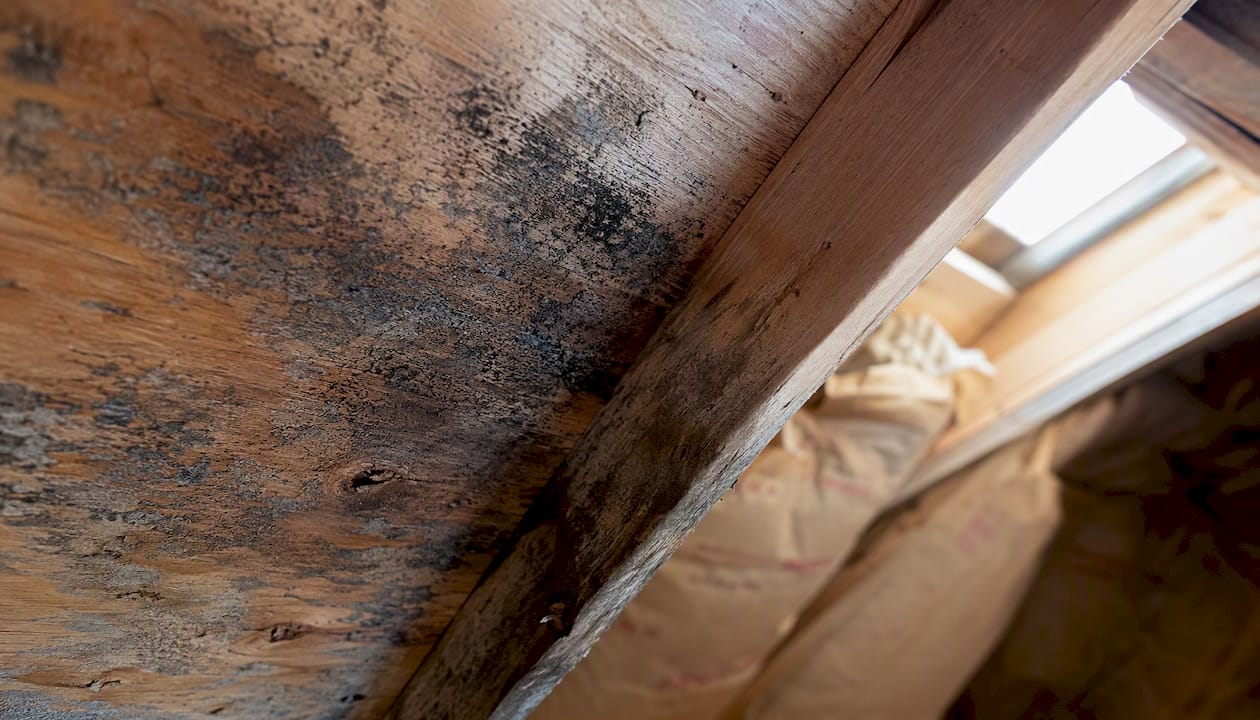
- Dark spotting or staining on roof sheathing (black, gray, or greenish patches)
- Rusty nail heads where condensation has repeatedly formed
- Wet, matted, or discolored insulation
- Frost or condensation on the underside of the roof deck in winter
- Staining along rafter edges where air movement concentrates moisture
Sensory clues: A musty, earthy odor coming from the attic hatch or upper-floor rooms is often the first sign homeowners notice. If the smell intensifies when the HVAC runs, duct contamination is possible.
Simple inspection workflow:
- Shut off the HVAC before entering to avoid spreading spores through the duct system.
- Temporarily seal the attic hatch with tape around the frame to limit cross-contamination while you're up there.
- Enter from the access point and map the attic systematically: scan sheathing panels, rafters, ridge board, insulation surface, and all vent openings.
- Use a moisture meter on any sheathing that looks stained or discolored. Wood moisture content above 19% indicates active dampness that needs drying before remediation.
- Photograph everything. Date-stamped photos document the scope for insurance purposes and give a contractor a baseline.
Pro Tip: *A moisture meter reading is the single most useful tool for distinguishing old, dry staining from active mold growth that needs immediate attention.
Estimate the total affected area in square feet as accurately as you can. That number drives the DIY-versus-professional decision and gives any contractor a starting point for scoping the job.
What health and structural risks does attic mold create?
Attic mold rarely stays in the attic. Spores travel through air leaks, HVAC systems, and even the natural stack effect that pulls air upward through a house.
Health effects vary by individual sensitivity. People with asthma, allergies, or compromised immune systems tend to experience symptoms first: persistent coughing, runny or itchy eyes, nasal congestion, and worsening respiratory symptoms. Children, elderly residents, and anyone on immunosuppressive medications face higher risk. Healthy adults in a well-sealed house may notice nothing for months, which is part of what makes attic mold dangerous — it can grow extensively before anyone feels it.
Structural risks are often more immediately costly than health effects. Prolonged moisture on roof sheathing causes:
- Wood delamination and soft spots in OSB panels
- Rot in rafters and ridge boards
- Rusted and weakened fasteners (ring-shank nails, joist hangers)
- Shortened roof life when condensation cycles continue unchecked
- Compromised insulation R-value as wet insulation compresses and loses effectiveness
A roof deck that has been wet for two or more seasons may require partial or full sheathing replacement, which adds thousands of dollars to a remediation project. Catching the problem early, when mold is surface-level and the wood is still structurally sound, is the difference between a $1,500 job and a $7,000 one.
Can you remove attic mold yourself, or do you need a pro?
The answer depends on three things: how much area is affected, whether the moisture source is identifiable and fixable, and whether the HVAC system is involved.
The EPA's guidance is the clearest benchmark available: homeowners may generally handle mold problems under 10 sq ft. Anything larger, or any situation involving HVAC ducts, typically requires a professional.
Call a professional when:
- The affected area exceeds 10 sq ft
- Mold is present on or near HVAC ducts, air handlers, or return vents
- You cannot locate the moisture source
- The wood sheathing feels soft or shows signs of rot
- Mold has returned after a previous DIY attempt
- Anyone in the household has respiratory conditions or a compromised immune system
DIY is reasonable only when:
- The affected patch is clearly under 10 sq ft
- The moisture source has already been identified and fixed
- The wood is dry (moisture meter reads below 16%)
- You have proper PPE: N95 or P100 respirator, nitrile gloves, eye protection, and disposable coveralls
Even in a legitimate DIY situation, use an EPA-registered fungicide or antimicrobial solution formulated for porous wood, not bleach. Bag and seal all waste before carrying it through the living space.
Quick decision checklist:
- Area under 10 sq ft? ✓ Possible DIY
- Moisture source found and fixed? ✓ Proceed
- Wood dry (under 16% MC)? ✓ Safe to clean
- HVAC unaffected? ✓ Lower risk
- Any "no" above? → Call a certified remediation contractor
What does a professional attic mold remediation project look like?
A reputable contractor follows a documented process. If a quote doesn't mention most of these steps, ask why.
Step-by-step professional workflow:
- Initial inspection and scope definition. The contractor assesses the full extent of mold growth, identifies moisture sources, and determines whether air or surface sampling is needed to identify species or establish a baseline for clearance testing.
- Containment setup. Poly sheeting and negative air pressure isolate the attic from the living space. This prevents spores disturbed during remediation from migrating into bedrooms and common areas.
- HEPA filtration and air scrubbing. HEPA air scrubbers run continuously during the project, capturing airborne spores down to 0.3 microns.
- Removal of contaminated insulation. Saturated or heavily colonized insulation is bagged, sealed, and removed before any sheathing treatment begins. New insulation goes in only after the wood is dry and clean.
- Treatment or removal of affected sheathing. Depending on severity, the contractor either dry-ice blasts, media blasts, or hand-sands the sheathing surface, then applies an EPA-registered fungicide and encapsulant. Structurally compromised panels are cut out and replaced.
- Drying and moisture control. Industrial desiccant dehumidifiers and air movers bring wood moisture content down to an acceptable level before any encapsulation or new insulation is installed.
- Source repairs. Roof leaks, misdirected exhaust fans, and ventilation deficiencies are corrected as part of the project or coordinated with a roofing or HVAC contractor. Skipping this step means the mold returns.
- Post-remediation clearance testing. An independent third-party inspector (not the same company that did the remediation) collects air and surface samples. Results must meet pre-defined clearance criteria before the job is considered complete.
Common equipment on a professional job:
- HEPA vacuum and HEPA air scrubbers
- Negative air machines (typically 500–2,000 CFM)
- Moisture meters and thermal imaging cameras
- Media blasting equipment (dry ice, soda, or corn cob media)
- Industrial dehumidifiers and air movers
- Full PPE: Tyvek suits, P100 half-face respirators, nitrile gloves
A typical moderate-severity attic job takes two to four days for remediation, plus additional time for drying and clearance testing. Containment, HEPA filtration, and independent clearance testing are the professional trust signals that separate a thorough contractor from one who sprays and walks away.
Attic mold remediation costs: what to expect and what changes the price
Cost ranges vary significantly by severity, attic size, and local labor rates. Here's a realistic breakdown by tier.
| Severity Tier | Typical Cost Range | What's Usually Included |
|---|---|---|
| Minor (under 10 sq ft, surface only) | $500–$1,500 | Inspection, limited containment, HEPA vacuuming, fungicide treatment, basic clearance |
| Moderate (10–50 sq ft, insulation affected) | $1,500–$4,000 | Full containment, insulation removal and disposal, sheathing treatment, drying, clearance testing |
| Severe (50–200+ sq ft, structural concerns) | $4,000–$10,000 | All above plus sheathing replacement, roof repairs, ventilation corrections, extended drying |
| Structural/full-deck (widespread rot, full replacement) | $10,000 or more | Partial or full sheathing replacement, major roof work, full remediation protocol |
Line-item cost drivers:
- Containment and setup: $200–$600 depending on attic access and size
- Insulation removal and disposal: $1–$2 per sq ft of attic floor
- Sheathing treatment (blasting or sanding): $2–$5 per sq ft of affected area
- Sheathing replacement: $3–$7 per sq ft of material and labor
- Roof repairs: Highly variable; minor flashing repairs start around $300, full section replacement runs $1,500 or more
- Ventilation corrections (baffles, ridge vent, soffit repair): $500–$2,000
- Clearance testing: $300–$600 for independent post-remediation sampling
What else affects the final number:
- Attic access difficulty (low-pitch roofs, small hatches, knee walls)
- Local labor rates (Maryland costs tend to run higher than rural Midwest markets)
- Whether the contractor is IICRC-certified (certified firms typically charge more but follow documented protocols)
- Mold species (some species trigger more aggressive containment requirements)
Insurance reality: Homeowners insurance generally excludes mold caused by maintenance failures or chronic ventilation problems. If the mold traces to a sudden, covered peril — a burst pipe or storm-driven roof damage — some coverage may apply, but mold remediation is often subject to sublimits or exclusions. Document everything with photos and get a written scope from your contractor before filing any claim.
How to prevent attic mold: ventilation, ducting, and routine checks
Prevention costs a fraction of remediation. Most attic mold problems are preventable with three interventions: proper ventilation, correct exhaust fan termination, and air sealing.
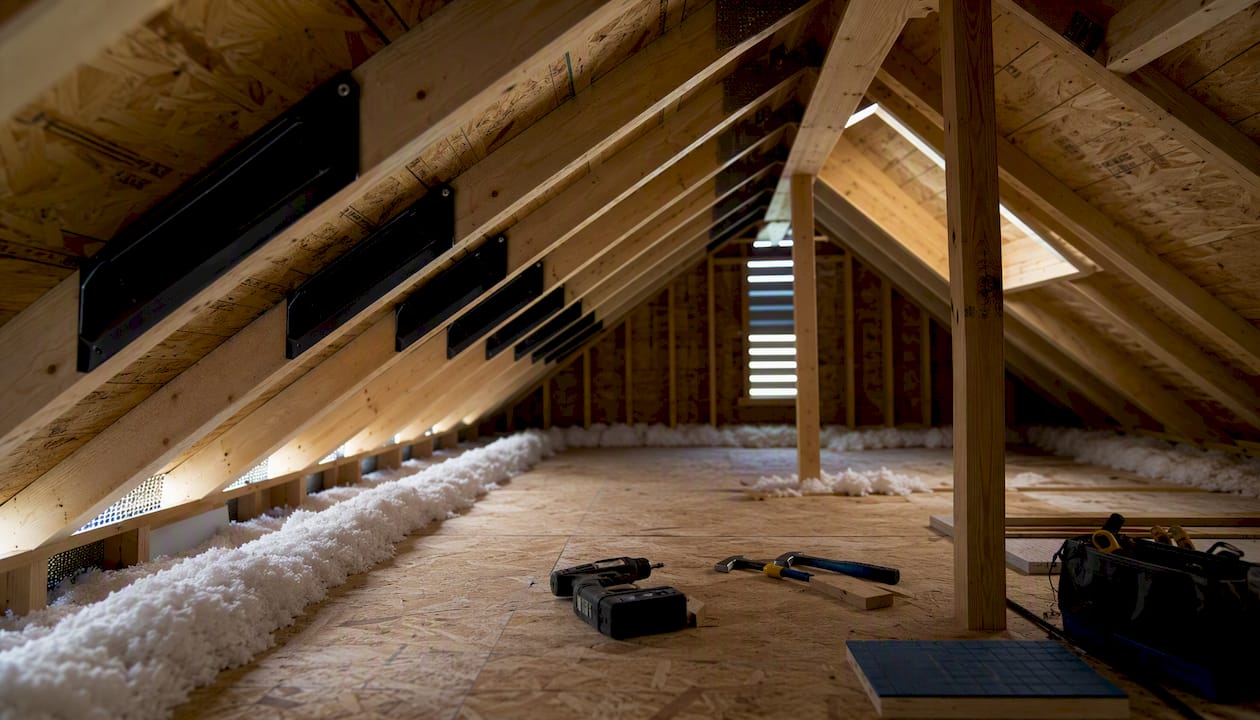
Ventilation requirements and best practices:
| Ventilation Parameter | Code Minimum (IRC R806) | Practical Recommendation |
|---|---|---|
| Net free area ratio | 1:150 (1 sq ft NFA per 150 sq ft attic floor) | Target 1:150; 1:300 only with vapor retarder and upper-vent placement |
| Vent placement | At least 40% in upper half of attic for 1:300 exception | Ridge vent plus continuous soffit vent for balanced airflow |
| Baffle requirement | Required at each rafter bay at eaves | Install baffles before adding insulation to keep soffit vents clear |
The IRC R806 standard is the code floor, not the performance target. Many roofing professionals recommend aiming for 1:150 because it provides a buffer against seasonal humidity spikes and gives the attic enough airflow to dry out after minor moisture events.
Exhaust fan and duct termination:
- Every bathroom fan, kitchen exhaust, and dryer vent must terminate to the exterior, not into the attic.
- Use rigid, insulated metal duct for bathroom fans. Flexible uninsulated duct loses heat and allows condensation inside the duct itself, which drips back into the attic.
- Check termination points annually. Birds, squirrels, and debris can block exterior vent caps within a single season.
Air sealing attic bypasses:
Warm air from the living space rises through gaps around recessed can lights, plumbing stacks, attic hatches, and top plates. Sealing these bypasses with fire-rated caulk or spray foam before adding insulation is the most cost-effective single intervention for preventing condensation on the roof deck. Do not add insulation over existing wet or moldy insulation. Remove it first, dry the sheathing, and then re-insulate.
Pro Tip: Fixing ventilation and ducting often costs far less than a second remediation project. Many remediation scopes include a ventilation correction line item precisely because contractors know that an under-ventilated attic will grow mold again within a year or two.
Routine inspection checklist:
- Inspect the attic after every major storm for signs of water intrusion
- Check wood moisture content annually in late winter (peak condensation season)
- Verify all soffit vents are clear of insulation and debris each spring
- Confirm exhaust fan terminations are unobstructed and functioning
- Look for frost on the underside of the roof deck during cold snaps — it's a direct indicator of excess moisture
How do you choose a qualified attic mold remediation contractor?
The remediation industry has no universal licensing requirement in most states, which means the quality gap between contractors is wide. Credentials and process transparency are the most reliable filters.
Credentials to verify:
- IICRC certification (Institute of Inspection, Cleaning and Restoration Certification): Look for technicians certified in Applied Microbial Remediation (AMRT) or Water Damage Restoration (WRT). Purerestomd's technicians carry IICRC certifications, which is the standard to hold any contractor to.
- General liability and workers' compensation insurance: Ask for certificates before work begins.
- References from similar attic jobs: A contractor who has done dozens of attic remediations will have a documented process; one who primarily does water damage may not.
Questions to ask during an estimate:
- What does your containment setup look like for an attic job?
- Do you use HEPA air scrubbers during remediation?
- How do you handle insulation disposal?
- Who coordinates roof or ventilation repairs — your crew or a subcontractor?
- Do you perform clearance testing, and is it done by an independent third party?
- Can you bill my insurance directly?
- What does your written scope of work include, line by line?
Red flags that should end the conversation:
- A verbal scope with no written line-item proposal
- Pressure to sign a contract on the spot
- No mention of containment or HEPA filtration
- No clearance testing offered or included
- A bid significantly lower than others with no explanation of what's excluded
- Claims that bleach is an effective treatment for attic mold
Comparing scopes beyond price: Ask every contractor for a written, line-itemed proposal that specifies containment method, equipment used, disposal plan, moisture drying protocol, and clearance testing procedure. A lower bid that omits clearance testing or insulation removal is not a bargain — it's an incomplete job that will likely need to be redone.
What the research says about attic ventilation and mold
The technical case for fixing ventilation before anything else is well-supported by both regulatory guidance and industry data.
The EPA's mold cleanup guidance is unambiguous: fix the moisture source first. Without that step, remediation is temporary regardless of how thoroughly the mold is removed. The agency also draws a clear line at 10 sq ft for homeowner-managed cleanup, with larger problems and any HVAC involvement requiring professional intervention.
On the ventilation side, RoofVista's industry analysis estimates that approximately 90% of attic mold cases trace back to ventilation failures or exhaust fan errors. That figure reflects the practical reality most remediation contractors encounter: the roof itself is rarely the primary cause. The moisture pathway is almost always a building-performance failure — inadequate venting, a fan dumping into the attic, or an unsealed bypass.
Key code and research anchors:
- IRC R806: 1 sq ft NFA per 150 sq ft attic floor (1:150 baseline); 1:300 permitted with conditions
- EPA threshold: homeowner-managed cleanup appropriate under 10 sq ft; professional required above that or with HVAC involvement
- Industry consensus: moisture source correction is the primary intervention; surface cleaning without drying is cosmetic only
- Post-remediation clearance testing is the documented standard for verifying a professional job is complete
These aren't abstract standards. They're the benchmarks you should use when reviewing a contractor's scope and when discussing ventilation corrections with a roofer or HVAC technician.
A perspective on what attic mold really tells you about a house
The most common attic mold call we see in Maryland involves a bathroom exhaust fan that was installed correctly — into the attic — by a builder who met code at the time. The homeowner has no idea. The fan runs every morning, dumps warm humid air onto cold sheathing all winter, and within three to five years there's a black bloom across a 40 sq ft section of the roof deck. The fix isn't complicated: reroute the duct to the exterior with rigid insulated metal duct, remediate the affected sheathing, replace the insulation, and verify ventilation is balanced. The mold doesn't come back.
What that scenario illustrates is that attic mold is usually a diagnostic problem before it's a remediation problem. Homeowners who call worried about costs and health impacts are right to be concerned, but the most important question isn't "how much will this cost to clean?" It's "why is there moisture here, and is it still happening?" Answer that first, and the remediation scope becomes much clearer and often smaller.
One practical reassurance worth stating plainly: thorough documentation, a written scope, and independent clearance testing protect you in two ways. If you ever file an insurance claim, dated photos and a professional scope letter are the difference between a covered claim and a denial. If you sell the house, a clearance certificate from a certified remediator is evidence that the problem was properly resolved, not just painted over.
Purerestomd handles attic mold from inspection through clearance
When the affected area is beyond DIY scope, or when you simply want the job done right the first time, Purerestomd's IICRC-certified teams are available 24/7 across Maryland. The process starts with a thorough attic mold inspection that identifies every moisture pathway before any remediation work begins.
From there, Purerestomd handles the full scope: containment, HEPA air filtration, insulation removal and disposal, sheathing treatment or replacement, drying, ventilation corrections, and independent clearance testing. Direct insurance billing means you're not managing paperwork while managing a mold problem. The 30-minute emergency response time matters when a roof leak is actively wetting sheathing and every hour of delay expands the affected area.
Homeowners across Maryland, from Columbia to Ellicott City, can request an inspection and get a written, line-itemed scope with no pressure to sign on the spot. Contact Purerestomd to schedule your attic inspection and get a clear picture of what you're dealing with before committing to any remediation plan.
Sources
- Mold cleanup in your home | US EPA
- Attic Ventilation & Mold Prevention Guide | RoofVista
- How to Get Rid of Mold in Attic: A Florida Homeowner's Guide
- Does Homeowners Insurance Cover Mold? - Progressive
This article is general information, not a substitute for advice from a qualified doctor. Consult a qualified healthcare professional about your own circumstances before acting on anything here.
FAQ
Can attic mold be fully removed?
Yes. Attic mold can be fully removed when the moisture source is identified and corrected before remediation begins. Surface cleaning alone without drying the underlying cause will result in recurrence.
How much does attic mold remediation cost?
Minor attic mold jobs typically run $500–$1,500. Moderate cases involving insulation removal usually cost $1,500–$4,000, and severe or structural cases can exceed $10,000 depending on sheathing replacement and roof repair needs.
Will homeowners insurance pay for attic mold?
Generally, no. Homeowners insurance typically excludes mold caused by maintenance failures or chronic ventilation problems. Coverage may apply if the mold resulted from a sudden covered peril like a burst pipe, but remediation is often subject to sublimits or exclusions.
How serious is mold in an attic?
Attic mold is a structural and health concern that worsens over time. Prolonged moisture causes wood delamination, rafter rot, and rusted fasteners, while spores can migrate into living spaces through air leaks and HVAC systems, triggering respiratory symptoms in sensitive occupants.
How do I know if I need a professional for attic mold?
If the affected area exceeds 10 sq ft, the HVAC system may be involved, or you cannot locate the moisture source, hire an IICRC-certified remediation contractor. The EPA recommends professional remediation for larger or HVAC-linked mold problems.